Saturday, 19 April 2014

Genmaicha and an Uninvited Guest

Opening the window to savour the spring morning air, I settled down to write. There was a pot of Japanese Genmaicha tea by my side to accompany this daily, early morning, routine.

I hadn't been feeling too good. Things had been crowding my mind and I needed to be more sensitive to what was churning within; it had been making me nauseous these past few days. So I opted out of my usual Darjeeling tea. The caffeine in it stimulates me. And the green Sensa leaves with the roasted rice, which makes the essential Genmaicha, would help me de-toxify. Sans the caffeine in that regular cup of chai, I could hope for a subtler state of mind to observe more closely what was going on inside my head. I had also decided to fast to aid the detox process.

Sencha has a flavour that's close to that of a salt-less broth of boiled veggies and is an acquired flavour.  I like it:  the toasted rice adds such a wonderful aroma to Genmaicha and also enhances the otherwise ascetic taste of green tea.

I first tasted this in Japan in the late 1980's and revisited the flavour on another visit in 1996. The hotel we stayed in Tokyo had a supply of powder that served as green tea. You could heat the water and make yourself some. And that is what I did each day.

My taste for Genmaicha and preference for it over the Sencha green tea, I acquired on a trip to Boston in 1998, where my younger sister used to live. She introduced me to it and I carried back a supply of circular tea-bags made especially for the American market. But they didn't last long.

A lot of people in Delhi drink green tea these days and you can buy it almost everywhere - flavoured with mangoes and apples and more. But this isn't the same green tea made with the Japanese Sencha leaves. Most of it is made with young Assam tea leaves or Darjeeling - of the Camellia variety. But Mittals in Sunder Nagar always has some of the authentic stuff. Not the powdered variety but the leaf. And Vikram Mittal is ever-obliging to get some if he doesn't have it in stock.

My mornings are precious for the serenity of being awake while most people are asleep. But this morning a bird flew into my bedroom. I was charmed.

It’s impossible to capture them on camera usually, so I sat very still. I took out my phone and, was busy photographing it, when I realised doing this could go on forever and captive or not, a bird is a bird whose wings will always flap. I didn't get very good images either. This was partly because fabulous as the i-phone camera is, it doesn't have my Nikon's 42x zoom [which was in another room and I didn’t want to miss the moment or scare the bird by opening the door etc], and partly because the bird was moving constantly!

Very quietly, I got up from my bed and ventured closer. I walked slowly and without my chappals, as soundlessly as I could, but it darted here and there and kept hitting itself against the glass. I reached out to open the window wide, but when it took a leap of wing, it was always on the side of the glass that wasn't open - the wrong side.
I think that this family of birds is quite silly. They are also a nuisance for those of us living in high-rises because they crap and mate in every nook and cranny and eat almost anything, including cement and my lovely green-plant leaves. I try and get around that by feeling them bajra  every morning, which is why they sit on the ledge outside my bedroom window each morning.  Sometimes they knock on the window to remind me that I am late in feeding them, but none has ventured further than that and neither do I encourage it.

This morning, this hapless pigeon popped into my room uninvited, however unwittingly. And I was as surprised as it was. Whether or not I liked these birds, the fact was that it seemed so lost and I could sense and see that it wanted help. It was, after all, in my domain, so instead of distastefully shooing it away; compassion got the better of me.
I tried to reassure the creature. I spoke softly.  I measured my tone of voice to calm its ruffled feathers. Saying as gently as I could, "Give me a chance to hold you." I didn't want to grab it and chuck it out. And even if I wanted to I couldn’t have.

The pigeon grey with those mesmerising and constantly changing hues of teal into purple and grey, which graced its neck, kept me glued. I still wanted a picture but the pigeon felt trapped, so my priority was to set it free.

It was scared. In that state of panic it fluttered and hit the glass, in a desperation I didn’t think it should have felt (after all, I was trying to reassure it and set it free). The vicious sound of its beak banging against the glass coupled with those fluttering wings was distressing.  I became aware of a sense of fear welling up inside of me.
How would I hold it, its claws are so pinkly creepy. What if it hurts me? When living creatures, including human beings, perceive themselves under threat or feel defenceless they tend lash out and that that is what I have seen them do. So I was afraid. I didn’t know quite what to expect! I quelled my sense of unease and bent lower, as softly and as gently as I could. I stilled my mind, made it resolute to catch the bird. But I was squeamish and wondered how they caught those terrified chickens in the slaughter house. The thought of that throbbing feathered thing, struggling in my palms, in total distrust of me [I must seem like a giant to this tiny creature], began to disturb me .  I started feeling the fear in a way that was unnerving.  How could I be so afraid of a frightened bird, of such minuscule dimensions? Noting this was not reassuring for me. My own negative self-talk was beginning its rancour.

But it was trapped in my house, trapping me in my own fear and I had to do something. I kept whispering, "Let me help you, please help me set you free. I’m not going to hurt you, I‘m a friend here. Just stay still for a moment, I'll just hold you and promise not to hurt you. I just want to set us both free."

But I couldn't bring myself to get a hold of the pigeon. I just couldn't grasp that fluttering body, so restive, so scared. I moved back after a while. And it leapt up into the air, hitting itself on the wrong side of the window, yet again. I thought I should try and slide the glass and open the side it seemed to prefer. I was, however, surprised that it didn't even seem to sense the open spring air wafting in from the other side.

I had to lean over. There was no way I could do it without the menacing movement of arching my large frame over that tiny and terrified soul. And sure enough, in its defence, it lunged at me, terrifying me further. All through this I was silently chiding myself for allowing its fear to rattle me. But it did.  And I wondered if it could not sense the breeze on the open side of the window, could it  sense my fear?  Or was it too caught up in its own anxiety of not being able to return to the skies again?

It had now reached a point, where I could not get back to what I needed to do with my life until I had dealt with the bird - set it free. My mornings are precious and writing at that time is sublime, effortless and insightful. Almost as if in the quietude of mind, rested by sleep and the silence of a world still not fully awake to itself, my souls speaks easier to me. I was getting upset with the pigeon - this hapless creature that had invaded my space.

The earlier charm of capturing it on camera, getting that closer look at its feathers et al, was giving way to irritation - just slight, but it was there. I kept reminding myself, the bird was a messenger. The universe had sent this feathered friend to help me, to show me the way. I tried to look back in mind, of thoughts it could be addressing, which wasn't easy to do when I was also trying to concentrate on the task of helping the flapping bird fly out. But the idea calmed me a little. And that sort of helped but, I still couldn't bring myself to hold those fluttering wings. I was chicken and not very proud of myself for it.

There had to be a way! There was no-one else around. Mahipal would not be here for a couple of hours at least. I had to put my mind to it and get it done. This was something I had to do for myself today. And then I found a piece of card - it was always there but just then its whiteness gleamed and caught my eye. About eighteen inches or so, not quite a square, it was light enough not to hurt the bird yet large enough to encourage it to leap, guiding with its form, to fly up in the right direction.
And in that instant, with the help of that white card, carefully holding it such that it didn't touch the bird but just nudged it in the right direction, I managed to do it.  

 The grey pigeon flew out of the window. With its peacock coloured neck and that clear dot of white on its pincers and those creepy looking pink claws, it found its way out into the sky. For a moment it was stunned. Or so it seemed, for it turned back for an instant and I imagined this was in disbelief, that it was finally free.  I mean could there ever be regret for an experience where it engaged with me only in fear?


 I was relieved. I could now reclaim what was left of the early morning calm. But my sense of relief was brief. Not only had the bird disrupted my precious routine, I now had to tackle that fear in me that had been excavated in engaging with it!

Yes, excavated - not embedded by the experience just narrated.  Unknown to me, fear existed. The bird had been a messenger from the universe - a catalyst for me to be able to see this –  for only then could I set myself free.

Now that the bird had returned to the skies, it was my turn.


Monday, 10 March 2014

Journeys

Journeys of a mind, travelling
                                 beyond space and time,
journeys of trudging
                    through mush and grime.........


For me journeys are not just about travelling around the world, looking at marvels of nature or mankind, but journeys of the mind. We don’t really know the destination; experience is the journey. It is about perceptions and feelings and emotions and revelations. It is about people and places that enrich and arouse the spirit. Rising above the mush and grime of daily living to infuse it with the spirit’s passion to live another day, breathing in its grace, leaving behind the grudges of yesterday. It’s about looking at the world around you and engaging with it to find yourself through its multitudinous illusions.... at least trying to!

A recent train journey that was delayed by about five hours made me realise just how much I would have missed had the train arrived in Delhi, on time. We were supposed to reach Nizamuddin Railway Station around eleven a.m. which meant that all the places we were to have passed in the dead of night were the ones I was awake to look at: the delicately billowing sarson, miles and miles of yellowed fields waking up to their golden hue, reflecting the sun’s passion as it sharpened its rays and more. I spent most of this extended time either searching platforms for a much needed cup of tea or looking out of the train through the lens of my camera. Very much a visitor in my own country, curious about everything that the locals took for granted. In doing this I was no less of a curiosity to them, especially the chai wallahs busy racing up and down the platforms serving tea, while I chased them with my camera.

Aditya Dhawan’s collection of photographs on the metro, - Metro-tales as he calls them, remind me of just such a curiosity. In the first image – [he hasn’t named them], a rather solid steel bar divides the frame, virtually in half, vertically slicing a man’s body such that, ironically, it exaggerates his belly. He isn’t fat, but not lean either. The photographer’s focus is on this central figure dressed in a green T-shirt, printed with black letters in English, tucked inside blue jeans, secured with a black belt. He, our Mr. X is carrying a paper bag in his left hand and two more lie on the right side, as if left there so that he could hold onto the hand-stirrups above [which we do not see]. His eyes look blankly ahead – face deadpan, as if in another world, with hopefully, enough attention to ensure he gets off at the right stop. Maybe the bags on the floor of the carriage don’t belong to Mr. X but to the faux-leather-covered arm that arches across the top of the frame. A rather sinister element in this photograph because all you see is the arm.  One assumes there is a body attached to it and that it isn’t someone’s severed limb. Almost all the other travellers are in a kind of dark shadow, not because of insufficient lens exposure but because they are mostly wearing dark blue or black. This creates an aura of darkness which, however, is interrupted with the hint of a smile, gingerly peeping through heads and arms - a fellow traveller enjoying a joke perhaps? It’s barely perceptible and though it does lighten the mood, the frame is rather sombre and reminiscent of the socio-political atmosphere of the country at this point in time.

I have to confess that, I have not yet been on the Delhi Metro. But having travelled on the underground in various part of the world, I am no stranger to such journeys where everyone, including myself, was just waiting to get off at our designated stations and hardly noticing what was going on, not thinking twice about such everyday scenes. However, Aditya draws my attention to them not because he has captured something apparently significant but precisely because he has not. That is what makes it significant because, in expecting some great revelation, I look and, when I look, I see things that I would otherwise miss.

 And this is the thing that I love about art: when you look you find yourself in it through the ramblings of the mind. I focus on things I see, and let them speak to me. What did you see in that image? It is, after all, a question of perception. A lot of assumptions come into play and while I saw that happening as I looked, I decided to question them because, in reality, when we assume we actually miss what else could also be going on. The sombre mood, the arm that could be a severed limb, the dark aura because of the clothes and the photographer’s choice of lighting options [did he or didn’t he use a flash and why not?] builds up the mood for something more than the physical dimensions of the scene conjure up. It makes life interesting.

 In another image we have a child that is clearly upset. Its facial expression – the elongated cheeks, flared nostril, strained muscle on the right side of the neck, the wide open mouth and that look of longing, calling out to someone or for something that has gone out of his/her grasp, the sense of separation –conveys more than just a child’s petulant cry for a toy or comforter.

The child appears to be clad in a snug quilt-like outfit, partially unzipped. It’s placed, most likely, on someone’s lap, but without making that assumption based upon experience, going just by what I can see, it could be abandoned and maybe that is why it is in so much anguish? A hand, much larger hand, more than ten times the size of its tiny, exquisitely crafted fingers, touches as if in support. And yet the touch is tentative, there is no clasping of fingers nor does this hand hold onto the arm of the child. A thumb merely touches the sleeve. Would that be the hand of an indulgent mother, letting her child cry its heart out, uncaring of the discomfort of co-passengers? Or, is it an exhausted mother who cannot care at this point, nor really do much in the present situation? Or maybe it is the hand of an indifferent passenger, whose compassion is being awakened upon seeing the distraught, abandoned child. Yes, I am trying not to assume but question. It’s possible that an unseen hand holds the child securely and this is just an innocuous gesture and I am deliberately trying to read meaning into it.

But wait, there’s more. We have a view of this child from above. All other bodies are faceless. What we see are shoes, slipper-clad feet, a light-bluish duffle bag resting on the floor and two steel pillars rising upwards from this floor. One pair of feet is shod in white and grey Nike sneakers with the Nike logo signed off in gold.  This hint of glitter, which is not gold but a sharp shade of yellow vinyl, is complimented by a sweater in close proximity. It is knitted in an elaborate, geometrically-floral pattern, in black, white and golden ochre. Under the light in the train’s carriage, it sparkled as if embroidered with metallic thread.

Bags on the floor, back-packs, rucksacks and a woman clad in a blue-flowered, mill-printed shalwar kameez sits beside the child. An ample figure, her hands are clasped in her lap, maroon plastic bangles on a dark-skinned arm holding a black cloth bag. I catch a glimpse of a metro route map on the door of the carriage, partially obscured by passengers hovering close, possibly so they can run out as soon as the door opens at the next station. These are the additional props and figures in this scene.

What interest me above all, in this frame, are the dust drawings on the floor. These are not carefully considered drawings executed by skilled draughtsman, but drawn by shoes and slippers as feet swivel the dust on their way through the carriage. I suppose it could be called a performance by travelling companion-strangers, each adding or subtracting from the last foot-print. Their eyes rarely have a role to play in this drawing for they are mostly eyeing available seats, a place to fit their bodies or seeking proximity to the door when their stop is near. I mean, who really looks at the floor? But my attention is brought to this again and again because Aditya’s photographs appear to be not just images of motley of strangers inadvertently travelling together; they’re evocative of the very nature of life and its idiosyncrasies, most especially ways of seeing and the crafting of our perceptions. And besides, his obsession with feet and how they are shod draw my attention to the floor of the train’s carriage.


Stilled in time, in that moment, he captures not just an essence but many facets of life that lead from the physical to the metaphysical and back to the physical, quite simply because, he deliberately presents severed limbs, half bodies and two pairs of shoes that belong to three different bodies in a surreal presentation of identity or loss of it, in a crowded metro. The slice of life he presents is abstracted from the physical reality that he sees which makes these Metro-tales evocative of states of the mind - its imaginable and unimaginable capacities.

But what intrigues me is that when I try and cut out what I know and just look based on what is in front of me, it really is such an impossible task because then I cannot really define anything. I cannot really tell you what it is that I see. And yet in trying to do this as an exercise, a world of possibilities is uncovered. Krishnamurti says that to know what ‘is’ requires awareness, a very alert, swift mind..... to observe and study but not judge, to be alert yet passive.

The next image is priceless from this point of view and I am really grappling for words. The photographer shows us nothing but lower limbs of the human body and a lot of toes. In fact at one point the big toe of two feet that belong to different bodies, come so close that I can imagine them having a conversation – toe speak!

In the foreground of this: painted toe-nails, black vinyl slippers decorated with white floral embellishment and toe rings [bichoos] on two adjoining toes emerging from under bright yellow voluminous folds of what has to be a shalwar, defines the gender as female, a married woman. This lower extremity is poised in the air as if the legs have been crossed, knee over knee in a convent-style advocated lady-like fashion, a must for the genteel. The dark skin, well worn slippers, peeling nail polish implies that this woman is not used to indulgent pedicures of the genteel but the convention of crossing legs seems to have percolated through social strata and is standard social behaviour today.

In a photographically engineered footsie scenario, another foot stands at an interesting angle to this slippered matron’s foot. An expansive curve forms between the legs. This other limb, grasps between its big toe and adjoining toes, a bright cobalt blue, albeit dusty, Hawai [rubber] chappal and the leg is clad in grey denim which has visible creases of wear. I assume by the stance of the leg and the shape of toes that the wearer is male. The floor in the foreground is also grey and so is the side of the blue chappal. As the eye moves up the leg, the contrast diminishes and the leg almost merges with the grey colour of the floor which has now receded into the background. In between these two legs of opposite sexes, placed together on this journey, that form a veeish curve, there lies something that looks like a black bag. It could be dark grey but actually looks like a lump of something solid and weighty. It is identified as a bag through its metallic accessories of zip and a ring that probably holds the strap. Other details are fuzzy, at least on the computer they appear so.

What can such an image and the others before it  tell us? Aside from the esoteric idea of looking at the world around us with a sense of wonder but without judgement, at another level what are these Metro-tales really narrating? It’s actually hard to describe the images in words because Aditya has chosen very obscure ways of depicting signs of social change and behaviour patterns where so much westernisation has percolated through the various strata of society, noted through dress-codes and more.

An almost obese Buddhist monk, eyes closed, one hand placed on each knee, is wearing sleeveless saffron and maroon robes. The white head phones inside his ears could belong to an i-pod or i-phone, but is he listening to music or meditating on this crowded train? Another man sleeps, and there are tired-looking travellers who choose not to take a nap, someone fiddling with his cell phone, someone talking on one. And, a lone man, in what seems like an empty compartment, who looks as if he has lost his way in life.  The prize shot is one taken between colourful bandwallahs, en route to a wedding or on their way back, one of them asleep and another anxiously posing. Is that a selfie? 


Tell-tales of everyday life depicting the angst of a chaotic society undergoing change both social and economic, peppered with photographic humour of quirky shots featuring of only shoes and various patterns, in stripes and checks on shirts and trousers of male attire, on the metro. Not to forget blue-jean clad legs in rubber slippers, feet propped up on the steel pillar in front of the seat they occupied, bringing forth the question: would one not see this lack of civic sense, on public transport, anywhere else in the world?


It’s a subtle commentary, but that is what is so special about these images. They reveal, in a way, that it is your perception, drawn from your experience and understanding of the world that determines what you see. The photographer takes you on a journey of self-exploration, through the curiosity of your own questioning mind, beyond the obvious, to form an insightful picture of that moment frozen in time. The images capture within their ambit a slice of life where, paraphrasing William Blake, we can see a whole world in the unusual perspective of Aditya Dhawan’s lens. 

Monday, 16 December 2013

The American Brush - Guest Post by American Painter Kathryn Myers

As I write this on the train to and from New York, it occurred to me that, in India, it would be unfathomable that I would spend time on a train looking at my computer screen rather than out the window.  In India, even the most seemingly mundane or incidental activity could be cause for active engagement, a chance to frame and share the experience. Facebook, which I had not regularly used before, became a daily diary that allowed me unfold my story slowly, morning by night, day by day.  Usually, I come home and people ask “how was India?” and I want to say, “Do you have six months to sit and let me tell you?” Away from my regular responsibilities, in India, the internal dialogue that is often detached from what is actually occurring around me, muted by familiarity and routine, became sharpened with a refreshed and heightened attention to the present. 
 
 Without constrictions of time, I could follow unlikely paths that beckoned, or wait out a storm in a tiny chai shop not annoyed at being lost or frustrated by a seeming waste of time.  I could see everything as an adventure, an opportunity, a chance to talk to a stranger, a chapter in time which, until nearly the moment I left for home, seemed filled without end. Without reason, destination, or errands to run, mostly relying on my feet than my car, I would go out to just look, and to look again, enjoying creating categories of imagery in an attempt to organise the uncontainable. Some of these, such as the palimpsest of layered signs, something I became aware - upon my return - does not exist in the US, where a “post no bills” sign actually is obeyed, have developed into upcoming projects for my studio art classes.
 
As I continue to deepen my knowledge about India and Indian art, inspired and motivated by the Indian art course I teach at UConn and the paintings and videos I create as a practicing artist, what  I am drawn to falls  into places both rooted in prior experience and seen anew. Recognising that my students have been particularly drawn to my sense of connection with India, I began to create a series of short videos of devotional activities that I lecture about in class, things I have seen dozens of times on prior visits.  An Aarti in the Swaminayaran temple in Ahmedabad, the haunting plaintive call to prayer at the Jama Masjid in Delhi, or a lyrical sacred song sung on Ganges. In these simple pieces, I am able to speak about history and tradition as well as how I experience it, primarily that which is so unusual in the Christian tradition which my students are most familiar with - the overlay of the sacred and every day, the ghats being shared with dhobi walls, chai vendors and pilgrims. How the Adhan or call to prayer envelops the bazaar neighbourhood of Old Delhi, how generations of people, aunties and young women with cell phones, gathered for the intense body-enveloping sound of the ringing bells of morning darshan.  They also allow me to recapture in a more abstract way, the sensations, sounds and sights that arrested my senses before my intellect that, opened doors to knowledge as well as the deeper recesses of my heart and soul. 
 
The sense of the mythic and ancient that many travellers are initially drawn to in India has always been paired, for me, with the intense force of the present.  As I engage more fully in the contradictions and coalescence of past and present, I no longer find them as uncomfortable contrasts, or interferences, as I once did. In Orissa, my long anticipated view of Chauthyogini temple, the goddesses’ sacred space of power invaded by a bevy of workmen, disrupted my long sought out and perhaps naïve desire for a “moment of transcendence.”  My feelings shifted from annoyance to amusement and, in the end, it was a far more memorable experience as a marker in my own time, rather than the mythic time of the monument.  By contrast, my visits to the tiny Chausatti Devi in Varanasi hidden away on a side alley in that teeming city where one never expects to experience anything in solitude, feels like my private temple, and has to my gratitude, grounded me in times of need. It is then that I find myself exceedingly drawn to India for reviving my lapsed Catholic ability to experience the occasional moments of serenity, wonder and transformation that, in India are often just an instant away from earthly chaos. 

 Returning to places I know well, such as Varanasi, Ahmedabad or Goa, offered the comfort of familiarity, spending time with friends that have become family, enjoying shared memories and the most recent gossip over Goan feni, Indian rum or countless cups of chai. The familiar in this sense allowed for a needed sense of “normalcy”, the chance to sustain a regular structure of work time, writing, painting and video editing that, countered the exhaustion, numbness and jadedness that extensive travel can cause. Starting from a place of familiarity pushed me to look beyond what I thought I already
knew, to a deeper level of experience and observation or to look at the familiar in a new way.  New adventures such as my road trip with Pradosh (whose family so enthusiastically embraced “auntie,”) from Varanasi to Bhubaneswar on to Andhra Pradesh, through painted villages, family porches, storms and two rainbows, kept alive the addictive sense of the unknown and unpredictable, as well as contending with contradictory feelings about that which is so rapidly changing with that which seems impervious to change. Delhi is my new New York, things always going on, with an art scene I feel like I have known since its awkward adolescence fifteen years ago and have seen grow into something quite astonishing that I feel connected to and proud of.
 
Along with unstructured time to absorb, collect and create, was the sense of purpose that has driven much of my work for the past two years, my “Regarding India” video series www.regardingindia.com.  With several rewarding opportunities to show this work, I overcame a sense of caution foreigners often have in India, of seeming naïve, patronising, or “out of it”. Rather I was moved, encouraged and energised by the response to my work. With concern in respect of adding to the bulk of still unedited work, I still added a few new interviews to the series. Perhaps it was faith in my ability to sustain this work and an increased sense of confidence for I enjoyed the process more this time. My inquiry was more focused and I felt as if the artists I met - Dinesh, Waswo, Meera,  Heidi and others - had become friends.  I enjoyed as much reconnecting with people I met for the first time during the interviews, spending time with Ravi and Dorothea, and Jyotibai and Jyotsna.
 
 I felt a significant shift as India ceased to be so much about place this time, and more about people. Surprisingly ambivalent with my decision to travel north, trips I so much enjoyed in the past, when it was time to depart, I started regretting not sitting out the May heat in the studios and kitchens of friends rather than negotiating the challenges and loneliness of solo travel. Loneliness used to be my frequent and comforting travel companion in India. I grew used to weeks of internal dialogue, but now I can choose not to be alone.  Even in the very last hours before I left for home, suddenly sick with a new flu, friends came to visit me, Shelly and then Sundeep, and the night before I had experienced a convivial gathering of friends and a studio visit with Gopika, the beauty of whose work can only truly be appreciated up close, and I felt grateful for the opportunity to have this and other friendships grow.  
 
It would have been tragic to not want to come home. When it was time to board the plane I was really ready as there is always a desire to unpack the experience, to regroup and plan for the next time.  Nobody can live vicariously or virtually in another world. I have friends, family, a house, garden, job and history that I love, and love to come back to.  But through my ability to come and go, I am inspired to try and make the best use of my dual sense of belonging by bringing what I can of India back here, and what I can bring from here, back to India, including art, friends, and the excitement of ideas.


Kathryn Myers is a Fulbright Scholar, a professor at University of Connecticut [UConn] and a painter, who has been a regular visitor to India, working on a video documentation of Indian Art and Artists. The video series can be see at www.regardingindia.com
Kathryn's paintings can be found on her website-
www.kathrynmyers.org


Thursday, 17 October 2013

Threads of Punjab


Bakshi Rana
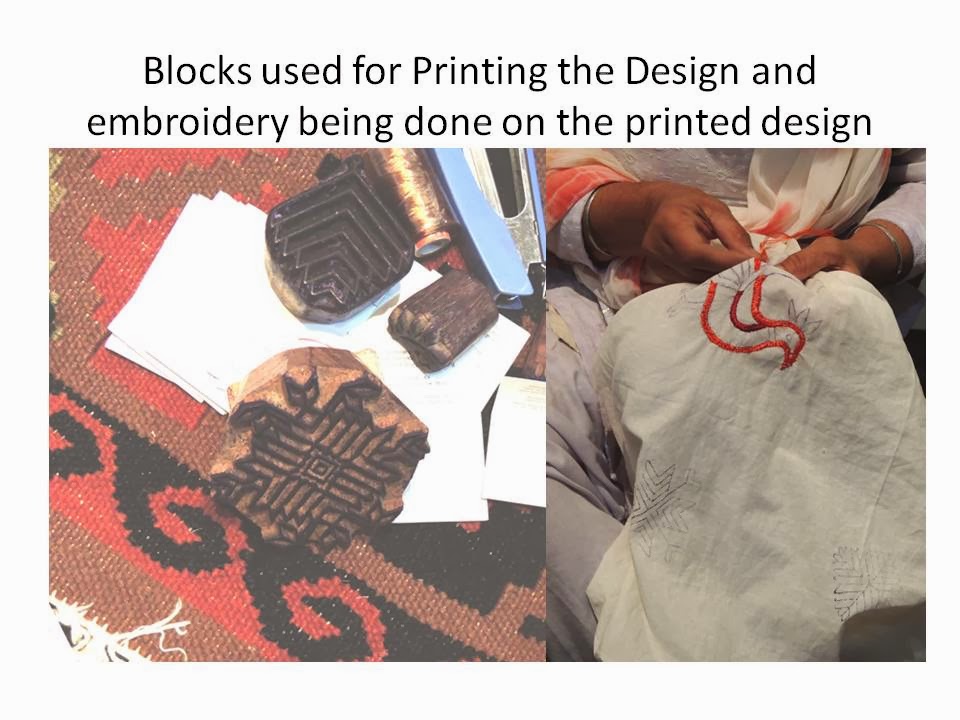
I met Lajwanti[i] Parvati Maasi[ii], Prito Aunty and Bakshi Rana in April 2013 at the Indira Gandhi National Centre for Arts in New Delhi. They had travelled from Tripri[iii]  in Punjab, to demonstrate the art of Phulkari embroidery. But while sipping chai with them and chatting,  hearing their stories, I realised that they had travelled much farther than that.
 
They had all learned Phulkari out of choice, to fulfil an aspiration but, none of them did this work today, for the love of embroidery. They said it was ‘majboori’[iv] that they had to do it to earn, to keep a roof over their heads. Parvati Maasi, as everyone referred to her, was the oldest and also the most forthcoming of them all, that is, apart from Lajwanti whom they all work for and who was miffed with the change in policy at the Punjab Emporium in Delhi because this had taken away a large chunk of her business. Each of them had stories to tell about errant husbands and hardships borne. Bakshi Rana and Parvati Maasi had come to India from Pakistan at the time of Partition and they had some stories to tell about that too, even though they were very young at that time. But, it was their journey through Phulkari, as women who spent their days working with needle and thread, that interested me.
 
 Phulkari, which literally means ‘flower work/craft’, is the embroidery of rural Punjab. It was traditionally passed on from mothers to their daughter.  “Ih phulkari meri maan ne kadhi, iss noo ghut ghut jhaphiyan paawan” [“My dear mother has embroidered this Phulkari, I embrace it again and again with affection”] is a song that refers to the tradition where mothers [and grandmothers] embroidered shawls for the young bride-to-be of the family.  Prito Aunty aka Pritam Kaur recounted how she had made her own dowry, yet also spoke of the work she did today as majboori. When I asked what she would do if she had all the money she could ask for. Her reply was ironical. She said she would like to buy these fabrics like she had seen us urban women do. It was disconcerting to note that she had the wealth she sought in her own hands but did not see it as such.  When I said as much, she just kept quiet.

Prito had embroidered chaddars  and dupattas  as well as woven punja  dhurries to take with her to her new home. She was born in Kinnaur village, district Patiala, around 1963; her parents were poor and did ‘majdoori’[labour],  mostly making ‘manjees’[beds made from rope] . Her mother earned through doing some embroidery work too. Although traditionally this art was practiced mostly as a personal pursuit and not something for profit or sale, it was not uncommon for wealthy families to get others to do it for them, even though they themselves had learned Phulkari work.
 
In an article for ‘Threads and Voices[x]’ published by Marg, Jasleen Dhamija spoke of the crafting of these chaddars with such affection, sense of romance and nostalgia for a time past and personal reminisces of family life in Abottabad that, I began wondering if there was any history of this craft in my own family.  I almost wanted there to be something to link me with it.  After all, I am a Punjabi by birth even if I have never lived in Punjab and, I work with embroidery.  My mother hadn’t lived in Punjab either, but my father migrated with his family to Bombay, at the time of Partition, from Multan. Parvati Maasi and Bakshi Rana also came from the same region and had seen this work being done around them, so it was plausible.

My Naani  was from Kapurthala which is in the heart of Punjab but she was married at fourteen years of age and moved to Delhi, so this connection to the traditions of Punjab was clearly not a strong one.  My mother also said that, from the age of ten, Bibijee [xii] showed a deeply religious inclination and did not do any kind of embroidery or much else aside from taking care of her home and family, adding that her own grandmother, did not do any embroidery either but, she was a fabulous cook.   Well, that put paid to hopes of any thread of interest that I had in embroidery being drawn from family tradition, at least from my mother’s side of the family. Although we are Punjabi’s, Phulkari embroidery had not been passed down through generations in my family and when I think about it, I cannot remember  seeing anyone in my family wear these embroidered shawls either.

 Phulkari and Bagh are really colourful, embroidered shawls worn by the women of Punjab[xiii] and were enormously popular from 1850-1950 AD. Their origin is lost in time but it is thought that the tradition came into India with the migration of the Jat peoples from Central Asia[xiv]. There are apparently no references to Phulkari in classical Indian literature[xv], nor are there any surviving pieces from before the 1850’s.

 History tells us that the plains of Punjab were rich cotton growing areas and almost every village had a settlement of weavers who wove the hand spun yarn provided by their farming neighbours, in exchange for agricultural produce. Spinning was a household occupation. The untwisted skeins called ‘pat’ that were used as embroidery thread were imported from Afghanistan, Kashmir and Bengal. This silk was expensive and therefore not wasted on the reverse of the cloth. The stitches were made by counting the threads of the woven structure of the cloth – typically stitches are made at right angles so that the embroidered patterns reflect light, according to the direction of the stitches. The basic stitch is a darning stitch and, a Holbein stitch is used for the Phulkari called Chope[xvi] but, several other stitches are also employed, for outlining motifs and edging the piece.

Traditionally, Phulkari was done on thick, almost coarse, cotton fabric known as khaddar[xvii] where each colour had its own significance[xviii]. This khaddar fabric embroidered with striking floral patterns is the basic Phulkari. The embroidered shawls that are fully covered with embroidery, where you cannot see the fabric beneath are known as ‘Bagh’ or a garden. Three to four narrow loom cloths were joined to form the complete shawl, typically 4 x 8 feet in size. In some areas, particularly West Punjab the strips were first embroidered and then joined. In East Punjab, the panels were usually joined first and then embroidered across the whole cloth, including the seams, for a more coherent design. The predominant colours of silk used were gold and ivory – referred to as marigold and jasmine, or wheat and barley – reflecting the agricultural tradition of the region.

In north Punjab, another tradition developed known as Thirma which was made exclusively by Hindus and Sikhs. Their colours range from rich raspberry red to pink. In some pieces, large-scale triangles interrupt the long border on opposing sides. Placing of these triangles is significant, for when worn by a bride, the triangle falls over her head, symbolizing the auspicious ‘tilak’ worn on the forehead.

Apart from regional differences there are also religious differences. The geometrical designs primarily associated with Muslim communities reflect the Islamic restraint on figurative work. Hindu and Sikh Phulkaris incorporate human figures animals, flowers  and birds, presenting a rich repertoire of designs including myths and legends but they can also be quite abstract such as patterns that recreate the ‘maze’. Another feature of Phulkari is the deliberate mistake:  because only God is perfect, so either black was added or a part of the design was left unembroidered. This was also done to avert the evil eye. After 1920, the tradition of Phulkari is said to have declined with the introduction of poorer qualities of material and fewer stitches employed. However, it is Partition that marks the greater decline of this tradition[xix].

Parvati came to India, from Pakistan, in 1948. She was six years old and does not remember much except that it was cold. A truck took all those leaving her village of Bhawalpur to Khanpur, from where they took a train to Abhor. Parvati and her family then came to Patiala and were given government quarters. Her mother worked in people’s homes, washing clothes and dishes, and Parvati would accompany her. In the evenings, they used to embroider things for themselves, one evening a Rajasthani baniya[xx] passed by their galli,[xxi] saw them working and asked them to make some pieces for him. He gave them  the ‘chaddar’, ‘golle’ and anchor-wale lacche[xxii]Usse hum hoshiyar ho gaye, kaam karne lag gaye,” [we became wise to the profitability] and started working freelance, earning five to twenty-five paisa per motif, making one to two rupees a day. Lajwanti is a distant relative and when she started her business Parvati began working for her.

The Parvati that I met was obese; she was old with failing eyesight and diabetic but full of stories. She had retired from active work but came along with the others because they are family[xxiii]. All the four women were above fifty years and had long-standing relationships with Lajwanti. Most of Parvati’s family used to spin thread -“Gandhi wala charkha”[xxiv]– her mother, Naani and Parvati did spinning, more than embroidery even though they did embroidery for a living : “mn badde chakkar khaunda hai, Na khushi na dukhi – velli nahin baith sakdi hu, mn bahut khush haunda hai, kadhai karde karde” [the mind goes round and around. I feel neither happy nor sad. I just cannot sit idle, but when I am embroidering my mind is at peace.]

In the Marg article Jasleen wrote: “Ghoo ghuoo would go the lacquered charkha which my grandmother carried, much to my father’s irritation, all the way from Abbotabad when we moved to Delhi” adding that, the charkha was intertwined with memories of her childhood. It was her Dadi’s companion and she would spin everyday while reciting the Gurbani[xxv] or Pothwari[xxvi] songs from her childhood - “ghoo ghoo charkeya main kata ya na?”[shall I spin or not]. In Abbotabad, their ancestral home, the thread was then given to the Hindu weaver to weave and the Muslim dyer to dye a deep maroon or russet, her Dadi never dyed the fabric black or blue. Jasleen then recounts her Dadi sitting with Hazra Bibi, an expert embroiderer, who also looked after Jasleen, discussing what embroidery to do. Old, empty, English biscuit tins were filled with colourful silk threads bought from itinerant Aghani thread-sellers. Colours were selected and matched and the Phulkari work commenced by Hara Bibi, who apparently produced the finest work in that region. 
 
She also recalls karva chauth[xxvii] when her mother would dress up, wrapping herself in her wari-da-bagh[xxviii], which Jasleen’s fathers Dadi[xxix] had made for her.  Jasleen however, never learned the art as they had already left Abottabad when she would have been old enough to learn and her Dadiji never taught her. However, traditionally, she says, a girl learned to embroider from her paternal grandmother and mother, beginning with using cotton thread, graduating to embroidering her own dowry, when the older women in the family or around her, would smile and say that she was embroidering her own garden of happiness.  It was a common sight to see women sitting in an open court-yard embroidering and singing: “Bharam koiya shant, sehaj, swami, Pargas bhaiya kauul khilia” [when doubt in the mind is gone, there is peace and quietude my lord. Just as the sun rises and the lotus blooms.]


Ah! What nostalgia, but there was none of this in the stories
of the four women I met that day. They had only pain and hardship to recount. Bakshi Rana was born in Khanpur Pakistan and came to India in 1948 when she was around nine years old. She began doing Phulkari embroidery when she was about fifteen years of age. Watching others, “ik umang jaag uthi”, a desire came into being and she thought she would like to do it too. Around the same time, she was married to her dead sister’s husband, her brother-in-law, and widowed five years later at the age of twenty. Of all the four women, she seemed the saddest and wore a really haunted look. Her sister had four or five children [their stories all lack accuracy and clarity in telling] whom she brought up as her own. As I listened, I couldn’t help thinking, what a life! There was this fifteen year old with that faint desire in her heart to do some colourful embroidery work, possibly to create her own dowry, when her sister dies and the responsibility of her sibling’s family falls on her young shoulders. She doesn’t have the luxury of choosing her spouse or the pleasure of bearing her own children, so where then is there the luxury of desires and aspirations? The mind possibly shuts down all its imaginative faculties when faced with such circumstance.

It’s no wonder then, that umang turned into majboori. I keep wondering whether things would have been different if Partition had not happened and they had stayed in Pakistan, in their villages. Would these women have had different stories to recount?  As if reading my thoughts Parvati Maasi started singing this song: “Bande teri zindagi Waghe nadiya da paani, chaar din di bahar, ho hoshiyaar bandeya, nahin toh royega zaro zaar bandeya” [your life is like the waters of the river Wagah, the precious days of bliss may flow without your realising it, so be present and enjoy each day, for otherwise you will shed tears in regret for the rest of your life]

Embroidery is a great stress buster and I experience this first hand. These ladies also agreed that doing this work helps them deal with their lives in various ways and “sukoon milda hai”[xxx] but without the ability to think creatively, cultivate the imagination of women like Jasleen’s grandmother and those before her, who made things for their families, recording events in the family life through subtle changes in colour and pattern; without the freedom to do this, out of choice, for themselves, the work cannot have the same resonance and energy.

The quality of workmanship has changed. It was Punjab that was most affected with the advent of Partition and it is possible that this played its part in the decline of the art of Phulkari. But, I think that basically the creative spirit of the subcontinent had been stifled much before this. The process was slow and subtle and difficult to perceive or comprehend until things came to a head.

Indian textiles were enormously valued in the maritime trade of South-East Asia. These fabrics were used as currency for trade in spices which were prized by Europeans. Getting monopoly over Indian textiles was a way to profit in this trade. For Indonesians, the people from India who made the textiles they prized were considered gods. But when the Europeans came they did not understand the significance of this beyond the money they could make and the British were especially ruthless in this regard. Gradually, they changed the way that these fabrics were created and started introducing designs brought from Britain which were then copied and exported back. They stopped trading fabrics that the local artisans lovingly crafted, in much the same way that the women of Punjab used to embroider the Phulkaris [even though Phulkaris were not part of this trade] with marks and patterns that reflected their personal histories, investing the fabric with the labour of love.

When you take creativity out of anything you virtually kill the spirit of the person doing the work. The art of living,  understanding the freedom to create life the way you imagine it can be, which was intertwined with the concept of crafting in ancient India, is further being eroded by this frenetic age of technology.

The once creative craftsmen/artisans have become reduced to skilled labour[xxxi]. These women cite majboori as the reason they do embroidery. There is no personal investment or sense of creativity and joy. Living in poverty, personal grief and a lack of education has stifled the spirit of creativity through which humans thrive and grow. Can any art flourish and grow this way?


[i] Lajwanti has been awarded a master-craftsman award for phulkari. Born in Patiala in1953, she learned from her naaani and has worked in this field since a child. Her husband left her with small children [3 boys 2 girls] when she started this work as a business.  All her children have worked with her and are national craftsman awardees too. She has 500 women working for her in Tripri.
[ii] Like mother – mother’s sister is traditionally called maasi
[iii] near Patiala
[iv] Necessity/compulsion
[v] shawls
[vi] Veils/ lighter shawls
[vii] Richly patterned Dhurries [rugs] where a tool, which draws it design from the five fingers of the hand, is used to push the weft thread down.  
[x] Marg Publication, Mumbai. Volume 58, NO:4, edited by Laila Tyabji
[xi] mother’s mother
[xii] We addressed my naani as Bibijee – a traditional Punjabi way of addressing the female elders in the family
[xiii] This work was also done in parts of neighbouring Haryana
[xiv] Ancient European historical records and archaeological findings support that the Central Asian people such as Scythians, Samartians and Alans are possible forefathers of the modern Jats, in part.
[xv] The Embroidered Shawls of Punjab. John Grisham. Asian Embroidery edited by Jasleen Dhamija. 2004.Crafts Council of India
[xvi] The Chope is quite distinct from form the Phulkari and Bagh embroideries where bold patterns of stylized peacocks are embroidered in Holbein stitch with gold thread on a red/maroon khadi background.
[xvii] Coarse, cotton fabric woven on a pit loom, in plain weave.
[xviii] Four colors of khaddar were generally used where each color had its own significance– white used by old women or widows, red used by young girls and brides-to-be, blue and black were kept for daily use.
[xix] The Embroidered Shawls of Punjab. John Grisham. Asian Embroidery edited by Jasleen Dhamija. 2004. Crafts Council of India.
[xx] Trader from Rajasthan
[xxi] lane
[xxii] ‘Anchor’ [brand name] floss
[xxiii] I imagine there was also some business prudence involved as Lajwanti did not want her younger karigars[xxiii] poached upon
[xxiv] Spinning wheel used by Mahatma Gandhi
[xxv] Word of the Sikh gurus, usually sung
[xxvi] a dialect of Punjabi spoken widely by the population of the Potohar Plateau in Northern Pakistan.
[xxvii]  is an annual one-day festival celebrated by Hindu women in North India in which married women fast from sunrise to moonrise for the safety and longevity of their husbands
[xxviii] Is embroidered by the groom’s paternal grandmother in golden yellow silk. The grandmother begins to embroider when the boy is born and it often takes her ten years. The random appearance of different colours or change in pattern is not careless mistakes but represent significant events in the life of the family. The embroidery mirrors the family’s joys and sorrows so when the young bride is wrapped in this she is symbolically entering her husband’s family’s history
[xxix] Paternal grandmother
[xxx] We find peace and solace.
[xxxi] As designers many of us go into the villages and give them our designs to make. And my own experience and that of others is that even when given a free hand to create, they hesitate and prefer to be told what to make.