Showing posts with label philosophy. Show all posts

Tuesday, 25 September 2018

Mynapi Waterfall Trek - Negotiating the Rivers of Human Terrain


I'm totally zombied out. Sitting in bed, looking at the sun dappled bamboo outside my window, I'm finding it difficult to express the experience I underwent yesterday. All through the drive back home, I kept checking in to figure out what I was feeling and drew a blank. Such as I often do when any event is overwhelming or extremely challenging. It had been a long and arduous day but I wasn't tired, even though my body was hurting. I was in a nirvanic – a beyond words, kind of space.
 
I woke at 5am to leave for Panjim by 6am, to meet Bianca and Bjorn and their team from Off-trail Adventures by 7am. I had to park my car at Patto Plaza, walk across to the other side of the Panjim-Ponda Road, meet the other trekkers at Heera Petrol pump and board the bus that would transport us to the location.
 
 
Strapped with a ten litre backpack, a fanny pack with my phones and emergency essentials, and carrying yet another bag with a change of clothes, more water and food, I ambled across, the ten minute distance, without demur. Ordinarily, I would have scouted for help, but I had signed up for a day long trail where I was supposed to traverse 18 kms, so this was just the start.
 
 
Picking up people along the way at Cortalim Junction, Verna and Margao, we reached Quepem at 8.40 am for a quick breakfast. Before leaving for the final hour-long bus lap towards the Netrawali Wild Life Sanctuary, where the expedition officially begins.
 
 
 Goa is so green in the monsoon that it's a delight for the eyes. And the emeraldic-leaf green of the paddy is a very special colour. Unlike any hue in my paint or thread palette. But, this agrarian landscape wasn't a patch on the virgin forests that unfolded as we tread the terrain of the Western Ghats.


It was my first hike of this kind and that too as I completing sixty years of age. It was ambitious but I had no idea of the agony my frame would go through as I negotiated smooth rocks, wet and slippery with slime, the possibility of leeches shimmying up my flesh unseen to suck warm blood and more. And, when I got home at 9 pm, fifteen hours later, the top of my thigh muscles were stiff – more like rigor mortis rigid, but it was my big toes that were wailing louder than the cicadas of the forest. Even the gentle touch of the light quilt I sleep with, was evoking yowls of pain. And to top it all, grasping at crevices to find a grip, at the very edge, before we glimpsed the Mynapi waterfall, I think I may have cracked the middle finger on my left hand. Or at the very least pulled a muscle. I had to put the full weight of my 65kg on hands and knees to scramble up. They're not used to it.
 
 
Today, I've tried to get up and about as I would a normal day, but if I sit or stand, it's really painful. My shoulders are speaking of their burden (which wasn't much more than a litre of water, light trekking sandals, a sandwich, a light raincoat-which was pointless to wear) and 10gms of salted Kaju. But, I'm inclined to think the load has more to do with feeling exhilarated by an situation and occurrences that tested me at so many levels and left me relatively immobilized. And, it is my inability to put this entire venture into any comprehensive perspective that’s keeping the mind in a spin. I've not really wanted to get on with my usual day or do anything other than look at the pictures and re-live those moments. Or search online for things like shock-proof sticks and dry bags so that I'm better prepared next time. And a better pair of shoes too!
 
 
 Yes, there has to be a next time. Being so close to nature, without the trappings of urban behavioural niceties, I felt the rawness of fear. I faced the power of the resolve: ‘I have to find a way’. I grappled on all fours, heaving myself up or slithering down on my butt. All very ungainly and un-lady-like, and in full view of strangers – all of them, mostly youngsters in their late twenties or early thirties. It was a no-holds barred episode. It was a getting in touch with yourself encounter like nothing else I have associated with. A revealing confrontation at that.


As we entered the sanctuary, leaving the bus behind, we strolled along a tarred, regular road but within minutes turned off to the left, towards the Mynapi falls. The signpost said 4.5 kms. Very doable I thought. Since the age of 34 years, when I'd become aware of the merits of some exercise, I've been striding exactly this much each evening - down Walkers Lane in Friends Colony (East), in New Delhi- topping it up with swimming and cycling, so I thought it was going to be par for the course. Yes, uphill for sure, because we were going to the waterfalls, but just a couple of years ago I'd done the haul from Gethia up to Nainital and back and also climbed up and down Matunga Hill in Hampi, at the crack of dawn, wearing plastic Crocs without a strap. That had been quite scary too because it had rained and the boulders in Hampi, well they’re something else. So I thought I was prepared. Doubt hadn't even entered my head.


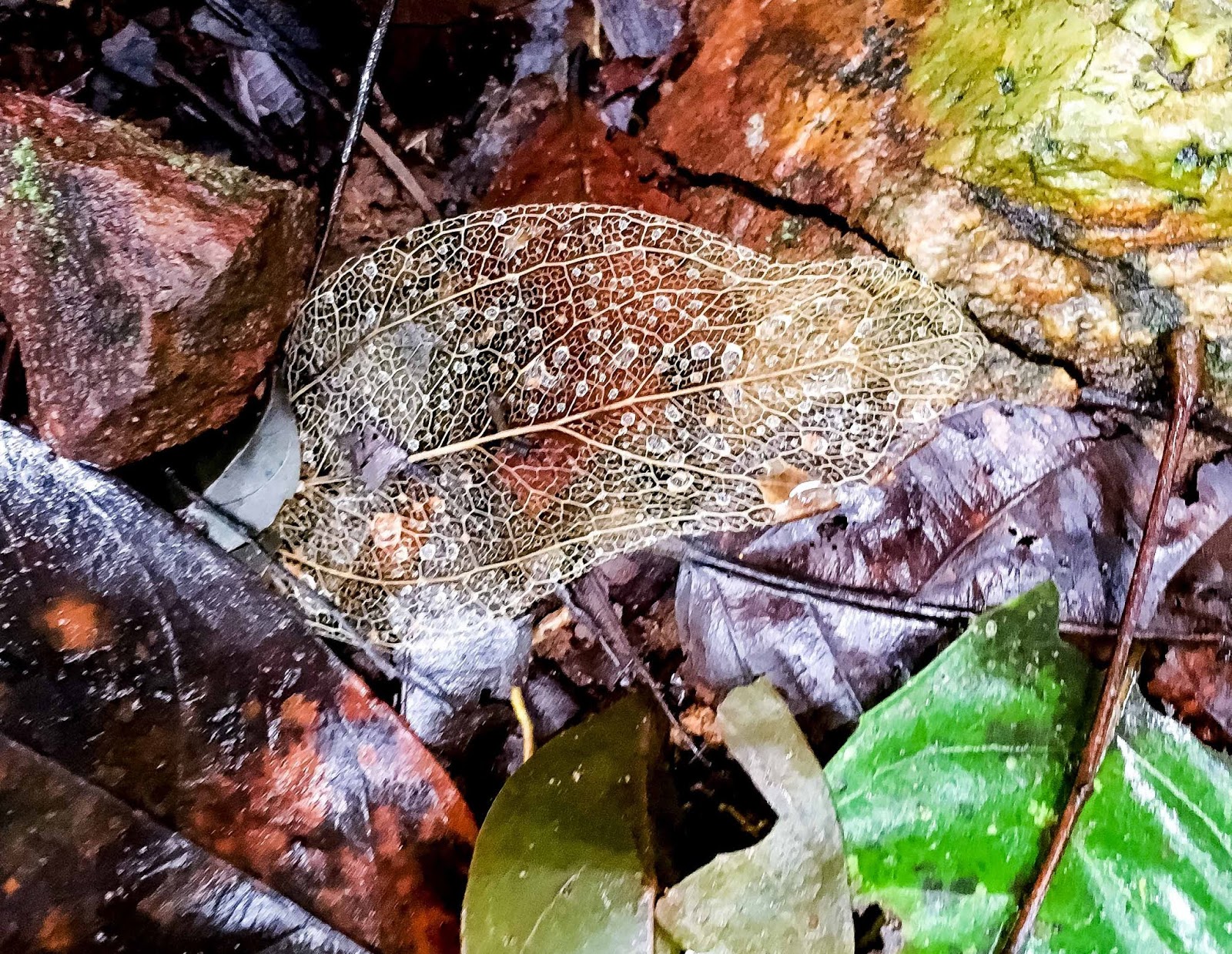
As we entered the forested area, I could hear an uprising of some insects. It was as if they were wailing that their coveted greens were being invaded. I was told they are the cicadas – extremely small but very noisy. And yes, they could really cook up a racket. I was looking around eagerly, at flowers and the tall foliage, growing higher than us. Reminding myself to keep my gaze focussed on whoever was ahead of me lest I lose sight. We bent lower than low, crouching under boughs and leapt over fallen or felled tree trunks lying in the path. Trampled over a seemingly unending carpet of leaves, red, green, brown, blackening as they composted themselves back into the earth. The light on them glinting as if shining off silver. It was an overcast day, but no rain yet. I couldn't imagine what they'd look like on a sunny day. Even as the tall forestation probably doesn't let in much light anyway. But the mulching leaves fascinated me – especially the blackened ones.


An adept trekker classmate of mine had shared a few tips. She'd suggested changing into sandals as we crossed the rivers and streams, advising that it's best not to keep your feet in wet shoes and socks all day long. But we came upon a narrow rivulet within fifteen minutes and it was barely four feet wide, so I didn't change. I couldn't bring myself to stop to change and revert back into Keds after a minute’s stride. My socks and shoes were now wet and we later strode 3-4 kms in the river itself. With uneven rocks, often jagged and pointed, where I needed to lodge my feet in whatever gaps I could find, I cannot envision the state of my feet without the protective covering of my socks and shoes. Even though the wet and confined feet did eventually lead to unbearable pain and a mild infection necessitating antibiotics and loss of toe-nail. t didn’t make sense then, to fiddle around with footwear mid-way.


At first we rambled alongside the river. Vicinal to the soothing resonance of water rushing downhill. Gurgling and splashing as she fluidly opposes boulders and mud banks, insistently carving a path despite all the obstacles in her way. I was loving every minute so far. Then we crossed to the other side because the topography was relatively easier. At one point all we had, to place our feet on to cross a hilly edge, was a thick vine. Bianca kept encouraging us, saying it's very strong, don't be scared. But I was. Having her at hand-holding distance, should any of us topple or if it gave way, was little consolation but as I put one foot on it and then the other and crossed that two-foot space, and it didn’t break with my bulk nor after ten or more who came before and  after, I realised just how strong they were. And later, grappling for support among the boulders, as the flow of the watercourse got rougher,  I scanned the foliage on my side, looking for these vines to hold on to.


We kept crossing the gushing stream back and forth - guided by Bianca at the front, Prashant in the middle and Bjorn at the tail. I chose to stay with Bjorn. I couldn't contemplate attempting the hazardous slog through the water, flowing with quite a strong current at points, all on my own. I'd already slipped once and his strong, youthful arms had saved the day. So this is what I banked upon the rest of the way.
 
 
Every time he thought there was some stable ground, and let go of my hand. I took a dunking. I must have fallen at least five times. But being at the end, also gave me time to stop and take some photos. It was dicey taking my iphone out of its protective cover.  I only attempted this once in a while. The photos I have are mere trinkets of what I saw with my eyes, endured with my body and the unbounded beauty which gave me the strength and spirit to keep on track.


The youngsters that were part of this group didn't think this old aunty, would actually manage that final steep cliff which led up to the water fall. And honestly, if I'd thought about It, I wouldn't have. And when I do reflect back on the trek, it's this moment that keeps coming back.  I'm filled with such a sense of daunting. It was treacherous, to say the least. I'd be terrified attempting it again, knowing what a close call it is. That hard rocks and fast flowing water, awaited my fate some fifty metres or more down below.
 
 
But Bianca had come back for Priyam and me, the stragglers who were being assisted by Bjorn and Prashant. Just thinking that she's gone up with the others, descended, back-tracked to find us, then scaled up ahead of me, showing me how to do it, gives me the shivers. We were so close to the waterfall, in its full flow at the monsoon. I could hear the flowing waters, I was wet with its far-reaching spray And so was the almost ninety degree vertical cliff-rock we ascended – without any mountain-climbing skill or gear. It was just a short stretch but what a task it was!


At an extremely crucial point, one foot lodged as firmly as one can on a  narrow and precarious crevice and the other reaching to find its foothold, from behind me Prashant says "look up, look up, you’ll get a sneak preview”. I didn't want to take my eyes off the risky geography I was tackling. I didn’t have a secure foothold either but, I'm a sucker for waterfalls. There is something so magical about this cascade of water pouring down from the height of hillsides. Be it the Canadian Niagara or the famed milky Dudhsagar on the Goa-Karnataka border, I have made my way to them delighting in their majestic watery vistas. So I did look up - just one moment of perilous viewing before Bianca urged me to take the next few steps up, hold onto her hand and heave myself up to see it, in all its cascading glory. A bride’s lushly crocheted lacy veil, trailing through the steep rocks covered on either side - a mossy carpet of green, a vertical and hazardous church aisle with a deliciously refreshing aqueous pool at its base.


We had been walking for over three hours at this point. It had been arduous to say the least. Not because the hike was taxing in the physical capacity, but because it had required every vestige of courage, presence and sheer utter focus -  such that is not factored into the rituals of daily living. At one point Prashant and a few others pulled a log of wood, from the water, for us to move from one point to the next. And in one of my photos I can see him giving a young man a push to garner enough height to rise up. It was tough. I was relieved to have reached the scenic spot. I was ravenous and drained. So the first thing I did was to eat my egg and cheese sandwich, gulp down some Electral before I off-loaded my backpack and fanny pack to crawl my way down into the water. I wanted to get right under the fall but was advised not to as, being so forceful at this point, it also carries small stones down from the mountain.
 
 
I bathed and crawled back onto the mud splattered, wet and slithering rocks, on all fours. It was a kind of primordial reconnecting with one's animal self. Uncaring of anyone's gaze, of the mud on my butt and drenched hair- looking nothing like the carefully crafted urban visage I'm accustomed to recognising as myself. It didn't matter. I sat on a stone-free muddy spot, momentarily  secure of my seat and gawped at the flow of water, conjecturing with Joan and Jaffrey as to its height. Was it 300 metres, was it 200 or more, we couldn't decide but it was beautiful. Not as awe-inspiring as the Niagara, nor as wide and as gushing a river of milk as Dudhsagar, but tucked away in this nook, away from the prying eyes of the casual passer-by; away from the reach of those that don’t value nature’s bounty enough to refrain from despoiling, it was a sight to behold. Especially since one had trudged a difficult path to do so. I was exhausted but enthralled. I was mesmerized by this proximity to nature that had compelled a propinquity to my own  - that sense of provocation I have always been prone to. That never giving up attitude - no matter what. That slow but steady stride and this love for being among rivers and mountains and the grace of green that surrounds it - the natural habitat of the planet. Facets of my own nature that,  I don't often recollect, nor consider much, unless life mirrors them back to me, this way.


Priyam and I had taken our time getting there, so we had less rest than the others, before Binaca herded us off again. No, we didn't go back the way we had come. I think I would have died had we to do that, but the ascent up from the base of the waterfall was steep. Ultra-steep and there was barely enough mud to give our feet traction. At one point, unable to muster the spirit to haul myself up with the depleted strength of beleaguered thigh muscles and leaning on equally dog-tired arms, from behind me, Nalita gave a push up from my bums. It was effective and a relief not to rely on my fatigued form alone. It was an extremely narrow track and we had to keep moving single file. I was in the middle, not the end as before, so had no option but to keep travelling. But my vitality was flagging. I hadn't eaten much breakfast because not only was it early, I wasn't sure of how I'd fare in a bus through the Ghats on a full stomach. A sweet bun (local Goan bread) and tiny glass of tea had been enough. And with sips of water and the occasional salted Kaju, it had brought me to the falls.


 Lunch was going to take time to create its own energy. And the muscles were beginning to ache. Not to forget the toes. My god they hurt. But I kept moving until the trail widened a bit and the others could pass. When we stopped, Bianca took one look at me and said my lips were white. My remaining water was turned into Electral in a jiffy and I sat on a jutting rock, resting and sipping. I relaxed enough to see the misty view of the Ghats through the vines and took a picture from that spot. Too tired to lift my butt and move ahead of the dangling vines, I let them define the view – that was after all as I was seeing them, wasn’t it.
 
 
Joan, Lucy, Prashant, Jaffrey and Bjorn stayed with me till I felt able to resume the track. My legs and hands were trembling. They said we're half-way there. It's downhill now and that gave me courage. But I realised this wasn't true. Bjorn used the half-way there phrase three times later and when I said “but that's what you said an hour ago”. He smiled, telling me only right at the end, that is the only way to keep people going. If you think the end is in sight, you muster strength. And it's true. That was probably how I kept proceeding. Even after a massive cramp in my feet and legs, when I finally changed into my sandals and gulped some salts. It was only then that I  took a longish break. So long, in fact, that when we reached the bus, Bianca was beginning to wonder if she needed to get some medical facilities to us.


But the snails and flowers and unbelievably beautiful caterpillars and millipedes that dotted the landscape diverted attention from the rigour and pain. And then at the last lap it started to rain quite heavily, but the tree cover was so dense that I didn't feel much on me. We reached the bus dripping wet from head to toe. We'd crossed a few more brooks and gushes. Washing my face with the cooling freshness of the water, even our feet felt great to wade through them. It took some of the tiredness away. And the entire journey was dotted with such, always available refreshing, moments - even in the midst of hardship. It was quite an eye-opener to see just how much of what one needs is really always at hand.
 
 
 Tired, relieved, but mostly chuffed at having completed the journey in one piece, I changed my clothes and got onto the bus when everyone burst into applause. Joan sat down next to me and said "can I please take a selfie with the legend" and she's got one of me looking wan and exhausted - my hair like nothing I'd ever dare post in a photo. But then I didn't care. I couldn't. These social niceties were out of place where one's endurance, grit and resilience had been tested. When the body strong was more valid that body beautiful. When triumph was an obstacle course completed and not how presentable I looked at the end of it. If only one could make this more relevant in terms of the rigours of living. Not to care what experience does to our self-image, was a profound realization.


At the end of the whole journey, when we got off the bus at Panjim, Yogesh, Priyam and I sauntered up towards Panjim bus stand. Yogesh is a young strapping lad and he was the first one to reach Mynapi. He'd been so pickled by it that he told everyone again and again. Clearly all of us had markers of achievement along the way, each one a personal triumph. I shared that my limbs were aching but that I wasn't tired and Priyam exclaimed that's exactly what she was feeling too. A question of mind more thrilled than the body could cope with, said wise Yogesh.


It was Priyam' s first trek too. She’d come from Mumbai to hike up to Mynapi. But she was much, much younger and it reassured me to know that she was experiencing similar pangs of discomfort as I. She also shared that while she watched and waited as I struggled with the last leg but extremely treacherous and precarious ledges before reaching the waterfall, she’d thought to herself, this may well be her last day on this planet. Thankfully I hadn’t had the time to think about this, that I had preceded her, and urged by Bianca, didn’t stop to fear. Those tremors came as an afterthought.


We'd walked on the edge of experience. We'd staggered on the very ledges of life. Our accomplishment lay in embracing the foreboding that nature posed on our way and reaching home safe and sound. Barring a few leeches that had sucked the blood off Lucy and Jaffrey, the soon to be wedded couple, and a few others,  there had been nothing untoward and tragic that occurred. We all carried that sense of elation within – a palpable excitement of living through it - a shared journey, shared rigour and shared joys.


As I mulled over this extraordinary happening - I considered why this has been so rewarding but the other challenges where we have had to touch our primate selves in similar ways - the emotions that life can evoke in us, that others can raise in us - the rigour of relationships and more, why don't we feel this same sense of exhilaration, accomplishment and sense of our own power in them? Why do we cower and demur from these triumphs; making these expeditions in nature  hallowed goals. Quite honestly, it has to be the daily march through the dark alleys of being, traversing the rivers of human terrain which are the quintessential encounters we undertake that, test the spirit equally, if not more. Requiring as much of a leap of faith. Don’t they, every day?


Monday, 13 July 2015

How Do You Like Your Tea?


I haven’t been enjoying my morning cuppa for a while and it’s been bothersome because I like the idea of drinking tea in the morning. Coffee is too strong and something I indulge in only when I am really tired and need to keep going. Don’t get me wrong, I love the taste and aroma of coffee but it just wires me up too much. But while tea does add a dash of caffeine to my lazy morning start, it’s not a jolt; it enables a steady, watchful pace into the day.

I have been experimenting with all kinds of teas, mixing up unlikely leaves to get something, a new taste, infuse some flavour into a jaded palette. And, over the last couple of days, I have realised that I just want a sweeter brew. I want it milky and sweet and this is something new for me. For years now, I have kept both the sugar [well, I take sugar-free instead] and milk to an absolute minimum, to relish the flavour of the leaf – the essence of the tea –rather than bury it with the add-ons.

May be it’s just a phase. Maybe it’s the heat or maybe I am just feeling a bit lost in the mire of doing. I don’t really know at this point what is causing this change from the subtle to the robust taste of things, but it is something I have noticed and am curious about.

It’s taking me back into the watchful mode, making me look at my days, my feelings and thoughts in an active way which, with all that doing, all that work, that doesn’t really do much other than exhaust me and leave little room for reflection, has been enervating indeed. I love looking at life unfold. I like to see how miracles occur in the day, how my thoughts create or how things unfolding around me create my day – its events – not necessarily stuff that delights, but bringing forth anger and irritation and more. I have realised that it isn’t so much about being busy as it is about not being able to deal with the stuff inside, the emotional ups and downs through engaging with people and not getting the desired response, or having to deal with their energy levels which could well be at odds with mine. And over the past couple of weeks of some quieter moments, I have realised it mostly comes about because of judging the way that I feel.


I was coming out of the pool the other day and a young man of thirty-something, who had been playing with his wife and kids as I swam my 50 lengths in under 40 minutes [it’s a small pool so no more than 825 metres], commented on my stamina. He was a virtual stranger and I was taken aback and, in my awkwardness, didn’t exactly take the compliment with enough grace. And that made me start the old babble inside the head. I stopped myself saying, it was okay to have been awkward, I was taken by surprise and focused upon getting out and getting back to work, I hadn’t expected it. And it was unusual one, don’t you think? 

A few moments later, I did something else that made me feel guilty – even as I was asking something of someone, knowing full well why I was doing it. And it made me realise just how much one does tend to judge oneself for things.  Where does this judgement come from? Who has decided what is the right way and the wrong way to do things and live life?

I have just spent a whole twenty days tuning into the Hay House online summit and heard over thirty-five speakers over three weeks. It was very inspiring. I learned many things and certain things that I had experienced were given definitions and more in the same vein. But what I noted especially about the whole summit was that everyone spoke about different things. Some were scientists who had learned about the spiritual dimension through their work and some were just people who had been abused as children and found a way out. Others were people who had evolved deep philosophies for their own life which they shared as courses and books and stuff. What interested me most were the stories that everyone had to tell, where the most miserable of circumstances and enormous pain was not something that they allowed themselves to be stuck in, but through which they have found their own philosophy and techniques to live a better and happier life.  Often the ideas of one could seem to be in conflict with other speakers, but this is what made it a great lesson in non-judgement. It was so apparent listening to diverse voices from all parts of the world, from various disciplines of learning that anything and everything leads to a deeper understanding of the spirit of being. And that there really is no other path for everyone other than what your life has charted. It’s about the proverbial Mahabharata of our personal lives, not something that is understood or arrived at by renouncing the world. What we need to renounce is judgement that says this is right and this is wrong.

I was sharing this with a friend, who then asked but what would you say for a man who has just killed someone in road rage? We had been discussing a mutual friend’s sudden illness when the conversation turned to this as I was trying to explain the mind-body connection. I was telling her how illness is essentially caused by suppressing our feelings and not expressing them, for various reasons. She said would you condone the killer, would you say that it was not wrong? I didn’t have to think this one through because for me it was the same thing – the sick person and the one who carried so much rage inside of him were coming from similar spaces of suppressing their feelings, of not finding the courage to express. In effect, probably judging themselves for feeling whatever it was because someone, somewhere, had dinned it into their heads to either get over it and let go, or such like. Something we often do, when we cannot listen to another’s pain.

I also noted that some of the summit speakers impacted my mind more than others. I tried various techniques, choosing a few that fitted in well with the way that I liked to meditate and heal the chakras, etc. But, above all, what I enjoyed listening to was the way everyone had positive things to say about experiences that could debilitate the best of us into not feeling good enough, into not wanting to get up and face the day, into despair and depression. Non-judgement didn’t come from sitting and saying why did I say this or that, or why did I think this or that and feeling bad about it.  It came from an acceptance that what they felt and experienced was what they knew and that their experiences taught them. Once we become aware, things do change. Life was their teacher and this inference was uplifting. 


My need for a more robust flavour in life, for sweeter and milkier tea rather than the subtle was just something that I needed to allow to come into being, for it to reveal the change in the mental patterns and resultant body chemistry. Maybe I was more willing to experience life in a more robust way. Or, maybe I needed a more robust flavour to bring me back into the fray....whatever it was, who’s judging, right?

Sunday, 31 August 2014

Madhya Pradesh - Narratives of Self Discovery


The other day, I was staring up into the sky, my back on the water, as I finished my swim. I saw hundreds of birds flying here and there and here and there, randomly. Some would disappear into some crevice or other and then charge out as if on some urgent errand and there really was nowhere they were going, nor any pattern to their flight paths.

I am usually so driven with reasons for anything I do; conforming to a routine of doing rather than that of being. Watching the birds fly so aimlessly got me thinking - about this journey called life. Where do we go, what is it that we do or why and what is the purpose of it all? Are we any different to these other creatures of nature that fly the sky?


And, it was a trip to Madhya Pradesh that I undertook few months later, which seemed to put into perspective the kind of travel that one does through life – of savouring the little things that come up.  I started seeing that it was in essence only about the journey, the people we meet, the sites we encounter and the images we form in our minds.  Can there be any other point? Yes, I know there is the existential quest of who am I, but can that ever be examined without the experiences we encounter; and then what?

Anyway, let me tell you about this journey to Madhya Pradesh, the middle kingdom. 


Landscape on the way up from Maihar to the Rampur Plateau
One day, quite out of the blue, I got a call from an old friend. She said: “Come see me, come to Madhya Pradesh and spend a few days at my art centre in Maihar”.  I asked her why to which she replied, “I don’t know, just come, I just felt like inviting you."

It isn’t as if we hadn’t been in touch since college, where we studied textile design together at the polytechnic, in mid-late 1970’s. Ambica, now owned and ran a successful art gallery in Kolkata. Art being the common denominator, we did have occasion to meet. But, it was Facebook that really kept the thread of connectivity alive and the way in which Ambica prefaced her invitation was the clinching factor. She has a way with people and is very affectionate; and that did the trick.

It was mid-December when she called. I had planned a Christmas open house on 22nd December, inviting neighbours and friends to share a Christmas cake I had baked - my first attempt. So, on 24th December, I flew to Khajuraho and met up with Ambica and her family and a whole new world opened up to me. The entire journey from Delhi to Maihar and back was enriching – to say the least!

My flight to Khajuraho was on time; well, just half an hour late, but

given that it was ‘fog season’, this was something to cheer. The flight was chock-a-block full.  I had a window seat and thought I would write in my journal but it really was too distracting with my elbow nudging my neighbour on the right and hitting against the plane wall on the left. So I just stared out the window instead, taking photographs of the snow-clad Himalayan peaks which I could see far-far away. The sky was a beautiful powder-blue and soft, white, woolly clouds, like a hand-knitted fabric, extended from below the belly of the plane - a blanket of cloud reaching far out into the distance. The snow capped peaks encircled an imaginary horizon [because I couldn’t see below the cloud cover] like a long arc bending from end to end of my vision. They were faint, yet quite clearly discernible to the naked eye, more so than the pictures my I-phone camera was able to take. I took lots of pictures simply trying to capture the essence of what I could see, but none matched up to the experience of spying those tiny peaks thousands of miles away.

It was this ethereal sight, filling me with a sense of serenity, which got me reminiscing about Ambica and our college days. One of the most vivid memories that I have are of  a bunch  of enthusiastic eighteen year olds working on an assignment of tie-dye – dying our samples, out in Ambica’s back-garden. She had invited us to her home in Sarvodaya Enclave and I think there must have been about ten of us chatting and eating and working. The lawn was a mess after we had finished. There was dye on the grass and strands of multicoloured thread everywhere. Her mother fed us, helped us untie the knots we couldn’t open and then cleaned up after us without any fuss. I haven’t forgotten this for the simple reason that I envied Ambica. My own mother, always a stickler for cleanliness, would throw a fit if I accidentally dropped poster colour [gouache] on the floor. Every time I meet Aunty I remind her of this and she smiles quietly, as if happy to revisit this memory.

 
Temple Complex in Khajuraho
Anyway, as the flight landed in Khajuraho, I switched on my phone when a sms informed me that madam had found a beauty parlour and was having a pedicure. Khajuraho is a small village in the Chhatarpur district of Madhya Pradesh in Central India but even so I had no idea that getting a pedicure was an unusual feat. The SUV she had sent to pick me and my baggage, wound its ways from the airport through a complex passage of lanes and by-lanes, too narrow for the SUV, and suddenly Ambica emerged from a curtained doorway - not exactly relaxed but peeved because the beauty-parlour recommendation hadn’t quite met her expectations. There was no loo, no running water and the beautician retreated intermittently to her nearby home to get some hot water in buckets – some pedicure she had!


We then proceeded to the Taj Hotel for a late lunch and onto the temples which I was very keen to see but Ambica wasn’t. She’d been there too often and said it no longer held any charm for her. I refused to go alone and reminded her of the voluptuous drawings she had done at the national museum [another college assignment] and suggested that she should do some here while I wandered off with Satendra, the guide we had hired. Ambica always drew well with a firm, unhesitating line, and her figures were more than ample. The sculptures at the temples in Khajuraho should have been an inspiration but she now devotes all her attention to nurturing artists rather than indulging in art-making herself, so she reluctantly tagged along with me.

I know that Khajuraho is well documented and every tourist  visiting in India has been there and nothing I can say will shed new light on it. But for me, it was my own discovery of this ancient site that enchanted.
 
 Satendra [09893938015 satendrasrivastava@rocketmail.com] was knowledgeable and his first few sentences gripped my attention......the erotic postures on the temples? Yes, I found them most interesting, but not titillating although Ambica may like to disagree since I focussed the camera lens with such intensity on as many as I could capture. Something she teased me about for most of the trip.  I was intrigued by the complex poses which seemed impossible and generated a sense of awe for the flexibility that could actually twist bodies into such contorted and complex postures.

 In her book on ‘Indian Erotica’, Dr. Alka Pande says that theses sculptures focus on earthly sensuality and divine love. There are sculpted apsaras painting their eyes with kohl and other alluring postures of shringar. I spied one removing a thorn from her foot in such a convoluted pose that anything less than a yoga master would have toppled off. This was no mundane event, it was being enacted as a ritual of enticement, or so it seemed.  Dr.Pande says that the maithuna couples [lovers] are symbolic of transcendental union and are not ‘coarsely representative of sexual intercourse’.  From the Tantric viewpoint, they depict the rise of sexual energy from the ordinary to the higher plane where the kundalini is awakened. Although they have been “misinterpreted as mysterious pagan rituals”, these figures, in her estimation, are not meant for “sexual enjoyment” but clearly suggest Tantric asanas for attaining self-realisation through union with a female/male partner.


Apsaras
What Satendra had to say was curious. He said that the Chandela kings, who claimed to be descendants of Chandra kulla [moon born], were rulers of this central part of India from 9th - 13th centuries A.D. At that time society was apparently, deeply inclined towards moksh [liberation from the cycle of birth and death] and celibacy was the chosen route to achieve this.  Therefore the Chandela kings introduced erotic sculptures on the temple facades so that when people came to pray, they would also be sexually aroused and thus hopefully procreate. Satendra said the rulers feared that without this, life would come to an end and with it their dynasty too.

Sounds plausible, but as I noted and the guide also pointed out, the postures were very yogic, as opposed to merely titillating. The complex poses seemed akin to a meditative act through the body, where intense concentration was needed. His was an unusual perspective which I tried to verify through the guide book, but they had the usual stuff about the name Khajuraho being derived from ‘Khajoor’ or date palms and that in early records it was actually called Khajurvatika – garden of date palms. The guide book cautioned that though erotic, these sculptures are not pornographic to excite “savage passion” but that they are sublime and sensual. I have to say I was confused.


Shirshana
Alka  Pande says that the “couples in erotic postures belong to a secular theme” where the “artisans gave full vent to their imagination....... beyond the kamashastra prescriptions.” One such example, on the north wall of the Vishwanath Temple, is based on the yogic posture of Shirshana or headstand, where two female attendants support the couple in a coital pose, on either side, while the male fondles their genitalia. Looking at this sculpture, standing in front of it, in Khajuraho, feeling the stone, taking in the carving with my senses, I was in filled with admiration. Was it at all possible? What kind of expertise in yoga would be needed to achieve this? Who were these people, what must it have been like to have lived in that era? It seemed to be so open-minded an uninhibited compared to the times that we live in. Were these couples married? What was their relationship? I had a million questions running through my mind. 
 
Friezes on Temple facade
 Engrossed with my camera and Satendra’s informative titbits, I could have spent a whole day there. Some of the friezes also depict animal passion in humans in the form of bestiality [Lakshman Temple] which, Satendra said, was indulged in while away on battle [with horses], adding that some friezes also cautioned about such excesses. He pointed out one such sculptural narrative which begins with a woman having intercourse with a dog, someone from the local village is a witness who goes and tells the whole village and then a King is seen dispensing justice/meting out punishment. It was defaced and one could barely discern the figures, but once pointed out, it was quite amazing to make the connection. Sculptures on the temple facades also depicted scenes from everyday life such as dancers and musicians, hunting scenes, animal fights, armies marching to battle, sculptors at work; teachers with their pupils and other activities. 
 
Defaced Frieze
Ambica rushed me through the large complex of temples and we didn’t even have a cup of tea. She insisted that there wasn’t time as the journey to Maihar would take us about three hours by road, travelling through the famed Chambals hills, renowned for the exploits of  Phoolan Devi, the Bandit Queen. She didn’t want to undertake this journey in the dark. But dark it did get. And having been terrified enough by her, it took all of my courage to insist on a loo stop, bang in the midst of the dreaded hills. It is one of the perils and quirks of travelling through the Indian countryside where there are no public conveniences and we are compelled to answer the call of nature; in natures own unkempt back yard. Phone-torch in hand, gingerly but desperately, I wandered off into the nearest ample shrub, crossing my fingers that no snake would slither by. The rest of our journey, we chatted like school chums with so much to share. Catching up like this was really fun. 
 
Art Ichol Art Residency under construction - Chambal Hills in the distance
Getting to Maihar in darkness meant that I was unable to see exactly what the location was or where this neo-colonial bungalow, which has a history of its own, was positioned. Unable to sleep because of all the excitement and a new place, I could hear a stream of constant traffic. Plus, it seemed that a railway line was very close by too and around 12.30 am, someone started playing the dhol and then I could also hear a chorus of bhajans. I was later told that the house was bang on NH 7, a railway-line ran alongside the back of the house and there was a mandir nearby too.

I can’t seem to leave behind the railway line and mandir noises. This cacophony of the chaotic Gurgaon urban-scape of Palam Vihar had followed me here too!
 

When we reached Maihar, from Khajuraho, I met Ambica’s husband Sanjeev, their older son Adit, and Charles Kim, a student intern from the US. It was cold but we sat outdoors, around a fire, drinking wine, exchanging stories and singing old Hindi film songs. But at night, while sleep escaped me, I was still in Khajuraho. I loved the temples. It was really awesome to see every inch of the external stone walls, covered lushly with carvings of such exquisite detailing and near mathematical precision. I have not really studied stone carving much, so was not aware of the kind of skill involved, but looking at those temples made me  think they were totally fabulous, and wonder, how did anyone create something like this? I also mused about the fact that I knew next to nothing about the Chandelas and the Bundelkhand region I was visiting, and anything studied in school was long forgotten.  I finally slept with the thought that life, when looked at through the lens of history was fascinating. As an Indian, all of this was part of my socio-cultural gene.  I wanted to know more, explore how much of this was still part of our ethos, how this may or may not have influenced the Indian woman of today, and why or how these ideas had been sanitised through time. But, unfortunately, I have done little in this regard since I returned, almost a year ago.
 
View of River Tamasa from Writers Retreat - under construction. Old bridge seen in distance.
I spent four days with Ambica and her family. She wanted me to see everything - Amariya, the writer’s retreat that she was building on the banks of the River Tamasa of Rishi Valimiki and Sita of Ramayan fame, which flows down from the Kaimur [Vindhya belt] mountain range through Rewa and Satna in Madhya Pradesh travelling to Allahabad. The new Ichol Art Centre that was under construction on the other side of Maihar - facing the Chambal hills which we could see in the far distance. 
 
View from Rampur Plateau
The Rampur Temple plateau which has a breathtaking view and then she also insisted I listen to the Maihar band - the only Indian classical band in the country, doing their riyaaz [daily practice] early one morning. 
 
So much to see and take in, I felt over-stimulated and barely able to cope, but her enthusiasm was infectious and I went along. We would come home for lunch each day, eating out, basking under the warmth of the winter sunlight. And there was this spacious, antique bed laid out on the lawn where I would sun myself each afternoon. Relaxing after the tours, I would inevitably be staring up at the yellow and white painted arches with colourful Bougainvillea cascading down. I thus pondered upon all that I had seen, heard and felt, trying to figure out how it all fitted in, whether it did or not or how.


Maihar Band
 I had taken this trip just as impulsively and intuitively as Ambica had invited me. A journey had begun and an endless narrative was unfolding. Whether or not there was a purpose only time would tell and maybe we would devise one. But for me, then, as now, the journey was the essence – a narrative of self discovery, through history, memory and more – inhabiting the middle kingdom.