Showing posts with label photography. Show all posts

Tuesday, 25 September 2018

Mynapi Waterfall Trek - Negotiating the Rivers of Human Terrain


I'm totally zombied out. Sitting in bed, looking at the sun dappled bamboo outside my window, I'm finding it difficult to express the experience I underwent yesterday. All through the drive back home, I kept checking in to figure out what I was feeling and drew a blank. Such as I often do when any event is overwhelming or extremely challenging. It had been a long and arduous day but I wasn't tired, even though my body was hurting. I was in a nirvanic – a beyond words, kind of space.
 
I woke at 5am to leave for Panjim by 6am, to meet Bianca and Bjorn and their team from Off-trail Adventures by 7am. I had to park my car at Patto Plaza, walk across to the other side of the Panjim-Ponda Road, meet the other trekkers at Heera Petrol pump and board the bus that would transport us to the location.
 
 
Strapped with a ten litre backpack, a fanny pack with my phones and emergency essentials, and carrying yet another bag with a change of clothes, more water and food, I ambled across, the ten minute distance, without demur. Ordinarily, I would have scouted for help, but I had signed up for a day long trail where I was supposed to traverse 18 kms, so this was just the start.
 
 
Picking up people along the way at Cortalim Junction, Verna and Margao, we reached Quepem at 8.40 am for a quick breakfast. Before leaving for the final hour-long bus lap towards the Netrawali Wild Life Sanctuary, where the expedition officially begins.
 
 
 Goa is so green in the monsoon that it's a delight for the eyes. And the emeraldic-leaf green of the paddy is a very special colour. Unlike any hue in my paint or thread palette. But, this agrarian landscape wasn't a patch on the virgin forests that unfolded as we tread the terrain of the Western Ghats.


It was my first hike of this kind and that too as I completing sixty years of age. It was ambitious but I had no idea of the agony my frame would go through as I negotiated smooth rocks, wet and slippery with slime, the possibility of leeches shimmying up my flesh unseen to suck warm blood and more. And, when I got home at 9 pm, fifteen hours later, the top of my thigh muscles were stiff – more like rigor mortis rigid, but it was my big toes that were wailing louder than the cicadas of the forest. Even the gentle touch of the light quilt I sleep with, was evoking yowls of pain. And to top it all, grasping at crevices to find a grip, at the very edge, before we glimpsed the Mynapi waterfall, I think I may have cracked the middle finger on my left hand. Or at the very least pulled a muscle. I had to put the full weight of my 65kg on hands and knees to scramble up. They're not used to it.
 
 
Today, I've tried to get up and about as I would a normal day, but if I sit or stand, it's really painful. My shoulders are speaking of their burden (which wasn't much more than a litre of water, light trekking sandals, a sandwich, a light raincoat-which was pointless to wear) and 10gms of salted Kaju. But, I'm inclined to think the load has more to do with feeling exhilarated by an situation and occurrences that tested me at so many levels and left me relatively immobilized. And, it is my inability to put this entire venture into any comprehensive perspective that’s keeping the mind in a spin. I've not really wanted to get on with my usual day or do anything other than look at the pictures and re-live those moments. Or search online for things like shock-proof sticks and dry bags so that I'm better prepared next time. And a better pair of shoes too!
 
 
 Yes, there has to be a next time. Being so close to nature, without the trappings of urban behavioural niceties, I felt the rawness of fear. I faced the power of the resolve: ‘I have to find a way’. I grappled on all fours, heaving myself up or slithering down on my butt. All very ungainly and un-lady-like, and in full view of strangers – all of them, mostly youngsters in their late twenties or early thirties. It was a no-holds barred episode. It was a getting in touch with yourself encounter like nothing else I have associated with. A revealing confrontation at that.


As we entered the sanctuary, leaving the bus behind, we strolled along a tarred, regular road but within minutes turned off to the left, towards the Mynapi falls. The signpost said 4.5 kms. Very doable I thought. Since the age of 34 years, when I'd become aware of the merits of some exercise, I've been striding exactly this much each evening - down Walkers Lane in Friends Colony (East), in New Delhi- topping it up with swimming and cycling, so I thought it was going to be par for the course. Yes, uphill for sure, because we were going to the waterfalls, but just a couple of years ago I'd done the haul from Gethia up to Nainital and back and also climbed up and down Matunga Hill in Hampi, at the crack of dawn, wearing plastic Crocs without a strap. That had been quite scary too because it had rained and the boulders in Hampi, well they’re something else. So I thought I was prepared. Doubt hadn't even entered my head.


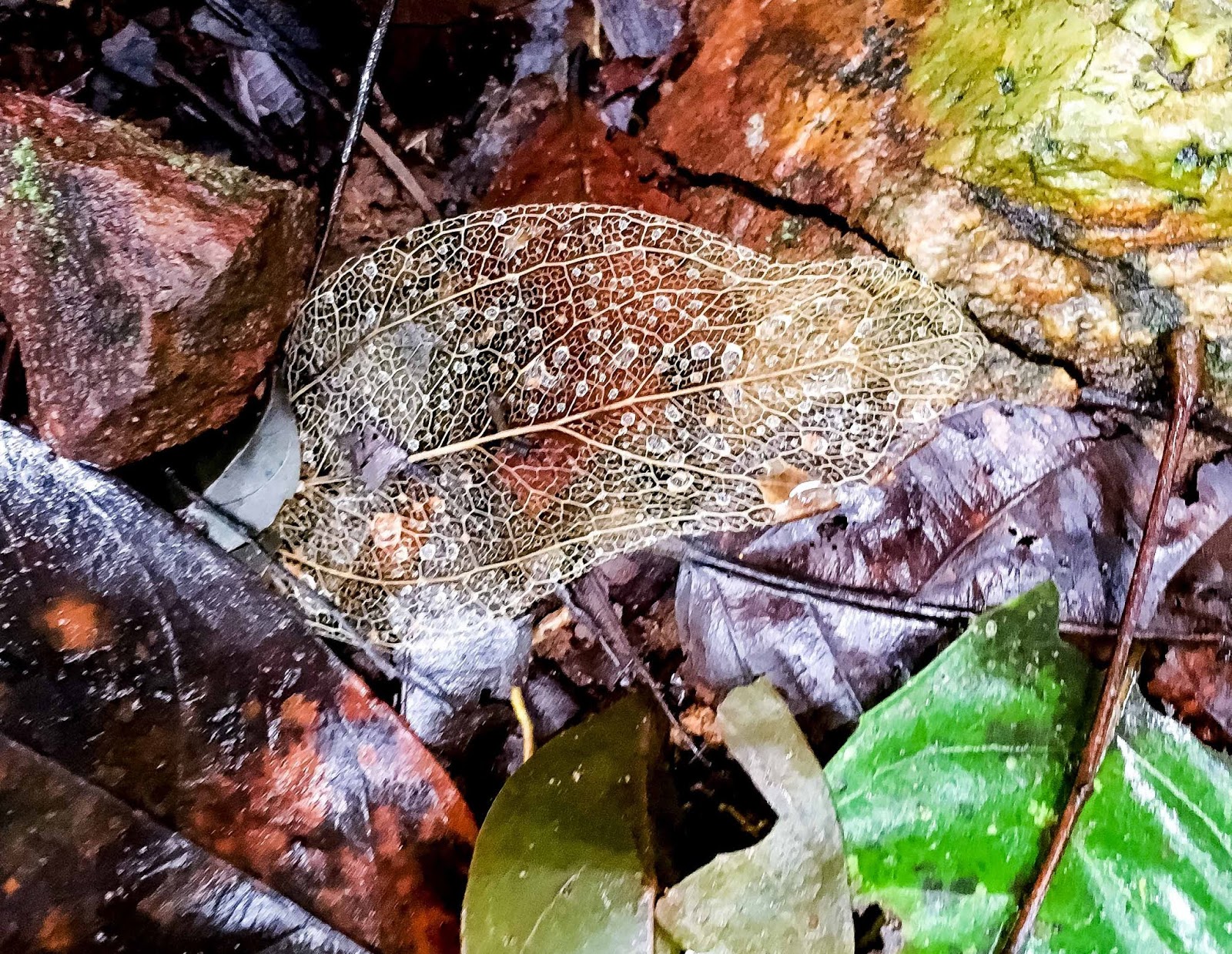
As we entered the forested area, I could hear an uprising of some insects. It was as if they were wailing that their coveted greens were being invaded. I was told they are the cicadas – extremely small but very noisy. And yes, they could really cook up a racket. I was looking around eagerly, at flowers and the tall foliage, growing higher than us. Reminding myself to keep my gaze focussed on whoever was ahead of me lest I lose sight. We bent lower than low, crouching under boughs and leapt over fallen or felled tree trunks lying in the path. Trampled over a seemingly unending carpet of leaves, red, green, brown, blackening as they composted themselves back into the earth. The light on them glinting as if shining off silver. It was an overcast day, but no rain yet. I couldn't imagine what they'd look like on a sunny day. Even as the tall forestation probably doesn't let in much light anyway. But the mulching leaves fascinated me – especially the blackened ones.


An adept trekker classmate of mine had shared a few tips. She'd suggested changing into sandals as we crossed the rivers and streams, advising that it's best not to keep your feet in wet shoes and socks all day long. But we came upon a narrow rivulet within fifteen minutes and it was barely four feet wide, so I didn't change. I couldn't bring myself to stop to change and revert back into Keds after a minute’s stride. My socks and shoes were now wet and we later strode 3-4 kms in the river itself. With uneven rocks, often jagged and pointed, where I needed to lodge my feet in whatever gaps I could find, I cannot envision the state of my feet without the protective covering of my socks and shoes. Even though the wet and confined feet did eventually lead to unbearable pain and a mild infection necessitating antibiotics and loss of toe-nail. t didn’t make sense then, to fiddle around with footwear mid-way.


At first we rambled alongside the river. Vicinal to the soothing resonance of water rushing downhill. Gurgling and splashing as she fluidly opposes boulders and mud banks, insistently carving a path despite all the obstacles in her way. I was loving every minute so far. Then we crossed to the other side because the topography was relatively easier. At one point all we had, to place our feet on to cross a hilly edge, was a thick vine. Bianca kept encouraging us, saying it's very strong, don't be scared. But I was. Having her at hand-holding distance, should any of us topple or if it gave way, was little consolation but as I put one foot on it and then the other and crossed that two-foot space, and it didn’t break with my bulk nor after ten or more who came before and  after, I realised just how strong they were. And later, grappling for support among the boulders, as the flow of the watercourse got rougher,  I scanned the foliage on my side, looking for these vines to hold on to.


We kept crossing the gushing stream back and forth - guided by Bianca at the front, Prashant in the middle and Bjorn at the tail. I chose to stay with Bjorn. I couldn't contemplate attempting the hazardous slog through the water, flowing with quite a strong current at points, all on my own. I'd already slipped once and his strong, youthful arms had saved the day. So this is what I banked upon the rest of the way.
 
 
Every time he thought there was some stable ground, and let go of my hand. I took a dunking. I must have fallen at least five times. But being at the end, also gave me time to stop and take some photos. It was dicey taking my iphone out of its protective cover.  I only attempted this once in a while. The photos I have are mere trinkets of what I saw with my eyes, endured with my body and the unbounded beauty which gave me the strength and spirit to keep on track.


The youngsters that were part of this group didn't think this old aunty, would actually manage that final steep cliff which led up to the water fall. And honestly, if I'd thought about It, I wouldn't have. And when I do reflect back on the trek, it's this moment that keeps coming back.  I'm filled with such a sense of daunting. It was treacherous, to say the least. I'd be terrified attempting it again, knowing what a close call it is. That hard rocks and fast flowing water, awaited my fate some fifty metres or more down below.
 
 
But Bianca had come back for Priyam and me, the stragglers who were being assisted by Bjorn and Prashant. Just thinking that she's gone up with the others, descended, back-tracked to find us, then scaled up ahead of me, showing me how to do it, gives me the shivers. We were so close to the waterfall, in its full flow at the monsoon. I could hear the flowing waters, I was wet with its far-reaching spray And so was the almost ninety degree vertical cliff-rock we ascended – without any mountain-climbing skill or gear. It was just a short stretch but what a task it was!


At an extremely crucial point, one foot lodged as firmly as one can on a  narrow and precarious crevice and the other reaching to find its foothold, from behind me Prashant says "look up, look up, you’ll get a sneak preview”. I didn't want to take my eyes off the risky geography I was tackling. I didn’t have a secure foothold either but, I'm a sucker for waterfalls. There is something so magical about this cascade of water pouring down from the height of hillsides. Be it the Canadian Niagara or the famed milky Dudhsagar on the Goa-Karnataka border, I have made my way to them delighting in their majestic watery vistas. So I did look up - just one moment of perilous viewing before Bianca urged me to take the next few steps up, hold onto her hand and heave myself up to see it, in all its cascading glory. A bride’s lushly crocheted lacy veil, trailing through the steep rocks covered on either side - a mossy carpet of green, a vertical and hazardous church aisle with a deliciously refreshing aqueous pool at its base.


We had been walking for over three hours at this point. It had been arduous to say the least. Not because the hike was taxing in the physical capacity, but because it had required every vestige of courage, presence and sheer utter focus -  such that is not factored into the rituals of daily living. At one point Prashant and a few others pulled a log of wood, from the water, for us to move from one point to the next. And in one of my photos I can see him giving a young man a push to garner enough height to rise up. It was tough. I was relieved to have reached the scenic spot. I was ravenous and drained. So the first thing I did was to eat my egg and cheese sandwich, gulp down some Electral before I off-loaded my backpack and fanny pack to crawl my way down into the water. I wanted to get right under the fall but was advised not to as, being so forceful at this point, it also carries small stones down from the mountain.
 
 
I bathed and crawled back onto the mud splattered, wet and slithering rocks, on all fours. It was a kind of primordial reconnecting with one's animal self. Uncaring of anyone's gaze, of the mud on my butt and drenched hair- looking nothing like the carefully crafted urban visage I'm accustomed to recognising as myself. It didn't matter. I sat on a stone-free muddy spot, momentarily  secure of my seat and gawped at the flow of water, conjecturing with Joan and Jaffrey as to its height. Was it 300 metres, was it 200 or more, we couldn't decide but it was beautiful. Not as awe-inspiring as the Niagara, nor as wide and as gushing a river of milk as Dudhsagar, but tucked away in this nook, away from the prying eyes of the casual passer-by; away from the reach of those that don’t value nature’s bounty enough to refrain from despoiling, it was a sight to behold. Especially since one had trudged a difficult path to do so. I was exhausted but enthralled. I was mesmerized by this proximity to nature that had compelled a propinquity to my own  - that sense of provocation I have always been prone to. That never giving up attitude - no matter what. That slow but steady stride and this love for being among rivers and mountains and the grace of green that surrounds it - the natural habitat of the planet. Facets of my own nature that,  I don't often recollect, nor consider much, unless life mirrors them back to me, this way.


Priyam and I had taken our time getting there, so we had less rest than the others, before Binaca herded us off again. No, we didn't go back the way we had come. I think I would have died had we to do that, but the ascent up from the base of the waterfall was steep. Ultra-steep and there was barely enough mud to give our feet traction. At one point, unable to muster the spirit to haul myself up with the depleted strength of beleaguered thigh muscles and leaning on equally dog-tired arms, from behind me, Nalita gave a push up from my bums. It was effective and a relief not to rely on my fatigued form alone. It was an extremely narrow track and we had to keep moving single file. I was in the middle, not the end as before, so had no option but to keep travelling. But my vitality was flagging. I hadn't eaten much breakfast because not only was it early, I wasn't sure of how I'd fare in a bus through the Ghats on a full stomach. A sweet bun (local Goan bread) and tiny glass of tea had been enough. And with sips of water and the occasional salted Kaju, it had brought me to the falls.


 Lunch was going to take time to create its own energy. And the muscles were beginning to ache. Not to forget the toes. My god they hurt. But I kept moving until the trail widened a bit and the others could pass. When we stopped, Bianca took one look at me and said my lips were white. My remaining water was turned into Electral in a jiffy and I sat on a jutting rock, resting and sipping. I relaxed enough to see the misty view of the Ghats through the vines and took a picture from that spot. Too tired to lift my butt and move ahead of the dangling vines, I let them define the view – that was after all as I was seeing them, wasn’t it.
 
 
Joan, Lucy, Prashant, Jaffrey and Bjorn stayed with me till I felt able to resume the track. My legs and hands were trembling. They said we're half-way there. It's downhill now and that gave me courage. But I realised this wasn't true. Bjorn used the half-way there phrase three times later and when I said “but that's what you said an hour ago”. He smiled, telling me only right at the end, that is the only way to keep people going. If you think the end is in sight, you muster strength. And it's true. That was probably how I kept proceeding. Even after a massive cramp in my feet and legs, when I finally changed into my sandals and gulped some salts. It was only then that I  took a longish break. So long, in fact, that when we reached the bus, Bianca was beginning to wonder if she needed to get some medical facilities to us.


But the snails and flowers and unbelievably beautiful caterpillars and millipedes that dotted the landscape diverted attention from the rigour and pain. And then at the last lap it started to rain quite heavily, but the tree cover was so dense that I didn't feel much on me. We reached the bus dripping wet from head to toe. We'd crossed a few more brooks and gushes. Washing my face with the cooling freshness of the water, even our feet felt great to wade through them. It took some of the tiredness away. And the entire journey was dotted with such, always available refreshing, moments - even in the midst of hardship. It was quite an eye-opener to see just how much of what one needs is really always at hand.
 
 
 Tired, relieved, but mostly chuffed at having completed the journey in one piece, I changed my clothes and got onto the bus when everyone burst into applause. Joan sat down next to me and said "can I please take a selfie with the legend" and she's got one of me looking wan and exhausted - my hair like nothing I'd ever dare post in a photo. But then I didn't care. I couldn't. These social niceties were out of place where one's endurance, grit and resilience had been tested. When the body strong was more valid that body beautiful. When triumph was an obstacle course completed and not how presentable I looked at the end of it. If only one could make this more relevant in terms of the rigours of living. Not to care what experience does to our self-image, was a profound realization.


At the end of the whole journey, when we got off the bus at Panjim, Yogesh, Priyam and I sauntered up towards Panjim bus stand. Yogesh is a young strapping lad and he was the first one to reach Mynapi. He'd been so pickled by it that he told everyone again and again. Clearly all of us had markers of achievement along the way, each one a personal triumph. I shared that my limbs were aching but that I wasn't tired and Priyam exclaimed that's exactly what she was feeling too. A question of mind more thrilled than the body could cope with, said wise Yogesh.


It was Priyam' s first trek too. She’d come from Mumbai to hike up to Mynapi. But she was much, much younger and it reassured me to know that she was experiencing similar pangs of discomfort as I. She also shared that while she watched and waited as I struggled with the last leg but extremely treacherous and precarious ledges before reaching the waterfall, she’d thought to herself, this may well be her last day on this planet. Thankfully I hadn’t had the time to think about this, that I had preceded her, and urged by Bianca, didn’t stop to fear. Those tremors came as an afterthought.


We'd walked on the edge of experience. We'd staggered on the very ledges of life. Our accomplishment lay in embracing the foreboding that nature posed on our way and reaching home safe and sound. Barring a few leeches that had sucked the blood off Lucy and Jaffrey, the soon to be wedded couple, and a few others,  there had been nothing untoward and tragic that occurred. We all carried that sense of elation within – a palpable excitement of living through it - a shared journey, shared rigour and shared joys.


As I mulled over this extraordinary happening - I considered why this has been so rewarding but the other challenges where we have had to touch our primate selves in similar ways - the emotions that life can evoke in us, that others can raise in us - the rigour of relationships and more, why don't we feel this same sense of exhilaration, accomplishment and sense of our own power in them? Why do we cower and demur from these triumphs; making these expeditions in nature  hallowed goals. Quite honestly, it has to be the daily march through the dark alleys of being, traversing the rivers of human terrain which are the quintessential encounters we undertake that, test the spirit equally, if not more. Requiring as much of a leap of faith. Don’t they, every day?


Tuesday, 31 October 2017

Harvesting Shenanigans

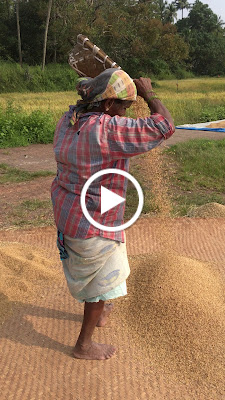
A rice-sifter at work


Every day, I pass through the same route, the same fields and villages, on my drive from Verem to Siolim. For the last six months, this route has been de rigeur because of the renovation work that’s in progress in my Siolim apartment.  It had been happening and stressful, then abandoned by a careless contractor,  re-started after a two month hiatus and much effort, and now I am toiling hard to get it completed. It’s been a testing phase. But, despite the anxiety of it all, over the change of seasons during the months from April to October, I’ve seen subtle variants in the landscape and activity en route; particularly in the villages of Pilerne and Saligoan.
 
Fields flank both sides of the Pilerne Road,
 from Mansher to Pilerne
 
Goa in May is surprisingly arid and dusty-dry. All the lush green that one associates with its landscape is a grimy shadow of its post-monsoon panorama.  Driving through winding roads that circle the gently undulating landscape, I’ve seen dry fields being ploughed in readiness for the rain. Watching, an otherwise laidback populace suddenly swing into action as soon as the pitter patter started, and  village men and women began sowing seeds for the paddy crop. Many fields don’t get worked upon because farming is labour intensive. And, according to locally rumoured calculations, only ten percent of land, in most of the villages of Goa, is cultivated. I’m told that the younger generation of landowners find it tedious to farm and hired labour is expensive. Rice is staple diet for the Goans but, those who opt out of farming find it easier, and cheaper, to purchase their requirement from the market. And their fields have lain barren year after year, three to four years in succession. Some locals say that the stretch from Verem to Pilerne got flooded when the Nerul creek flood gates got broken, some four or five years ago and no farming has been done since. Reportedly, it took the panchayat years to repair the system gates,  and once out of the habit of farming, these folks never mustered the energy to resume. Whatever the reasons, out of every four fields with billowing paddy green there are four more that have billowing weeds that look a lot like paddy to the uninitiated, like me.
 
Some fields are paddy and some are not!
 
 
For those die-hards who continue a dwindling tradition of farming, it’s a dedicated job.  In the middle of scorching afternoons, I’ve seen upturned plastic crates used as stools.  Placed in the middle of the large tracts of low-lying fields with not a tree for shade,  a lone, seated man or woman would keep vigil, shooing away birds and cows. Around this time, scrawny scarecrows also began to dot the landscape.  Made with the  traditional cross of sticks, these stick-figures were meagrely dressed with flapping plastic bags in pink, white and blue. On one such scarecrow, a discarded electricity meter was used to represent its face. And, it did look foreboding from the distance.
 
View of the fields off the Pilerne Road,
between Verem/Mansher and Pilerne
Towards the tail-end of the Monsoon Rains
 
For a city-bred lass like me, these things are novel and interesting to note. I’ve never had occasion to watch any kind of agricultural process and have only heard from domestic help about the rigours of kheti-baari. For me, being in the midst of this sowing and harvesting, of rice, was a first.  And even though it wasn’t always possible to stop, while driving, to satiate my curiosity. I couldn’t prevent myself from asking people I met during the course of my day, the many questions that would go through my head, as I passed the activity in the fields.
 
View of the fields off the Pilerne Road, between Verem and Pilerne
 
On the few occasions that I’ve stopped to chat with the farmers, I’ve learned a few things that local gossip couldn’t tell me. I’ve also seen dead snakes the exact colour of the glistening leaf-green paddy crop, crawl out of the fields onto the tarred road, crushed under the wheels of a truck or bus. I’d wonder how these farmers negotiated such hazards, to be told all kinds of scary tales, deepening my dread of the reptile family.
 
Freshly Threshed Rice Fields off the Saligaon Road, on my left as I drive through to Nagoa
 
May turned to October. Dussehra and Diwali have been celebrated as has Ganesh Chaturthi and Narakasura Chaturdashi. Visitors and holiday-makers throng the streets of Goa. Traffic is nearly as impossible as in  Delhi and the number of bikes is maddening. But, precisely because of the crush, in these past few weeks, the large tracts of open fields are especially soothing. In paying particular attention to them, I’ve also observed the harvesting in progress.
 
 
As comical as the human scarecrows were, at the start of the farming season, with their clapping hands and other shenanigans to distract bird, dog and cow from devouring the newly sown seeds, I’ve also noted similarly weird antics while the grain is being harvested. Just as one enters the tail-end of Saligaon leading to Nagoa, there’s a large tract of cultivated land and along this scenic route, I’ve seen some bizarre goings-on. From the point on the Pilerne Road heading towards Mapusa, where I turn off, to pass through Saligaon,  green fields lie on both sides of a generously curving road that allows me to see them from a distance and all the way through till I pass by, driving into the built-up, residential area of the village. 
 
 
One, hot, October afternoon,  I saw an ample-bodied, middle-aged woman, with short cropped hair,  wearing a calf-length, printed dress (looked like mill-printed polyester) clapping her hands and shouting out something, while intermittently waving a cloth in the air. First with one hand and then the other and alternating the two in rapid succession. This went on, right from the onset of the fields coming into my view, until I drove passed her, a good few minutes later. I have reason to believe that she did this non-stop for a good many hours and had been sitting out in the heat for much of the day, keeping vigil on the grain being threshed in the field before her.
 
 
The next day, I found her seated at another field along the same road. It could have been another person because I didn’t note the facial features earlier. But, from the body structure and attire, it seemed to be the same woman. This time, she sat on an upturned crate, at the edge of the field, on the verge of the roadside, while a handful of men stood mid-field of a small plot of land, threshing the crop, manually. She held a black umbrella over her head. It was an overcast day, but it hadn’t rained, so I was wondering about the umbrella, when she started opening and closing it. Every time she opened it, she’d raise up the umbrella and in closing it, bring it down - just above her head, and then open it and raise it again, in quick repetition of the same up-down movement. It was a most unusual sight and a quirky dance of sorts, for there was definitely a synchronised rhythm in these otherwise awkward movements. Sometimes, she’d just bob the open umbrella up and down.  And do the same with it closed. These movement were accompanied by a bevy of sounds - shouted out loud, enough to be heard but were unintelligible. She could have been addressing workers in the fields, but I cannot be sure. Most likely, she was shooing away the pesky birds, hovering above, hungry for a peck of freshly harvested grain.; telling them that they couldn’t have any.
 
During an earlier conversation, in July,  with Pratibha and Pandurang, a farming couple whose fields lie off the Pilerne Road near Moicawaddo, close to where I live in Verem, I’d learned that neighbouring farmers take turns to keep the pestilence away from each other’s land during the day and hire someone to keep vigil at night. I couldn’t help but wonder, if this lady with the umbrella was a land-owner keeping tabs on her numerous fields or if she’d been hired to do so. Because, whatever I’d seen her do was tedious. Inventive in her routine and strategy to keep prey at bay, it signalled endeavour of vested interest, precisely because of that,  but, seeing her in different fields on different says raised some doubt.
 
 
All these months, I’d been content to mostly observe the farming activities. Driving past busy, narrow roads doesn’t offer much scope for photography and neither was I in the right frame of mind. The odd conversations about farming had been with locals that I’ve met in the course of living, or the odd farmer I encountered during an evening walk. I kept telling myself that there would be plenty of time to document and get material for a story. I was always preoccupied with things to do at my apartment so there didn’t seem scope for much more than the passing glance, albeit drinking it all in with a sense of wonderment.
 
For days, prior to Diwali, I’d seen women lifting the threshed rice above their heads and shaking off the chaff, letting it fly off with the wind as they poured the sifted rice into large kattas. Lined up on the roadside these ample bags - both plastic and jute, bulged outwards, stately and statuesque with the grain. It was rural novelty at its best.
 
Work in my apartment was now happening at an easier pace. The pressure to complete this was still there, but nothing quite as strenuous as the past two months had been. Coerced by circumstance I’d taken on the role of a contractor to finish the abandoned work on my flat. I’d been going crazy with the job - so alien to anything I’d ever done in close to six decades of living. There had been almost no time to reflect on life unfolding, beyond some crochet which allowed confused thoughts to tumble out and create just enough space for another chaotic day. Fascinated as I was, I’d still be tired and too listless to make the effort to stop the car, get down and take photos. The thought of carpenters waiting for me, the constant demands for money and long list of things to be done would bog me down.  Every time I passed and noted something interesting and didn’t feel like stopping, I would tell myself that next year, I’d do a full documentation with thorough research.
 
 
But then one day, I thought that next year it will not be the same thing. I couldn’t lose the moments that fascinated me today, waiting for a good time to make note of them. Driving past, one Saturday afternoon, when there wasn’t such a crush of things to tend to, I decided that work or no work, it was too picturesque, for me to pass up this moment and wait another year to document. There were, mercifully, few cars on that stretch. Inspired to stop, by the visual of a weather-beaten woman winnowing, I parked my white i20 on the side and walked up to watch her lift the rice up in her wicker basket and sift it down, letting the wind waft away the chaff. I paused to record and listen to the soft rustle, a warm and comforting nuance, of rice grains falling: caressed by the soft hush of them kissing each other as they piled up on the ground. This was augmented with something the winnower seemed to be telling me but regrettably I haven’t yet learned any Konkani, so missed out on what she said.
 
 
I took my photos and drove on, stopping to chat with a Saligoan landowner who was selling his grain. I rolled down my window. He thought I wanted to buy some, so informs me that he has enlisted for government support, and was selling the rice at ₹21 per Kg, where otherwise the price would be ₹25 per Kg. I asked if all the rice was for sale or if he kept some too, when he said both and that by boiling the rice, it keeps well for a year.  A useful bit of information, for it was something I didn’t know. The patch of land, I found him standing by, didn’t seem to have much grain. I asked how much rice lay before us,  to be told it was about five quintals. I wondered if  that would  be enough for personal consumption and for sale, when sensing my question, he gestured to the land around, informing that he had many more fields.
 
And that is what made me realise that probably the lady of the umbrella dance also owned numerous plots of land. Since I had found her sitting in and around fields on the same stretch of fields, she could also have been his mother. I didn’t ask, but felt that I  shouldn’t have entertained those earlier doubts, because who’d imagine hired help going through such effort and such totally bizarre attempts at shooing off prey. The crazy stuff is what we rise to, when we care enough, isn’t it?


As I was wrapping up this story, the housekeeping staff walked in to clean my apartment with Saraswati leading the way. She is a young graduate, newly married, from neighbouring Karnataka and if she happens to find me in the apartment, she quizzes me about what I am doing - always curious and in awe of my creative endeavours. This time around, she insisted on knowing the story I was writing. As I narrated the dress-clad woman’s antics, telling her how I wondered if she owned the land or was hired to do these tricks, when she said with the unstoppable authority of youth : “ Maedum, paeesa dene pe bhi nahin hone ko hota, kitna sharm aata na?, voh Catholic Aunty ka khud ka land hoga, bilkul hoga, koi shak nahin!”
 
Well, that certainly put it unarguably into the same perspective I had arrived at. The crazy stuff is what we do when we are involved with and have a vested interest in the resultant outcome, anyone else would feel too embarrassed to do the same things. The ploughing and harvesting of seeds that we sow through life, are rife with many awkward moments that we’d probably be too embarrassed to own up to and face ourselves for, on hindsight. As would the woman, if I had taken a video, of her at work, and shown  it to her. Would she.....,I know that in her shoes, I would.  And probably never work with such uninhibited ardour and abandon again!


Monday, 10 March 2014

Journeys

Journeys of a mind, travelling
                                 beyond space and time,
journeys of trudging
                    through mush and grime.........


For me journeys are not just about travelling around the world, looking at marvels of nature or mankind, but journeys of the mind. We don’t really know the destination; experience is the journey. It is about perceptions and feelings and emotions and revelations. It is about people and places that enrich and arouse the spirit. Rising above the mush and grime of daily living to infuse it with the spirit’s passion to live another day, breathing in its grace, leaving behind the grudges of yesterday. It’s about looking at the world around you and engaging with it to find yourself through its multitudinous illusions.... at least trying to!

A recent train journey that was delayed by about five hours made me realise just how much I would have missed had the train arrived in Delhi, on time. We were supposed to reach Nizamuddin Railway Station around eleven a.m. which meant that all the places we were to have passed in the dead of night were the ones I was awake to look at: the delicately billowing sarson, miles and miles of yellowed fields waking up to their golden hue, reflecting the sun’s passion as it sharpened its rays and more. I spent most of this extended time either searching platforms for a much needed cup of tea or looking out of the train through the lens of my camera. Very much a visitor in my own country, curious about everything that the locals took for granted. In doing this I was no less of a curiosity to them, especially the chai wallahs busy racing up and down the platforms serving tea, while I chased them with my camera.

Aditya Dhawan’s collection of photographs on the metro, - Metro-tales as he calls them, remind me of just such a curiosity. In the first image – [he hasn’t named them], a rather solid steel bar divides the frame, virtually in half, vertically slicing a man’s body such that, ironically, it exaggerates his belly. He isn’t fat, but not lean either. The photographer’s focus is on this central figure dressed in a green T-shirt, printed with black letters in English, tucked inside blue jeans, secured with a black belt. He, our Mr. X is carrying a paper bag in his left hand and two more lie on the right side, as if left there so that he could hold onto the hand-stirrups above [which we do not see]. His eyes look blankly ahead – face deadpan, as if in another world, with hopefully, enough attention to ensure he gets off at the right stop. Maybe the bags on the floor of the carriage don’t belong to Mr. X but to the faux-leather-covered arm that arches across the top of the frame. A rather sinister element in this photograph because all you see is the arm.  One assumes there is a body attached to it and that it isn’t someone’s severed limb. Almost all the other travellers are in a kind of dark shadow, not because of insufficient lens exposure but because they are mostly wearing dark blue or black. This creates an aura of darkness which, however, is interrupted with the hint of a smile, gingerly peeping through heads and arms - a fellow traveller enjoying a joke perhaps? It’s barely perceptible and though it does lighten the mood, the frame is rather sombre and reminiscent of the socio-political atmosphere of the country at this point in time.

I have to confess that, I have not yet been on the Delhi Metro. But having travelled on the underground in various part of the world, I am no stranger to such journeys where everyone, including myself, was just waiting to get off at our designated stations and hardly noticing what was going on, not thinking twice about such everyday scenes. However, Aditya draws my attention to them not because he has captured something apparently significant but precisely because he has not. That is what makes it significant because, in expecting some great revelation, I look and, when I look, I see things that I would otherwise miss.

 And this is the thing that I love about art: when you look you find yourself in it through the ramblings of the mind. I focus on things I see, and let them speak to me. What did you see in that image? It is, after all, a question of perception. A lot of assumptions come into play and while I saw that happening as I looked, I decided to question them because, in reality, when we assume we actually miss what else could also be going on. The sombre mood, the arm that could be a severed limb, the dark aura because of the clothes and the photographer’s choice of lighting options [did he or didn’t he use a flash and why not?] builds up the mood for something more than the physical dimensions of the scene conjure up. It makes life interesting.

 In another image we have a child that is clearly upset. Its facial expression – the elongated cheeks, flared nostril, strained muscle on the right side of the neck, the wide open mouth and that look of longing, calling out to someone or for something that has gone out of his/her grasp, the sense of separation –conveys more than just a child’s petulant cry for a toy or comforter.

The child appears to be clad in a snug quilt-like outfit, partially unzipped. It’s placed, most likely, on someone’s lap, but without making that assumption based upon experience, going just by what I can see, it could be abandoned and maybe that is why it is in so much anguish? A hand, much larger hand, more than ten times the size of its tiny, exquisitely crafted fingers, touches as if in support. And yet the touch is tentative, there is no clasping of fingers nor does this hand hold onto the arm of the child. A thumb merely touches the sleeve. Would that be the hand of an indulgent mother, letting her child cry its heart out, uncaring of the discomfort of co-passengers? Or, is it an exhausted mother who cannot care at this point, nor really do much in the present situation? Or maybe it is the hand of an indifferent passenger, whose compassion is being awakened upon seeing the distraught, abandoned child. Yes, I am trying not to assume but question. It’s possible that an unseen hand holds the child securely and this is just an innocuous gesture and I am deliberately trying to read meaning into it.

But wait, there’s more. We have a view of this child from above. All other bodies are faceless. What we see are shoes, slipper-clad feet, a light-bluish duffle bag resting on the floor and two steel pillars rising upwards from this floor. One pair of feet is shod in white and grey Nike sneakers with the Nike logo signed off in gold.  This hint of glitter, which is not gold but a sharp shade of yellow vinyl, is complimented by a sweater in close proximity. It is knitted in an elaborate, geometrically-floral pattern, in black, white and golden ochre. Under the light in the train’s carriage, it sparkled as if embroidered with metallic thread.

Bags on the floor, back-packs, rucksacks and a woman clad in a blue-flowered, mill-printed shalwar kameez sits beside the child. An ample figure, her hands are clasped in her lap, maroon plastic bangles on a dark-skinned arm holding a black cloth bag. I catch a glimpse of a metro route map on the door of the carriage, partially obscured by passengers hovering close, possibly so they can run out as soon as the door opens at the next station. These are the additional props and figures in this scene.

What interest me above all, in this frame, are the dust drawings on the floor. These are not carefully considered drawings executed by skilled draughtsman, but drawn by shoes and slippers as feet swivel the dust on their way through the carriage. I suppose it could be called a performance by travelling companion-strangers, each adding or subtracting from the last foot-print. Their eyes rarely have a role to play in this drawing for they are mostly eyeing available seats, a place to fit their bodies or seeking proximity to the door when their stop is near. I mean, who really looks at the floor? But my attention is brought to this again and again because Aditya’s photographs appear to be not just images of motley of strangers inadvertently travelling together; they’re evocative of the very nature of life and its idiosyncrasies, most especially ways of seeing and the crafting of our perceptions. And besides, his obsession with feet and how they are shod draw my attention to the floor of the train’s carriage.


Stilled in time, in that moment, he captures not just an essence but many facets of life that lead from the physical to the metaphysical and back to the physical, quite simply because, he deliberately presents severed limbs, half bodies and two pairs of shoes that belong to three different bodies in a surreal presentation of identity or loss of it, in a crowded metro. The slice of life he presents is abstracted from the physical reality that he sees which makes these Metro-tales evocative of states of the mind - its imaginable and unimaginable capacities.

But what intrigues me is that when I try and cut out what I know and just look based on what is in front of me, it really is such an impossible task because then I cannot really define anything. I cannot really tell you what it is that I see. And yet in trying to do this as an exercise, a world of possibilities is uncovered. Krishnamurti says that to know what ‘is’ requires awareness, a very alert, swift mind..... to observe and study but not judge, to be alert yet passive.

The next image is priceless from this point of view and I am really grappling for words. The photographer shows us nothing but lower limbs of the human body and a lot of toes. In fact at one point the big toe of two feet that belong to different bodies, come so close that I can imagine them having a conversation – toe speak!

In the foreground of this: painted toe-nails, black vinyl slippers decorated with white floral embellishment and toe rings [bichoos] on two adjoining toes emerging from under bright yellow voluminous folds of what has to be a shalwar, defines the gender as female, a married woman. This lower extremity is poised in the air as if the legs have been crossed, knee over knee in a convent-style advocated lady-like fashion, a must for the genteel. The dark skin, well worn slippers, peeling nail polish implies that this woman is not used to indulgent pedicures of the genteel but the convention of crossing legs seems to have percolated through social strata and is standard social behaviour today.

In a photographically engineered footsie scenario, another foot stands at an interesting angle to this slippered matron’s foot. An expansive curve forms between the legs. This other limb, grasps between its big toe and adjoining toes, a bright cobalt blue, albeit dusty, Hawai [rubber] chappal and the leg is clad in grey denim which has visible creases of wear. I assume by the stance of the leg and the shape of toes that the wearer is male. The floor in the foreground is also grey and so is the side of the blue chappal. As the eye moves up the leg, the contrast diminishes and the leg almost merges with the grey colour of the floor which has now receded into the background. In between these two legs of opposite sexes, placed together on this journey, that form a veeish curve, there lies something that looks like a black bag. It could be dark grey but actually looks like a lump of something solid and weighty. It is identified as a bag through its metallic accessories of zip and a ring that probably holds the strap. Other details are fuzzy, at least on the computer they appear so.

What can such an image and the others before it  tell us? Aside from the esoteric idea of looking at the world around us with a sense of wonder but without judgement, at another level what are these Metro-tales really narrating? It’s actually hard to describe the images in words because Aditya has chosen very obscure ways of depicting signs of social change and behaviour patterns where so much westernisation has percolated through the various strata of society, noted through dress-codes and more.

An almost obese Buddhist monk, eyes closed, one hand placed on each knee, is wearing sleeveless saffron and maroon robes. The white head phones inside his ears could belong to an i-pod or i-phone, but is he listening to music or meditating on this crowded train? Another man sleeps, and there are tired-looking travellers who choose not to take a nap, someone fiddling with his cell phone, someone talking on one. And, a lone man, in what seems like an empty compartment, who looks as if he has lost his way in life.  The prize shot is one taken between colourful bandwallahs, en route to a wedding or on their way back, one of them asleep and another anxiously posing. Is that a selfie? 


Tell-tales of everyday life depicting the angst of a chaotic society undergoing change both social and economic, peppered with photographic humour of quirky shots featuring of only shoes and various patterns, in stripes and checks on shirts and trousers of male attire, on the metro. Not to forget blue-jean clad legs in rubber slippers, feet propped up on the steel pillar in front of the seat they occupied, bringing forth the question: would one not see this lack of civic sense, on public transport, anywhere else in the world?


It’s a subtle commentary, but that is what is so special about these images. They reveal, in a way, that it is your perception, drawn from your experience and understanding of the world that determines what you see. The photographer takes you on a journey of self-exploration, through the curiosity of your own questioning mind, beyond the obvious, to form an insightful picture of that moment frozen in time. The images capture within their ambit a slice of life where, paraphrasing William Blake, we can see a whole world in the unusual perspective of Aditya Dhawan’s lens.