Showing posts with label women. Show all posts

Tuesday, 31 October 2017

Harvesting Shenanigans

A rice-sifter at work


Every day, I pass through the same route, the same fields and villages, on my drive from Verem to Siolim. For the last six months, this route has been de rigeur because of the renovation work that’s in progress in my Siolim apartment.  It had been happening and stressful, then abandoned by a careless contractor,  re-started after a two month hiatus and much effort, and now I am toiling hard to get it completed. It’s been a testing phase. But, despite the anxiety of it all, over the change of seasons during the months from April to October, I’ve seen subtle variants in the landscape and activity en route; particularly in the villages of Pilerne and Saligoan.
 
Fields flank both sides of the Pilerne Road,
 from Mansher to Pilerne
 
Goa in May is surprisingly arid and dusty-dry. All the lush green that one associates with its landscape is a grimy shadow of its post-monsoon panorama.  Driving through winding roads that circle the gently undulating landscape, I’ve seen dry fields being ploughed in readiness for the rain. Watching, an otherwise laidback populace suddenly swing into action as soon as the pitter patter started, and  village men and women began sowing seeds for the paddy crop. Many fields don’t get worked upon because farming is labour intensive. And, according to locally rumoured calculations, only ten percent of land, in most of the villages of Goa, is cultivated. I’m told that the younger generation of landowners find it tedious to farm and hired labour is expensive. Rice is staple diet for the Goans but, those who opt out of farming find it easier, and cheaper, to purchase their requirement from the market. And their fields have lain barren year after year, three to four years in succession. Some locals say that the stretch from Verem to Pilerne got flooded when the Nerul creek flood gates got broken, some four or five years ago and no farming has been done since. Reportedly, it took the panchayat years to repair the system gates,  and once out of the habit of farming, these folks never mustered the energy to resume. Whatever the reasons, out of every four fields with billowing paddy green there are four more that have billowing weeds that look a lot like paddy to the uninitiated, like me.
 
Some fields are paddy and some are not!
 
 
For those die-hards who continue a dwindling tradition of farming, it’s a dedicated job.  In the middle of scorching afternoons, I’ve seen upturned plastic crates used as stools.  Placed in the middle of the large tracts of low-lying fields with not a tree for shade,  a lone, seated man or woman would keep vigil, shooing away birds and cows. Around this time, scrawny scarecrows also began to dot the landscape.  Made with the  traditional cross of sticks, these stick-figures were meagrely dressed with flapping plastic bags in pink, white and blue. On one such scarecrow, a discarded electricity meter was used to represent its face. And, it did look foreboding from the distance.
 
View of the fields off the Pilerne Road,
between Verem/Mansher and Pilerne
Towards the tail-end of the Monsoon Rains
 
For a city-bred lass like me, these things are novel and interesting to note. I’ve never had occasion to watch any kind of agricultural process and have only heard from domestic help about the rigours of kheti-baari. For me, being in the midst of this sowing and harvesting, of rice, was a first.  And even though it wasn’t always possible to stop, while driving, to satiate my curiosity. I couldn’t prevent myself from asking people I met during the course of my day, the many questions that would go through my head, as I passed the activity in the fields.
 
View of the fields off the Pilerne Road, between Verem and Pilerne
 
On the few occasions that I’ve stopped to chat with the farmers, I’ve learned a few things that local gossip couldn’t tell me. I’ve also seen dead snakes the exact colour of the glistening leaf-green paddy crop, crawl out of the fields onto the tarred road, crushed under the wheels of a truck or bus. I’d wonder how these farmers negotiated such hazards, to be told all kinds of scary tales, deepening my dread of the reptile family.
 
Freshly Threshed Rice Fields off the Saligaon Road, on my left as I drive through to Nagoa
 
May turned to October. Dussehra and Diwali have been celebrated as has Ganesh Chaturthi and Narakasura Chaturdashi. Visitors and holiday-makers throng the streets of Goa. Traffic is nearly as impossible as in  Delhi and the number of bikes is maddening. But, precisely because of the crush, in these past few weeks, the large tracts of open fields are especially soothing. In paying particular attention to them, I’ve also observed the harvesting in progress.
 
 
As comical as the human scarecrows were, at the start of the farming season, with their clapping hands and other shenanigans to distract bird, dog and cow from devouring the newly sown seeds, I’ve also noted similarly weird antics while the grain is being harvested. Just as one enters the tail-end of Saligaon leading to Nagoa, there’s a large tract of cultivated land and along this scenic route, I’ve seen some bizarre goings-on. From the point on the Pilerne Road heading towards Mapusa, where I turn off, to pass through Saligaon,  green fields lie on both sides of a generously curving road that allows me to see them from a distance and all the way through till I pass by, driving into the built-up, residential area of the village. 
 
 
One, hot, October afternoon,  I saw an ample-bodied, middle-aged woman, with short cropped hair,  wearing a calf-length, printed dress (looked like mill-printed polyester) clapping her hands and shouting out something, while intermittently waving a cloth in the air. First with one hand and then the other and alternating the two in rapid succession. This went on, right from the onset of the fields coming into my view, until I drove passed her, a good few minutes later. I have reason to believe that she did this non-stop for a good many hours and had been sitting out in the heat for much of the day, keeping vigil on the grain being threshed in the field before her.
 
 
The next day, I found her seated at another field along the same road. It could have been another person because I didn’t note the facial features earlier. But, from the body structure and attire, it seemed to be the same woman. This time, she sat on an upturned crate, at the edge of the field, on the verge of the roadside, while a handful of men stood mid-field of a small plot of land, threshing the crop, manually. She held a black umbrella over her head. It was an overcast day, but it hadn’t rained, so I was wondering about the umbrella, when she started opening and closing it. Every time she opened it, she’d raise up the umbrella and in closing it, bring it down - just above her head, and then open it and raise it again, in quick repetition of the same up-down movement. It was a most unusual sight and a quirky dance of sorts, for there was definitely a synchronised rhythm in these otherwise awkward movements. Sometimes, she’d just bob the open umbrella up and down.  And do the same with it closed. These movement were accompanied by a bevy of sounds - shouted out loud, enough to be heard but were unintelligible. She could have been addressing workers in the fields, but I cannot be sure. Most likely, she was shooing away the pesky birds, hovering above, hungry for a peck of freshly harvested grain.; telling them that they couldn’t have any.
 
During an earlier conversation, in July,  with Pratibha and Pandurang, a farming couple whose fields lie off the Pilerne Road near Moicawaddo, close to where I live in Verem, I’d learned that neighbouring farmers take turns to keep the pestilence away from each other’s land during the day and hire someone to keep vigil at night. I couldn’t help but wonder, if this lady with the umbrella was a land-owner keeping tabs on her numerous fields or if she’d been hired to do so. Because, whatever I’d seen her do was tedious. Inventive in her routine and strategy to keep prey at bay, it signalled endeavour of vested interest, precisely because of that,  but, seeing her in different fields on different says raised some doubt.
 
 
All these months, I’d been content to mostly observe the farming activities. Driving past busy, narrow roads doesn’t offer much scope for photography and neither was I in the right frame of mind. The odd conversations about farming had been with locals that I’ve met in the course of living, or the odd farmer I encountered during an evening walk. I kept telling myself that there would be plenty of time to document and get material for a story. I was always preoccupied with things to do at my apartment so there didn’t seem scope for much more than the passing glance, albeit drinking it all in with a sense of wonderment.
 
For days, prior to Diwali, I’d seen women lifting the threshed rice above their heads and shaking off the chaff, letting it fly off with the wind as they poured the sifted rice into large kattas. Lined up on the roadside these ample bags - both plastic and jute, bulged outwards, stately and statuesque with the grain. It was rural novelty at its best.
 
Work in my apartment was now happening at an easier pace. The pressure to complete this was still there, but nothing quite as strenuous as the past two months had been. Coerced by circumstance I’d taken on the role of a contractor to finish the abandoned work on my flat. I’d been going crazy with the job - so alien to anything I’d ever done in close to six decades of living. There had been almost no time to reflect on life unfolding, beyond some crochet which allowed confused thoughts to tumble out and create just enough space for another chaotic day. Fascinated as I was, I’d still be tired and too listless to make the effort to stop the car, get down and take photos. The thought of carpenters waiting for me, the constant demands for money and long list of things to be done would bog me down.  Every time I passed and noted something interesting and didn’t feel like stopping, I would tell myself that next year, I’d do a full documentation with thorough research.
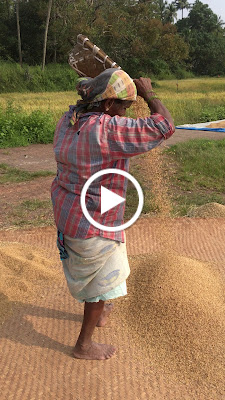
 
 
But then one day, I thought that next year it will not be the same thing. I couldn’t lose the moments that fascinated me today, waiting for a good time to make note of them. Driving past, one Saturday afternoon, when there wasn’t such a crush of things to tend to, I decided that work or no work, it was too picturesque, for me to pass up this moment and wait another year to document. There were, mercifully, few cars on that stretch. Inspired to stop, by the visual of a weather-beaten woman winnowing, I parked my white i20 on the side and walked up to watch her lift the rice up in her wicker basket and sift it down, letting the wind waft away the chaff. I paused to record and listen to the soft rustle, a warm and comforting nuance, of rice grains falling: caressed by the soft hush of them kissing each other as they piled up on the ground. This was augmented with something the winnower seemed to be telling me but regrettably I haven’t yet learned any Konkani, so missed out on what she said.
 
 
I took my photos and drove on, stopping to chat with a Saligoan landowner who was selling his grain. I rolled down my window. He thought I wanted to buy some, so informs me that he has enlisted for government support, and was selling the rice at ₹21 per Kg, where otherwise the price would be ₹25 per Kg. I asked if all the rice was for sale or if he kept some too, when he said both and that by boiling the rice, it keeps well for a year.  A useful bit of information, for it was something I didn’t know. The patch of land, I found him standing by, didn’t seem to have much grain. I asked how much rice lay before us,  to be told it was about five quintals. I wondered if  that would  be enough for personal consumption and for sale, when sensing my question, he gestured to the land around, informing that he had many more fields.
 
And that is what made me realise that probably the lady of the umbrella dance also owned numerous plots of land. Since I had found her sitting in and around fields on the same stretch of fields, she could also have been his mother. I didn’t ask, but felt that I  shouldn’t have entertained those earlier doubts, because who’d imagine hired help going through such effort and such totally bizarre attempts at shooing off prey. The crazy stuff is what we rise to, when we care enough, isn’t it?


As I was wrapping up this story, the housekeeping staff walked in to clean my apartment with Saraswati leading the way. She is a young graduate, newly married, from neighbouring Karnataka and if she happens to find me in the apartment, she quizzes me about what I am doing - always curious and in awe of my creative endeavours. This time around, she insisted on knowing the story I was writing. As I narrated the dress-clad woman’s antics, telling her how I wondered if she owned the land or was hired to do these tricks, when she said with the unstoppable authority of youth : “ Maedum, paeesa dene pe bhi nahin hone ko hota, kitna sharm aata na?, voh Catholic Aunty ka khud ka land hoga, bilkul hoga, koi shak nahin!”
 
Well, that certainly put it unarguably into the same perspective I had arrived at. The crazy stuff is what we do when we are involved with and have a vested interest in the resultant outcome, anyone else would feel too embarrassed to do the same things. The ploughing and harvesting of seeds that we sow through life, are rife with many awkward moments that we’d probably be too embarrassed to own up to and face ourselves for, on hindsight. As would the woman, if I had taken a video, of her at work, and shown  it to her. Would she.....,I know that in her shoes, I would.  And probably never work with such uninhibited ardour and abandon again!


Thursday, 2 March 2017

Exploring My Textile Obsession with Eri Silk of Meghalaya, Guest Post by Anna-Louise Meynell


5 generations of women and girls from a weaving family


Working with textiles, as I have done for the past fifteen years, is often a passport to genuine experiences and interactions with rural artisans. Each time I visit an artisan village on ‘work’ I leave feeling truly blessed to be able to overcome language barriers, by communicating through the language of textiles – its warp and weft – a mutual understanding of the craft of weaving.

Working with the weavers

I was trained as a weaver in Scotland, where I also grew up. I moved to Bangalore in 2005, and my relationship with Indian textiles and traditional artisans grew with each year I spent there. With such a rich textile heritage, it is easy to develop many textile obsessions, but there is one fabric that captured my attention from the moment I came across it. Eri silk. The soft handle, the rustic and slubby texture of the yarn, the matt sheen of this unusual silk, the weight and drape of the cloth and the subtle shades of natural dyes drew me in and found a place in my mind. I was fascinated by the fabric and the place where it was produced - North East India.

Family collection of traditional Khasi pieces


When people talk of textiles of North East India, it is rarely textiles of Meghalaya that will be first brought into the conversation. Bold tribal textiles of Nagaland, Eri and Muga silk with figurative motifs of tribal Assam are well established on the textile map. Some may know of the fine and compact Phanek embroidery and the Wangkhei Phee textiles of Manipur (using the same technique of jamdani from West Bengal and Bangladesh), while textiles from Meghalaya are barely given a mention. What a treat for me then, to be invited into the villages on a textile consultancy with NESFAS, a Shillong-based NGO, to assess the potential and production constraints of the Eri silk weavers, spinners and dyers and work with them to expand their markets. I found that while Meghalaya is a state more or less off the well-trodden textile trails of India it has a rich, sincere and humble textile history.

From Mustoh to the plains of Bangladesh,

As a Scottish weaver I have received a very warm welcome in Meghalaya. Each person I meet reminds me that Meghalaya was affectionately named ‘Scotland of the East’ by the British. I (try to) respond with equal enthusiasm every time as I talk of the similarities with Scotland; the rolling hills, the deep gorges, pine forests and clean fresh rivers. To talk of Meghalaya or equally of Scotland and not to mention the rain is impossible. Rain shapes a land, gives life, fertility and endless shades of the colour green. I have always found an affinity with people who come from rainy places and Meghalaya is no exception - though the rain here is on a completely different scale to my homeland. Officially known as ‘the rainiest place on the planet’ the people have come to accept and understand how to live with the rain, enjoying the dynamic seasons, never leaving the house without an umbrella. One particularly poignant moment for me was in Mustoh, a village in the hills bordering Bangladesh. Looking down on the flooding Bangladeshi plains while being pummelled with torrential rain (over several days) gave me real experience of the forces of nature that impact the lives of so many people.

Eri silk fibre and thread

But back to the weavers, and the indigenous craft culture of Meghalaya. While Eri silk is best known for its production in Assam, it also has a long history with the people of Meghalaya. The main hub of Eri silk weaving in Meghalaya is the Ri Bhoi District, an area on the border of Assam, halfway between Guwahati and Shillong. It is a lush, fertile area where literally anything will take root and flourish. The self-sufficient and naturally sustainable communities of Ri Bhoj are primarily agriculture based, their main produce being innumerable varieties of rice, ginger, turmeric, and a range of delicious seasonal vegetables such as pumpkin, spinach, radish, squash, brinjal, tree tomato, beans and many more. In most villages farming responsibilities come first, with the whole village working on planting and harvesting of rice. Traditionally weaving activities are integrated into village life in the moments when agriculture is less demanding. When women get together in the community it is not rare to see them spinning eri silk with the takli or drop spindle, as they share anecdotes from their family life. Understanding the relationship between Eri silk production and the rhythm of the agricultural seasons is the first step towards understanding the weaving communities in the Ri Bhoi District.

Studying the Khad Ar Lyngdoh designs

Village life in the Ri Bhoi District

Eri silk in Meghalaya has always been cultivated domestically, and still is today.  The silk worms feed on the leaves of a number of plants, most commonly the castor plant, and grow fat and green in the shelter of the rearing house - generally a purpose built bamboo shed in the compound of the home. For those of you reading this blog post who do not know about Eri silk, it is also known as ‘ahimsa silk’, ‘peace silk’ or ‘non-violent silk’ due to the non-violent method of extracting the silk from the cocoon. The cocoon is spun of short fibres, making it impossible to reel the silk from the cocoon. The majority of the world’s silk is reeled, whereby the cocoon is boiled with the worm still inside to loosen the silk filament before reeling. The Eri silk worm however is either taken out by breaking open the cocoon, or the worm is allowed to eat its way out through the cocoon to emerge as a moth and continue the cycle. As Eri silk is hand-spun, it is of no matter that the cocoon has been broken open, thus saving the worm of being boiled alive. The amusing irony that I have observed with this reference for Eri silk (‘ahimsa silk’), is that once out of the cocoon the majority of the worms will be served up for dinner or turned into pickle! Ultimately the worm is not harmed in production of the silk, but being a great source of protein, it is not wasted. You can often see large bamboo trays of these worms being sold in the market, and in fact they can fetch as high a price as the silk cocoon itself.

Eri silk worm

Cocoons are washed, hand-spun and the yarn is dyed with natural dyes. Traditionally the colours used in Meghalaya were stick lac red, turmeric yellow and black from iron ore. Today, with training and support from government and NGO’s, the artisans have greatly increased their repertoire of colours, experimenting with all kinds of leaves, flowers, roots and fruits in and around the forests. Amongst many other plants, they are now experimenting with hibiscus (china rose), ananto fruit, marigold flowers, guava leaves and teak leaves. The colours they create depend on the season, the availability of these wild natural resources and even how old the plant is.

Eri silk worms
Eri silk from Meghalaya is a tangible reflection of the rural communities it is produced in. The quality of the silk depends on the quality of the leaves the worm feeds on, the texture of the thread is dictated by the hand of the spinner, the natural dyes come from the wild produce of the land, and finally the weaver working with a floor loom made of local bamboo brings her own creativity to the design and construction of the cloth.

Preparing the warp for the traditional Khasi check shawl

My current work in Meghalaya is research for my doctoral studies, through the Centre for Sustainable Fashion, University of the Arts London. I have been undertaking an ethnographic documentation of the socio-cultural context of Eri silk production in the Ri Bhoi District, and a technical analysis of the weaving process, recording their skills as new technology is introduced to their current practices. I have spent much time staying with the weavers, observing their rhythm of working, delving into their tribal history, and studying the textiles in their family collections.

Eri silk woven on the floor loom. Turmeric dyed warp and twisted turmeric and lac red weft

I am happy to say that there is a deep and meaningful history of Eri silk textiles in Meghalaya, closely linked to the social history of the communities. I have found sophisticated supplementary weft designs that were woven on simple floor looms. These textiles were once used by traditional dancers as a waistband with long sashes. With the widespread conversion to Christianity many of the traditional celebrations died out, and with it the need for dancers, or indeed their stunning waistbands! These skills are not lost however, and I have found contemporary versions in acrylic or cotton being woven in some villages. On the trail of the supplementary weft technique I have come across interesting indications of tribal assimilation reflected in the textiles. The Assamese and the Karbi textiles are woven with highly figurative motifs of flowers or mythical animals, which are also found in the Ri Bhoi district.  The Khasi Bhoi people have very clear geometric patterns, yet use the same technique of supplementary weft. Khasis elsewhere in Meghalaya do not use this technique, nor do they have the intricate ‘dancers waistband’ in their traditional dress, indicating that the close interaction between the Karbi and the Khasi people of the Ri Bhoi District may have led to exchange of ideas and techniques in textiles. When one delves into the tribal history of the area it becomes clear that this is really a rich land of many layers.

Natural dyes


Mist and rain in Mustoh
In some villages there is a noticeable shift in the approach to weaving. In Umden, the ‘model village’ of eri silk production, weaving has become a thriving commercial business. Weavers work full time and some do not work in the field at all. Many are structuring their workshops to be able to accommodate larger orders. The frame loom, and fly shuttle loom is now widely used, millspun yarn is available which they use in the warp, and you can see far more experimentation in design moving away from the traditional textiles. 
Traditional dress of the Khad Ar Lyngdoh communities,
Khasi Bhoi ethnic group
None of this research is possible without building relationships with the weavers over several cups of tea, followed by endless chewing of kwai  (a large chunk of beetlenut, beetle leaf and lime) to give you that special village high! On occasions going into certain villages, my Khasi assistant and I have been warned not to drink any tea or eat food, if offered, due to the practice of black magic in the village. It is said the excrement of the silkworm, when crushed and sprinkled on food as black magic would bring bad luck, ill health and possibly lead to the death of the person who consumed it. Today they do not use the powder, though black magic powers are still respected or feared. One family we visited in Umkon, (the Ri Bhoi District) did not offer us any tea at all, which is very unusual in Meghalaya. Knowing that they have a reputation of practicing black magic, they do not offer guests tea to avoid an awkward situation. This was followed by a visit to another family in the same village, who told us tales of their grandfather transforming into a tiger, while we drank tea and ate pomelo fruit mixed with salt and black sesame and carambola from their garden. Our hosts’ grandfather was one of the few villagers who did not convert to Christianity in colonial times, a fierce defender of the indigenous Khasi religion. The tiger often appears in Khasi folklore and such stories are common even today. Though I cannot understand Khasi, watching her narrate the stories of her grandfather with such animation I could almost sense the tiger in her. Kong Kumari who had accompanied us to the village insisted we consume a tangy tasting powder as soon as we left, as a precautionary antidote to black magic. We took it on her insistence but as Vianney, my assistant, rightly said: “the food was given with such love, straight from the heart, it can only be received with warmth and gratitude.”


Floor loom weaving
My own interest in textiles has led me into deep discussions on tribal culture, the matrilineal system of the Khasis and role of women in Meghalaya, community systems of authority, the relationship with colonial settlers, the mass conversions to Christianity, the list goes on. What began as a search for indigenous textiles has opened-up doors to explore a rich cultural tapestry, building lasting friendships with people from such different backgrounds.

120 year old dancers waistband from the Khasi Bhoi communities,
Eri silk, exquisite supplementary weft designs


Anna-Louise Meynell is a designer of woven textiles from Scotland who has been living and working in Asia for 12 years. Her consultancy work in handwoven textiles takes her to inspiring communities in India, Laos, Cambodia and Myanmar. With so much travel and textiles in her life she describes herself as a ‘nomadic weaver’!


Anna-Louise has been working in Meghalaya since 2014, and is currently based in Shillong, doing research on the traditional Eri silk textiles of Meghalaya. The North East of India has captured Anna-Louise’s heart, mind and textile imagination and she may well be there some time longer!


Sunday, 27 November 2016

Aaro Aakash…….A Memologue of Leisure - Guest Post - Sunetra Lahiri


Dokka, the cottage for two where we stayed
I met Uday Hazra at a photography exhibition where he was one of the exhibitors. Till date I do not know exactly what he does for a living except that he is a writer, graphic artist, and photographer, has a philanthropic bent of mind and owns ‘Aaro Aakash’ which is neither a hotel nor a resort but rather a property having one big and one small cottage that he kindly allows his friends and relatives to stay in. Adjacent and older than ‘Aaro Aakash’ is ‘Anek Aakash’ but that property is for his personal use. He has been asking me to visit 'Aaro Aakash' before it becomes another concrete jungle and the sky becomes just a figment of imagination….. So this February before the summer heat became too much we, myself and my friend Lily, decided we would take up his offer.

We board an early morning train from Sealdah for Bolpur, Shantiniketan. It’s a grey day, cool; we refresh ourselves with paper cups of hot lemon tea from a passing vendor on the train.  It takes about three hours to reach our destination.

'Aaro Aakash'….10kilometre from Bolpur station is in a village – Kamarpara. The property is looked after by Basuda, the manager and Lalda, the cook and odd job man. They both live in the same village within shouting distance of the property. Basuda drives the brand new white Maruti 'Omni' and picks us up from Bolpur Station. When we reach 'Aaro Aakash' we find it picture perfect - rustic, organic, basic; the charm lies in its simplicity. Dokka, the cottage for two, lies at the end of the property separated from a bigger cottage beside a pond and amidst abundant greenery. Dokka has an open front porch. It has a swing, an old armchair and a charpoy. I stake claim to the charpoy much to my friend’s amusement. Lying on the charpoy watching a sun bleached February sky as sharp little neem leaves float down soundlessly to the ground is cathartic. The breeze, still cool with barely a hint of the coming summer, making gentle music as it passes through the trees. It is a moment of unmitigated bliss.


Ekka - the first cottage in Aaro Aakash

I look at my companion – who has quite recently finished her PhD in Philosophy. For four years while she was writing her thesis we did not travel much because of her commitments. We are kindred souls and need to dive deep into quiet to rejuvenate. This trip was her birthday gift to me. Sitting on the swing engrossed in a book she had carried all the way from home, content, peaceful and silent, she is the perfect travel companion – unobtrusive and non-invasive. It has always been like this…..the treasured company of someone in perfect tandem with your rhythm.
The door separating Ekka from Dokka

Lalda comes ambling down the narrow path…. Lunch is ready. Food is simple, fresh and hot, served with love on huge steel plates with matching glasses on reed mats laid on the raised table in a little thatched hut with mud walls. Rice is heaped on our plates. There are dishes of dal, vegetable curry, fried eggplant, and fresh water fish curry. We protest because we cannot eat so much. Lalda is disappointed to find how little we eat; he says the water is good, it will make us hungry and we should eat more. We smile, trustingly drink the water and soon are too full to think about evening tea.

There is nothing much to do and that suits us fine. We lie down on the porch furniture like languid overfed lizards of which there are too many and varied to notice. When I return and tell him about the burgeoning lizard population, Uday-da, who is rather passionate about the environment, ecology and all things that have life, says, “it’s their home too.” 
An abandoned abode on way to Lakhi Sayar
Towards evening, before the twilight slips into deep dusk we venture out to explore Lakkhi Sayar - a large water body. Much before coming here we have avidly followed Uday-da’s Facebook page which was full of photographs of the village, 'Aaro Aakash' and Lakkhi Sayar. It’s just round a bend in the road hidden by a little ridge about 500 yards from the gate. We climb easily, nimbly like the black goats grazing about. It’s a beautiful sight….a solitary boat at the edge of the bank, the sun reflected in broken ripples, birds wheeling and settling among dark trees on the far bank while darkness descended slowly. Like true amateurs, we try our best to capture the mood but must be content with the image etched on our mind. Along the winding path back to 'Aaro Aakash', we meet some village women returning from a day’s work in the field - colourfully attired, their sweat soaked vital faces glowing in the rays of the setting sun. 
The lone boatman  of Lakhi Sayar - the waterbody near Aaro Aakash

We return back and Lalda serves tea with biscuits. We refuse his offer of “telebhaja with muri” (deep fried pakoras with puffed rice). Lily sits on a weather beaten wooden bench in front of the other cottage sipping her piping hot beverage while I amble about busily taking pictures of the surrounding. The previous guests had left that morning so we were the only people on the property.

We spend the evening on the porch surrounded by Mortein coils. The place is mosquito heaven, surrounded by trees and water bodies. My friend reads articles and stories she has collected for just such an occasion. She is a good story teller, her voice smooth with the correct intonation. It’s a moment of … nirmal anand….. We are quite unaware of time till Lalda comes hurrying down the path carrying a hurricane lamp and announces that dinner is ready. The hurricane lamp brings back memories of a bygone time in Calcutta when whole portions of the city would be shrouded in darkness due to load shedding, lighted only by these glass lamps. They would get sooty every night and cleaning them out every day was a ritual. Somehow exams and homework and my childhood evenings will always be linked with these lamps – the smoky smell of kerosene and the acridity of singed hair when we leaned too close to the glass, our eyes full of sleep from the torpid heat and humidity.

After dinner we wander back to our porch and feel that it’s too early to turn in. But there’s not much else we can do. We call home and report that all’s well, finish our nightly rituals in silence, climb inside the mosquito net that Lalda has so thoughtfully hung for us over the bed, a low wooden chouki without headrest pushed against the wall near the window which looks out on the porch. We try to sleep but end up chatting instead, our body clock attuned to a more urban routine. We talk late into the night. What did we talk about? I cannot remember. Inconsequential nothings, I guess.

I wake up early, take out my camera and go out onto the porch. It’s eerily silent. The sun is a mystery – it’s there but I cannot see it. Fog lies thick and deep among the trees.  I sit down on the armchair and try to be one with the silence. After a while I take a walk, feeling the cool gritty soil underfoot. There is dew on the straggly grass that glistens like pearl. Faraway through the cotton-wool silence I hear the tinkling of cow bells. I do not know what hour it is, only becoming aware of time when   I see Lalda emerging through the fog, as if by magic, from some other dimension, carrying tea in a thick glass, asking when we would require hot water for our baths.
Subarnarekha - the bookstore everybody goes to

After breakfast Basuda drives us to Shantiniketan. We have been here before so we do not waste time doing the usual touristy things. We visit 'Subarnarekha', the bookstore near Viswa Bharati University, where one can find anything from the downright crowd pleasers to the esoteric to vintage to rare moth eaten books and out-of-print journals. It’s not very organised. Books weigh down overburdened shelves and are also stacked   on the floor standing in precarious piles and in every nook and corner. It is difficult to walk about in the narrow spaces. There are a few people in the shop and it is an intricate ballet negotiating the narrow spaces between books without knocking each other over. I let my friend spend a happy hour in the proximity of books without trying to venture in much myself for I’m clumsy and quite capable of causing an accidental book avalanche. The owners are laid back, “sukhi” people, who do not seem very interested in selling anything. In fact we waited a good while before the shop was opened, a little after 11 am. But the shop survives, I guess, because of the passion of a select clientele – those people who have such love for books that they are willing to rummage through dust and countless volumes stocked ad hoc, hoping to find one gem to add to their ever increasing library. 'Subarnarekha' is something of an institution. It’s been there for more than 30 years. Everyone’s been here from prominent Bengali writers, academicians and students – it’s a popular haunt of the intelligentsia.

We look at roadside shops selling myriad things from jewellery to clothes to saris to trinkets, leather bags, accessories and souvenirs but nothing catches our eye. We head to Alcha, the store in Ratan Pally whose owner Keya Sarkar is a friend. Alcha has a good collection of bags, saris and scarves, all locally sourced and manufactured. There is also a restaurant of the same name nearby, run by Keya’s husband Satish who makes lovely Spanish omelettes, slated to reopen soon with a revamped menu.

Fourteen years ago, I and Lily had been to Shantiniketan. We were young and broke. We had been to all the usual places in a cycle rickshaw which is now being slowly replaced by Totos, the Indian version of the Tuktuk. We head for Konkalitala because my friend Lily is a temple hound. I look around trying to find the familiar road that wound through the pristine countryside, stretched to the horizon on both sides. We had been there in monsoon and there had been an eerie calm before the storm, the sunlight falling through golden edged clouds making everything glitter. Now the road and the surrounding area around the temple have changed dramatically. Development has come to Shantiniketan. The horizon is no longer visible. All we see are ugly structures on either side. It’s no longer picturesque or pristine but we go nevertheless. After my friend offers puja to Goddess Kali, we get back to Shantiniketan, hungry.
We find a place to eat. We are sceptical about the food, being quite put off by the strange décor and not very clean washrooms. With much reluctance, we order Chinese. The place is understaffed and the few waiters are busy running about. Almost all tables are taken. We infer that it must be a popular joint. When our orders arrive, we find food is surprisingly good and non-greasy. We take our time over lunch and linger a while, finishing our fresh lime sodas. Then it is time to return.
Village road near Aaro Aakash

Basuda drives us back to 'Aaro Aakash'. It takes about half an hour. The silence embraces us like a cloak. It’s a little hot but not very. The late afternoon is spent lazing about on the porch. We fall asleep in the gentle heat. When I wake up it is nearing twilight. We must have napped for the better part of an hour. I wake up my friend and decide that we would like to explore the other side of Kamarpara. Cameras in hand, we walked down unpaved village roads clicking photos of whatever catches our fancy... The porous laterite soil sticks to our sandals. Though there is teeming life in every house for we can hear the low hum and chatter, babies crying, radios and we can smell the smokiness of coal fire in preparation for the evening meal. The roads are deserted except for stray dogs, an occasional cat, an old woman sitting at the entrance of her hut…..a young man returning home on his bicycle….. I’m delighted to find tortuous, gnarled trees which look as if they have been there since the beginning of time. We wander farther than desired, almost two kilometres from 'Aaro Aakash' and then decide that it would be prudent to return as it would get quite dark. Without streetlights -- we were not carrying a torch-- it would be difficult to negotiate these unknown roads.

We returned soaked in sweat to hot tea and village gossip. Lalda is voluble, talking about Uday-da’s generosity and philanthropic work and all that he has done for the village people. The evening rolls into night…. It’s been just two days that we have been here but we feel that we have been here longer than that. This place is timeless…in the sense that every day is much like the previous day so if one were not very careful it would be easy to forget mundane things like time, one’s spatial existence, the virtual reality of things….We do much the same thing as the previous evening. We speak of this and that….n’importe quoi….yet it makes us happy. Both of us, in our city avatars, are busy people - she with her academics and I with designing collections.

When I met Lily she was working in a school in another state and we only got to meet during vacations. I was once an avid letter writer and our friendship began through letters. We are bound by our love of travel, books and music… She is partial to Hindustani Classical Music particularly Ustad Rashid Khan and Pt. Ajoy Chakraborty while I have a more wide ranging interest but am drawn towards instrumentals and jazz. I have a modest library of books and I have shared the best ones with her. Her own stock of books is different – related to her studies though she does read Bengali journals and magazines voraciously. Both of us have enormous respect for the written word.

When she moved back to the city, we met more often. Lily is a good listener and, in the beginning, I had much to tell her but familiarity of all these years of being together has made words superfluous. Much like the art of writing letters, the art of conversation was dying. Sitting in that quiet place we were trying to resurrect it. We were surrounded by darkness, the sound of crickets, an occasional firefly flitting about. We consciously avoided using our mobile phones and realised that it was not very difficult. I was going through a very personal upheaval and Lily’s presence was calming.

Life like a many armed octopus, each arm leading outward to a whole universe of new worlds and returning back to a single source.....thoughts begin and move into an eternal, unfinished journey winding and weaving through a myriad of other worlds…...

In a world full of little moments –
Tucked in a fragrance, a feeling, a phrase......
Weaving a rich tapestry –
Of everything;
And sometimes nothing at all,
You bring me closer to my Earth.


We had forgotten what pleasure it was to have these kinds of rambling conversations amid unending silences without having the guilt that time was running out and things had to be done.

But time did run out in the virtual real world and the next day Basuda drives us back to Bolpur station where the waiting iron monster inexorably take us to the city and to our separate routine lives.


Sunetra describer herself as is eccentric; a philogalist, librocubicultarist, amateur author and artist who is brilliant in unimportant things. She trained at NIFT to become a designer while life had other plans. She is happy to be pottering about her workshop finding fault and complicating the lives of people who work for her.

Sunday, 15 February 2015

Textile Traditions of Kutch - [Part I]I . Guest Post by Archana Shah, Founder-owner of Bandhej

The art of block-printing on cotton cloth has been practised for over 5,000 years. Excavations at the Indus Valley sites (Kutch has over 26 Harappan sites, Dholavira being one) provide evidence that block-printing on cotton cloth in geometric patterns was practised during that period. 

The Ashmolean Museum, Oxford, has more than a thousand pieces of resist-printed and mordant-dyed fabrics, dyed in madder and indigo from the 11th century. These were found at Al Fustat near Cairo. The designs have a basic geometric pattern similar to the prints from Kutch. 

Kutch is known for the resist printed Ajrakh prints, worn only by men, the Maldhari communities of Banni and Pachcham. The unique feature of Ajrakh is that the fabric piece is block-printed on both sides, with the block impression matching exactly, making it a reversible cloth. This requires exceptional skill. The fabric goes through some 16 stages and it can take three to four weeks to complete the process of creating an Ajrakh. 

Maldhari wearing Ajrakh
This multipurpose cloth, greatly cherished by the pastoral Maldharis of Kutch and Sindh, is wrapped around the head as a safa, worn around the waist as a lungi, or used as a shoulder cloth. When it gets old and worn out, it is commonly used as backing for patchwork quilts. Apart from the Ajrakh, the block-printers of this region printed and dyed fabrics for the women of various communities living in Kutch.

In 1977, I had an opportunity of working with an Ajrakh artisan, Khatri Mohammad Siddik. NID was offered a design project by the Gujarat State Handloom and Handicraft Corporation, which had started a chain of retail stores called Gurjari.

The brief was to design a collection of printed surfaces using the traditional printing techniques from Dhamadka, a village known for its ancient art of Ajrakh printing. I was sent to Dhamadka with Sulekha to learn from this experience. We were to stay for a fortnight with Mohammad Siddik and his family to study their printing technique, work with them and design the collection.    

Sulekha and I were the first outsiders to have ever come to this village to produce a collection of textile products for an urban market. No one from Dhamadka had ever visited an urban centre or interacted much with people from the city. Having two young unescorted city women in their midst was a source of great curiosity. The people of the village were initially apprehensive about our living with a Muslim family. Luckily, Mohammad bhai, a well-respected man, was able to pacify the local people.

At that time, the village had no electricity, so the day started at sunrise and ended at sunset. Mohammad bhai’s workshop was across the road from his home. Early morning, he would go there to start preparing the colours for the day’s production. Through the day we worked at the workshop, gaining practical knowledge about the printing process and after dinner, Mohammad bhai would tell us stories about their history, his work and life in the village. Through these storytelling sessions, we also gathered a wealth of information about the process of block-printing, the preparation of vegetable and natural dyes, and their traditional designs.

Mohemedbhai's-Sons,-Jabbar,-Ismail-and-right-Razak
Living with Mohammad bhai’s family at Dhamadka was a great learning experience and it became the foundation for a lot of my future work, an association that continues even today.

Over the years, Mohammad bhai was invited by many museums to demonstrate his craft and received my honours. His three sons, Abdul Razak, Ismail and Jabbar, continue the tradition. They have mastered the art of natural dyeing and have taken the craft to new heights of excellence.

It is very hearting and a great honour that Mohammad bhai's son Ismail, who is not educated in the conventional sense, was awarded an honorary degree of Doctor of Arts by the De Montfort University, UK, for deep understanding and knowledge of his traditional craft of dyeing and printing.  

Bandhini

Three years later, the same university honoured Amitabh Bachan.
Bandhani, or Bandhej, derived from the Sanskrit word bandh, to tie, is a resist-dyeing process of creating a dot pattern. The tie-dye method is a simple technique, which ensures that the dye is prevented from reaching certain portions of the fabric which is tied, stitched or crumpled. This is one of the most basic of all textile arts and, for centuries, different forms of tie-dyeing have been practised in many parts of the world, including India, Japan, China, Southeast Asia and the various African countries.

The processes involved in tie-dyeing in India are basically the same today as those that have been practised since ancient times, with the exception of chemical dyes and bleaching, introduced in the late 19th century. 

Tying the Fabric - creating the dots

The most widely used element in bandhani fabrics is the simple dot or ring. Complex dot patterns are created by pinching and tying the fabric following a prescribed pattern before dyeing. Bandhanis are considered auspicious and worn by both Muslim and Hindu brides. An intricately patterned saree can take over eight to ten months to tie before dyeing, requiring great patience and skill.

During my trip to Mandavi in 1976, while walking through the old market area, I first discovered the fascinating bandhani technique. It was at a narrow, crowded lane, full of shoppers from various local communities, each wearing a different bandhani odhana, a head covering. As we made our way along the road, we chanced upon an elderly man tying knots on a white fabric as he sat waiting for customers outside his shop. 
  
This seemed rather unusual and we paused to see what he was doing. Khatri Alimamad Hasan Nironawala welcomed us to his small shop and showed us many odhanis and chundadis used by the local communities.   

As we were curious, he explained the process of making bandhani fabric and added that, though the women of all communities wore chundadis in the same combination of red and black, the designs and the colour distribution was unique to each community.

Meghwal

From the odhani worn by a woman, one could identify her community, while the colour and style of her clothing revealed much more, such as her marital status and age. Noticing our keen interest, Alimamad bhai invited us to visit his house where his son, Ismail, demonstrated the process of creating bandhanis. 

We were amazed to see how very basic tools were used to produce the most precious bandhani fabrics. The tying of the knots is done using a pointed thimble and the tip is used to push the fabric, which is pinched and tied. The cotton thread is passed through a fine glass tube, in order to prevent the thread from getting entangled.

In the Khatri community, a young girl contributes to the family income from the time she is nine or ten by tying the bandhani dots. In most cases, the family does not use her earnings, but puts it aside for her wedding expenses. The birth of a girl or boy child is equally celebrated by the Khatri community. It was heartening to hear a Khatri, Haroon bhai, say, ‘Amari chhokri koi divas bhare na pade.’ (Our daughters are never a burden.)

More than 25,000 people in Kutch today earn from bandhani. Seeing the potential for earning a livelihood while working within the comfort of one’s home, women of other communities have also started learning these skills.

With the traders demanding cheaper and cheaper goods, the quality of bandhani production has, unfortunately, deteriorated. There are a few hundred artisans who continue doing very fine work. With an urban patron willing to pay high prices for exceptional quality, there is hope that the craft will survive.

Meghwal-girls,-work-given-by-NGO

I was so inspired by all that I saw in Kutch and particularly the bandhani technique, that in the early 1980s, when I started my company to design and manufacture handcrafted clothing, I named it Bandhej – which celebrates my ties and bonds with this region. I incorporated some of the clothing styles that I had seen in Kutch into my designs, which continue to be popular.

Collaborating with craftspeople has been one of the most fruitful experiences of my life and I have learnt as much about human relationships as about craft processes and techniques. It has become the base for my design vocabulary and has had an immense impact on my visual language and design practice.

Meghwal-woman with godadi


Over the years I have strove hard to work with artisans towards improving their crafts, building upon their skills and knowledge by suggesting contemporary design directions and providing a market for their produce. In the process, Bandhej has played a modest role in rejuvenating many dying traditional crafts. I personally take it as a challenge to innovate and find new design directions for the same craft, season after season, year after year and we continue to work with artisans we once start interacting with, an association that in many cased has continued for over 30 years. Our efforts have had a rolling effect. Seeing the economic viability, many young artisans are encouraged to continue working with their tradition skills.

Apart from the beauty, craft offers a sustainable livelihood to many, next only to agriculture. A little intervention, support and exposure can revive crafts while offering a meaningful and dignified livelihood to many million. Over the years when great craftsmanship prospered, there was a patronage to support such production. Local communities used the artefacts produced by local artisans. The royalty and wealthy clients commissioned the production of high quality textiles. There was an appreciation and a market to support craftsmanship. With the disappearance of these traditional patrons, for the crafts to flourish today, the artisan needs new consumers.

Bhujodi - weaving
In the past, the artisan was in close contact with the users and understood their needs and requirements. The fashion conscious urban market regularly needs something new, a concept alien to the traditional craftsman. There is an abundance of skill but applications have changed and the artisan is at a loss as what to produce. In this situation, it is heartening to know that a few craftsmen continue their old tradition. Participating in exhibitions at urban centres has given the young artisans an exposure to new urban markets. Many continue to work within the parameter of their traditional skill, developing new products without diluting their inherent technique and identity.

The European Union has a new slogan: The future is handmade. To make this a reality, and for craft skills to survive and blossom, apart from a massive commitment from the  government to support such initiatives, it would require innovative and sustained design and marketing intervention by professionals who understand the needs of this new, ever-changing market while respecting the skills and labour of the artisans. India has a wealth of rich craft skills but it needs a new direction, a new application and a new patron.

Bhujodi - weaving


Archana Shah is a graduate of NID. Inspired by all that she saw in Kutch and particularly the bandhani technique, in the early 1980s, when she started her company to design and manufacture handcrafted clothing, she named it Bandhej – thus celebrating her ties and bonds with the Kutch region. 

She has also written a visually sumptuous book on Kutch titled ‘Shifting Sands’ published by Bandhej. To buy the book at a special discount, contact: archana.bandhej@gmail.com