 |
| A rice-sifter at work |
Every day, I pass through the same route, the same fields and villages, on my drive from Verem to Siolim. For the last six months, this route has been de rigeur because of the renovation work that’s in progress in my Siolim apartment. It had been happening and stressful, then abandoned by a careless contractor, re-started after a two month hiatus and much effort, and now I am toiling hard to get it completed. It’s been a testing phase. But, despite the anxiety of it all, over the change of seasons during the months from April to October, I’ve seen subtle variants in the landscape and activity en route; particularly in the villages of Pilerne and Saligoan.
 |
| Fields flank both sides of the Pilerne Road, from Mansher to Pilerne |
Goa in May is surprisingly arid and dusty-dry. All the lush green that one associates with its landscape is a grimy shadow of its post-monsoon panorama. Driving through winding roads that circle the gently undulating landscape, I’ve seen dry fields being ploughed in readiness for the rain. Watching, an otherwise laidback populace suddenly swing into action as soon as the pitter patter started, and village men and women began sowing seeds for the paddy crop. Many fields don’t get worked upon because farming is labour intensive. And, according to locally rumoured calculations, only ten percent of land, in most of the villages of Goa, is cultivated. I’m told that the younger generation of landowners find it tedious to farm and hired labour is expensive. Rice is staple diet for the Goans but, those who opt out of farming find it easier, and cheaper, to purchase their requirement from the market. And their fields have lain barren year after year, three to four years in succession. Some locals say that the stretch from Verem to Pilerne got flooded when the Nerul creek flood gates got broken, some four or five years ago and no farming has been done since. Reportedly, it took the panchayat years to repair the system gates, and once out of the habit of farming, these folks never mustered the energy to resume. Whatever the reasons, out of every four fields with billowing paddy green there are four more that have billowing weeds that look a lot like paddy to the uninitiated, like me.
 |
| Some fields are paddy and some are not! |
For those die-hards who continue a dwindling tradition of farming, it’s a dedicated job. In the middle of scorching afternoons, I’ve seen upturned plastic crates used as stools. Placed in the middle of the large tracts of low-lying fields with not a tree for shade, a lone, seated man or woman would keep vigil, shooing away birds and cows. Around this time, scrawny scarecrows also began to dot the landscape. Made with the traditional cross of sticks, these stick-figures were meagrely dressed with flapping plastic bags in pink, white and blue. On one such scarecrow, a discarded electricity meter was used to represent its face. And, it did look foreboding from the distance.
 | |
|
For a city-bred lass like me, these things are novel and interesting to note. I’ve never had occasion to watch any kind of agricultural process and have only heard from domestic help about the rigours of kheti-baari. For me, being in the midst of this sowing and harvesting, of rice, was a first. And even though it wasn’t always possible to stop, while driving, to satiate my curiosity. I couldn’t prevent myself from asking people I met during the course of my day, the many questions that would go through my head, as I passed the activity in the fields.
 |
| View of the fields off the Pilerne Road, between Verem and Pilerne |
On the few occasions that I’ve stopped to chat with the farmers, I’ve learned a few things that local gossip couldn’t tell me. I’ve also seen dead snakes the exact colour of the glistening leaf-green paddy crop, crawl out of the fields onto the tarred road, crushed under the wheels of a truck or bus. I’d wonder how these farmers negotiated such hazards, to be told all kinds of scary tales, deepening my dread of the reptile family.
 |
| Freshly Threshed Rice Fields off the Saligaon Road, on my left as I drive through to Nagoa |
May turned to October. Dussehra and Diwali have been celebrated as has Ganesh Chaturthi and Narakasura Chaturdashi. Visitors and holiday-makers throng the streets of Goa. Traffic is nearly as impossible as in Delhi and the number of bikes is maddening. But, precisely because of the crush, in these past few weeks, the large tracts of open fields are especially soothing. In paying particular attention to them, I’ve also observed the harvesting in progress.

As comical as the human scarecrows were, at the start of the farming season, with their clapping hands and other shenanigans to distract bird, dog and cow from devouring the newly sown seeds, I’ve also noted similarly weird antics while the grain is being harvested. Just as one enters the tail-end of Saligaon leading to Nagoa, there’s a large tract of cultivated land and along this scenic route, I’ve seen some bizarre goings-on. From the point on the Pilerne Road heading towards Mapusa, where I turn off, to pass through Saligaon, green fields lie on both sides of a generously curving road that allows me to see them from a distance and all the way through till I pass by, driving into the built-up, residential area of the village.

One, hot, October afternoon, I saw an ample-bodied, middle-aged woman, with short cropped hair, wearing a calf-length, printed dress (looked like mill-printed polyester) clapping her hands and shouting out something, while intermittently waving a cloth in the air. First with one hand and then the other and alternating the two in rapid succession. This went on, right from the onset of the fields coming into my view, until I drove passed her, a good few minutes later. I have reason to believe that she did this non-stop for a good many hours and had been sitting out in the heat for much of the day, keeping vigil on the grain being threshed in the field before her.

The next day, I found her seated at another field along the same road. It could have been another person because I didn’t note the facial features earlier. But, from the body structure and attire, it seemed to be the same woman. This time, she sat on an upturned crate, at the edge of the field, on the verge of the roadside, while a handful of men stood mid-field of a small plot of land, threshing the crop, manually. She held a black umbrella over her head. It was an overcast day, but it hadn’t rained, so I was wondering about the umbrella, when she started opening and closing it. Every time she opened it, she’d raise up the umbrella and in closing it, bring it down - just above her head, and then open it and raise it again, in quick repetition of the same up-down movement. It was a most unusual sight and a quirky dance of sorts, for there was definitely a synchronised rhythm in these otherwise awkward movements. Sometimes, she’d just bob the open umbrella up and down. And do the same with it closed. These movement were accompanied by a bevy of sounds - shouted out loud, enough to be heard but were unintelligible. She could have been addressing workers in the fields, but I cannot be sure. Most likely, she was shooing away the pesky birds, hovering above, hungry for a peck of freshly harvested grain.; telling them that they couldn’t have any.
During an earlier conversation, in July, with Pratibha and Pandurang, a farming couple whose fields lie off the Pilerne Road near Moicawaddo, close to where I live in Verem, I’d learned that neighbouring farmers take turns to keep the pestilence away from each other’s land during the day and hire someone to keep vigil at night. I couldn’t help but wonder, if this lady with the umbrella was a land-owner keeping tabs on her numerous fields or if she’d been hired to do so. Because, whatever I’d seen her do was tedious. Inventive in her routine and strategy to keep prey at bay, it signalled endeavour of vested interest, precisely because of that, but, seeing her in different fields on different says raised some doubt.

All these months, I’d been content to mostly observe the farming activities. Driving past busy, narrow roads doesn’t offer much scope for photography and neither was I in the right frame of mind. The odd conversations about farming had been with locals that I’ve met in the course of living, or the odd farmer I encountered during an evening walk. I kept telling myself that there would be plenty of time to document and get material for a story. I was always preoccupied with things to do at my apartment so there didn’t seem scope for much more than the passing glance, albeit drinking it all in with a sense of wonderment.
For days, prior to Diwali, I’d seen women lifting the threshed rice above their heads and shaking off the chaff, letting it fly off with the wind as they poured the sifted rice into large kattas. Lined up on the roadside these ample bags - both plastic and jute, bulged outwards, stately and statuesque with the grain. It was rural novelty at its best.
Work in my apartment was now happening at an easier pace. The pressure to complete this was still there, but nothing quite as strenuous as the past two months had been. Coerced by circumstance I’d taken on the role of a contractor to finish the abandoned work on my flat. I’d been going crazy with the job - so alien to anything I’d ever done in close to six decades of living. There had been almost no time to reflect on life unfolding, beyond some crochet which allowed confused thoughts to tumble out and create just enough space for another chaotic day. Fascinated as I was, I’d still be tired and too listless to make the effort to stop the car, get down and take photos. The thought of carpenters waiting for me, the constant demands for money and long list of things to be done would bog me down. Every time I passed and noted something interesting and didn’t feel like stopping, I would tell myself that next year, I’d do a full documentation with thorough research.
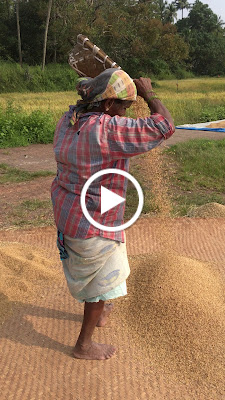
But then one day, I thought that next year it will not be the same thing. I couldn’t lose the moments that fascinated me today, waiting for a good time to make note of them. Driving past, one Saturday afternoon, when there wasn’t such a crush of things to tend to, I decided that work or no work, it was too picturesque, for me to pass up this moment and wait another year to document. There were, mercifully, few cars on that stretch. Inspired to stop, by the visual of a weather-beaten woman winnowing, I parked my white i20 on the side and walked up to watch her lift the rice up in her wicker basket and sift it down, letting the wind waft away the chaff. I paused to record and listen to the soft rustle, a warm and comforting nuance, of rice grains falling: caressed by the soft hush of them kissing each other as they piled up on the ground. This was augmented with something the winnower seemed to be telling me but regrettably I haven’t yet learned any Konkani, so missed out on what she said.

I took my photos and drove on, stopping to chat with a Saligoan landowner who was selling his grain. I rolled down my window. He thought I wanted to buy some, so informs me that he has enlisted for government support, and was selling the rice at ₹21 per Kg, where otherwise the price would be ₹25 per Kg. I asked if all the rice was for sale or if he kept some too, when he said both and that by boiling the rice, it keeps well for a year. A useful bit of information, for it was something I didn’t know. The patch of land, I found him standing by, didn’t seem to have much grain. I asked how much rice lay before us, to be told it was about five quintals. I wondered if that would be enough for personal consumption and for sale, when sensing my question, he gestured to the land around, informing that he had many more fields.
And that is what made me realise that probably the lady of the umbrella dance also owned numerous plots of land. Since I had found her sitting in and around fields on the same stretch of fields, she could also have been his mother. I didn’t ask, but felt that I shouldn’t have entertained those earlier doubts, because who’d imagine hired help going through such effort and such totally bizarre attempts at shooing off prey. The crazy stuff is what we rise to, when we care enough, isn’t it?

As I was wrapping up this story, the housekeeping staff walked in to clean my apartment with Saraswati leading the way. She is a young graduate, newly married, from neighbouring Karnataka and if she happens to find me in the apartment, she quizzes me about what I am doing - always curious and in awe of my creative endeavours. This time around, she insisted on knowing the story I was writing. As I narrated the dress-clad woman’s antics, telling her how I wondered if she owned the land or was hired to do these tricks, when she said with the unstoppable authority of youth : “ Maedum, paeesa dene pe bhi nahin hone ko hota, kitna sharm aata na?, voh Catholic Aunty ka khud ka land hoga, bilkul hoga, koi shak nahin!”
Well, that certainly put it unarguably into the same perspective I had arrived at. The crazy stuff is what we do when we are involved with and have a vested interest in the resultant outcome, anyone else would feel too embarrassed to do the same things. The ploughing and harvesting of seeds that we sow through life, are rife with many awkward moments that we’d probably be too embarrassed to own up to and face ourselves for, on hindsight. As would the woman, if I had taken a video, of her at work, and shown it to her. Would she.....,I know that in her shoes, I would. And probably never work with such uninhibited ardour and abandon again!


