Showing posts with label meditations. Show all posts

Wednesday, 27 July 2016

Discovering the Extraordinary in an Ordinary Day


Housekeeping has become the focus of my life, for a while now. Its taken precedence over almost everything else. I did manage to make it to Couture Week and also do research and write a couple of articles. And I'm currently engrossed in discovering the story of Muslin, whenever I get time after the housekeeping chores. But work isn't happening in quite the same way as I've been used to. The mundane act of drinking tea, which inspired an enormous body of textile art, has now been overtaken by much more mundane tasks necessary for everyday living. The ordinary is demanding my attention.  I am finding creative ways to tackle this facet of being, but not without my fair share of griping and bitching, yelling and crying too. But it's got to be done, there's no-one else, so I've got to do it and relegate needle and thread to another life-time, it seems.
 
What I find the hardest to handle, is the staff. The thing I've discovered is that no-one listens. If you give instructions, the attention is clearly someplace else and things never get done as specified, which is soooo annoying!  It’s not really a workable solution, but I now insist they look at me while I speak and then make them repeat my instructions back to me. In doing so, whenever I remember to do it this way, I have found some reprieve. I'm reassured that I've been understood and black will be black and white, white.  I've been used to writing down what needed doing but at this point none of my staff are literate and it is getting very difficult. But, having said that, there are also some fun moments in the midst of all the frustration. 
 
This evening, I needed to get some packing tape. I was expecting someone to come see my work, which had recently returned from my exhibition in Kolkata. I would need the tape to repack the art-works, once I had shown them. I'm not a frequent visitor to the local market, so I wasn't sure where to go to get this. There is a Vyapar Kendra close by but it  is very strangely built and on the odd occasion that I have gone and discovered a shop that's useful, I've not been able to locate it on my next trip. And, I almost always get lost on my way out. Not wanting to go on a wild goose chase when my energy is not quite up to speed, I looked up Google for a shop I'd been to with a neighbour and knew that they stocked stationery items. There was a number to call, which I did. Thankfully, they had what I needed and kindly said they'd send someone to the outer gate once I got to Palam Vyapar Kendra. My neck and shoulder had been playing up and daily physio was helping but I was advised to cut down the swimming. I hadn't felt like swimming this evening, in any case, so I decided to cycle to PVK, as the market is commonly called. It's about a 12 - 15 minute walk, so it didn't take me any time at all cycling there.
 
When I called the shop, as planned, the call wasn't answered. I tried four times and eventually got a female voice who said it was the wrong number. Strange, I thought abhi toh meri baat issi number se toh hui thi. I walked into the only shop I know in this market and asked for directions for Memory Point, the stationery store. They very kindly sent someone to escort me there, which was gratifying.
 
I got my tape, clarified the phone conundrum, got their card for future reference and was heading out, when I spied a fruit and veg store. I didn't have my wallet with me, but there was some change left over from paying for the tape. It was enough to get 6 peaches, 1 kg Mussambi's for juice, a large beetroot to make a cold soup, some inspiringly aromatic pudina, ½  Kg pumpkin to make a delicious roast pumpkin salad with, some kundru for lunch tomorrow and drumsticks for sambhar. I just love drumsticks and the rest of the sambhar is incidental. I picked up an ample bunch, paid my bill and headed out with my bhajji shopping to my cycle which was parked outside Suraj Store where I generally buy the electronic stuff I need. I stuffed up the painted pink basket that my cycle has upfront, it was packed tight. The long drumsticks sticking out quite awkwardly.
As I hopped on the seat and began to pedal, I giggled to myself, imaging what I probably looked like to passersby. I mean it isn't exactly your everyday sight is it, to see a curly grey-haired  woman in culottes, cycling down the streets of Gurgaon, her pink cycle-basket stuffed to the brim with veggies, is it?
 
It was dark but even though the white culottes must have been clearly visible, sleepy Palam Vihar didn't seem to blink an eye. Or if they did, I didn't notice.
 
I've been feeling quite frustrated at having to give so much attention to things I hadn't done for over a decade. In order to function with some measure of equanimity, I've been telling myself : " I love housekeeping!" Repeating it over and over, allowing myself to feel a sense of pleasure doing the chores as I meditate each morning. Sometimes, like this evening, I surprise myself by doing things I haven't done for decades - and bhajji shopping is one such, where I've either ordered over the phone since the 1990's or someone's been around to do it. Today, I picked each peach myself, making sure they were just right to eat. I savoured the aroma of the mint leaves as I lifted a bunch off the shelf and realised that in telling oneself that you enjoy doing things you don't relish in the normal course of living, and you do end up doing just that! I had enjoyed the veggie shopping and loved cycling back home with my basket, full to the brim.
 
An ordinary became extraordinary, not just because I've not done bhajji shopping for a while and thus savoured it. But for being reminded just how one can work successfully towards mastering the mind in small but significant ways. It was this which made an otherwise uneventful, ordinary day, into a memorable one.

Monday, 13 July 2015

How Do You Like Your Tea?


I haven’t been enjoying my morning cuppa for a while and it’s been bothersome because I like the idea of drinking tea in the morning. Coffee is too strong and something I indulge in only when I am really tired and need to keep going. Don’t get me wrong, I love the taste and aroma of coffee but it just wires me up too much. But while tea does add a dash of caffeine to my lazy morning start, it’s not a jolt; it enables a steady, watchful pace into the day.

I have been experimenting with all kinds of teas, mixing up unlikely leaves to get something, a new taste, infuse some flavour into a jaded palette. And, over the last couple of days, I have realised that I just want a sweeter brew. I want it milky and sweet and this is something new for me. For years now, I have kept both the sugar [well, I take sugar-free instead] and milk to an absolute minimum, to relish the flavour of the leaf – the essence of the tea –rather than bury it with the add-ons.

May be it’s just a phase. Maybe it’s the heat or maybe I am just feeling a bit lost in the mire of doing. I don’t really know at this point what is causing this change from the subtle to the robust taste of things, but it is something I have noticed and am curious about.

It’s taking me back into the watchful mode, making me look at my days, my feelings and thoughts in an active way which, with all that doing, all that work, that doesn’t really do much other than exhaust me and leave little room for reflection, has been enervating indeed. I love looking at life unfold. I like to see how miracles occur in the day, how my thoughts create or how things unfolding around me create my day – its events – not necessarily stuff that delights, but bringing forth anger and irritation and more. I have realised that it isn’t so much about being busy as it is about not being able to deal with the stuff inside, the emotional ups and downs through engaging with people and not getting the desired response, or having to deal with their energy levels which could well be at odds with mine. And over the past couple of weeks of some quieter moments, I have realised it mostly comes about because of judging the way that I feel.


I was coming out of the pool the other day and a young man of thirty-something, who had been playing with his wife and kids as I swam my 50 lengths in under 40 minutes [it’s a small pool so no more than 825 metres], commented on my stamina. He was a virtual stranger and I was taken aback and, in my awkwardness, didn’t exactly take the compliment with enough grace. And that made me start the old babble inside the head. I stopped myself saying, it was okay to have been awkward, I was taken by surprise and focused upon getting out and getting back to work, I hadn’t expected it. And it was unusual one, don’t you think? 

A few moments later, I did something else that made me feel guilty – even as I was asking something of someone, knowing full well why I was doing it. And it made me realise just how much one does tend to judge oneself for things.  Where does this judgement come from? Who has decided what is the right way and the wrong way to do things and live life?

I have just spent a whole twenty days tuning into the Hay House online summit and heard over thirty-five speakers over three weeks. It was very inspiring. I learned many things and certain things that I had experienced were given definitions and more in the same vein. But what I noted especially about the whole summit was that everyone spoke about different things. Some were scientists who had learned about the spiritual dimension through their work and some were just people who had been abused as children and found a way out. Others were people who had evolved deep philosophies for their own life which they shared as courses and books and stuff. What interested me most were the stories that everyone had to tell, where the most miserable of circumstances and enormous pain was not something that they allowed themselves to be stuck in, but through which they have found their own philosophy and techniques to live a better and happier life.  Often the ideas of one could seem to be in conflict with other speakers, but this is what made it a great lesson in non-judgement. It was so apparent listening to diverse voices from all parts of the world, from various disciplines of learning that anything and everything leads to a deeper understanding of the spirit of being. And that there really is no other path for everyone other than what your life has charted. It’s about the proverbial Mahabharata of our personal lives, not something that is understood or arrived at by renouncing the world. What we need to renounce is judgement that says this is right and this is wrong.

I was sharing this with a friend, who then asked but what would you say for a man who has just killed someone in road rage? We had been discussing a mutual friend’s sudden illness when the conversation turned to this as I was trying to explain the mind-body connection. I was telling her how illness is essentially caused by suppressing our feelings and not expressing them, for various reasons. She said would you condone the killer, would you say that it was not wrong? I didn’t have to think this one through because for me it was the same thing – the sick person and the one who carried so much rage inside of him were coming from similar spaces of suppressing their feelings, of not finding the courage to express. In effect, probably judging themselves for feeling whatever it was because someone, somewhere, had dinned it into their heads to either get over it and let go, or such like. Something we often do, when we cannot listen to another’s pain.

I also noted that some of the summit speakers impacted my mind more than others. I tried various techniques, choosing a few that fitted in well with the way that I liked to meditate and heal the chakras, etc. But, above all, what I enjoyed listening to was the way everyone had positive things to say about experiences that could debilitate the best of us into not feeling good enough, into not wanting to get up and face the day, into despair and depression. Non-judgement didn’t come from sitting and saying why did I say this or that, or why did I think this or that and feeling bad about it.  It came from an acceptance that what they felt and experienced was what they knew and that their experiences taught them. Once we become aware, things do change. Life was their teacher and this inference was uplifting. 


My need for a more robust flavour in life, for sweeter and milkier tea rather than the subtle was just something that I needed to allow to come into being, for it to reveal the change in the mental patterns and resultant body chemistry. Maybe I was more willing to experience life in a more robust way. Or, maybe I needed a more robust flavour to bring me back into the fray....whatever it was, who’s judging, right?

Friday, 11 July 2014

I Walk The Path of Water and Skies [Guest Post by Seema Kohli]


I was introduced to the Shakti as Goddess, or better still, she introduced me to herself when I was very young. As a family we were believers of Advaita Vedic order (monistic order of one Supreme Consciousness, with no idol worship) with secular leanings - extremely progressive in our approach imbibing, the best of all faiths.  But, at the same time there was no idol worship. 

Somewhere in early 1970’s I visited Haridwar along with my parents and bought the idols of all the three gods Brahma (creator), Vishnu (purveyor) and Mahesh (destroyer) with the Goddesses Durga, Lakshmi and a small Deepam. I felt a strange affinity with these images. So much so, that on my own, I started a small ritual of lighting the lamp; on some days I also bathed these Gods and Goddesses.  I had even borrowed a small book of basic chants and aarti of the Goddess Durga.  Thus, I developed a relationship without any communication or understanding. I was very young, maybe 10 or 11 years old.

While growing up, the more I started to hear about her, I wanted to read about her. And the more I read about her, the mystery deepened and I wanted to understand her better. It was as if someone was holding my hand compulsively and I did not want to leave that. I just wanted to wander away with her to somewhere mysterious. There was no fear; I felt protected all along.

So here started my journey to decode this basic flow of energy, the energy that makes this whole world go around. Everything is moving and is synchronized even if we think it is not, everything rejuvenating, positively recycled; in spite of the apparent death or stoppage everything comes around anew, afresh. 

Chaunsath Yogini at Mitauli, nr Gwalior, Madhya Pradesh

I wanted to understand her (the goddess) more closely and started reading, exploring and experimenting by visiting various sites of this energy, connecting to its vortex. Is it not apparent everywhere? Is it not the main source of life, breath and continuation? So then why these special sites….. I was and am still intrigued. Did I want to be comforted by the domesticated feeling of going Home? A physical place maybe, which we created to perform rituals to feel her physical presence - Temples. I visited various Shakti peeth in Himachal, Punjab Uttar Pradesh, Uttar Kashi and Bengal, in order to understand this ethereal power which they say, makes this universe spin.

Beraghat, Jabalpur, Chattisgarh
I began visiting various Yogini sites - where no rituals were taking place and also some, where rituals were still being conducted. The concept of ritual is extremely important to me as this repetitive exercise or habit helps discipline the mind. It also helps us on the path to self realisation. But, to me, these various rituals should be understood and self-created according to our perception of energy. Along with this, a study of scriptures can be used as tools.

The first Yogini site I visited was in Beraghat, Jabalpur, in 2005. I knew I had to come back here again to understand my relationship, the overwhelming power of theses circular spaces, where by just going around the circumference my own vortex seemed to align with the energy forces prevalent there. These sites are extremely calming and balance your inner space. The sense of rhythm and movement along with the deep set faces of the Yoginis is intriguing. It is one of the largest Yogini sites which has 81 Yoginis instead of the usual 64. Though there is fencing around the idols we can still get a clear view of the Yoginis. What I understand about the Shiva Temple at Bheraghat is that it was installed to “remove the flow of the negative power” of the Yoginis. The inscriptions speak about a queen mother that patronized the construction of this ‘traditional temple’ after her sons recovered from an illness.   Probably, she believed that those female creatures had negative powers. Among the many stories I have heard, some legends depict the Yoginis as malevolent creatures that could take away children, transform men into animals, etc. Some other legends talk about the benevolent qualities of the Yoginis such as teaching their followers to realize the divine enshrined within the body. 
Behraghat, Jabalpur, Chattishgarh


In most of these sites the sculptures are defaced - as is the case in Beraghat. Maybe as humans we want to check out our power by defacing and demolishing these sites of faith and reverence. Mind you, this kind of showing of power is not there only in one community but as humans on the whole.

Though I had been working on the idea of feminine energies such as Hiranyagarbha, Saptamatrikas, Dusmahavidyas and Ashtanayikas for a while, a more full-fledged plunge into the visual representation of Yogini came only after I visited these spaces in 2012 and aligned my mind, body and soul to them. For me now, the Yoginis not only exist in a mere mystical, visual form but also in a physical form. 


 All these sites have a sense of peace and calm about them. They were all built in secluded places,  hidden from public gaze. It is believed practitioners used to go to these secluded sites to perform various rituals and conduct experiments on themselves - their bodies in order to achieve self-realization. In the process they acquired certain “siddhis” where they were depicted as a certain form of a bird, reptile animal, human or endogenous form having a human body.  A power to construct, reconstruct; destroy and reconstruct the material world around them.  They could perhaps walk on water or wonder off into the skies with or without their bodies!

Chausanth Yogini at Ranipur, Jharial, Odisha
The Chausath Yogini at Ranipur Jharial is on the top of a hill isolated from the village settlements nearby. The main Yogini temple shares remarkable topographical similarities with other Yogini sites like the ones at Mitauli and Bhedaghat in Madhya Pradesh. The rocky landscape, reminds me of intergalactic space and the presence of a water body nearby seems to present an ideal setting for female mendicants to meditate and practice austerities. The circular hypaethral form of the Yogini temples is said to allow the circulation of divine cosmic energy that inhabits these sites. This idea of the “circulation of divine energy” also exists in Sufism (with the circular dance of whirling dervishes) as well as in shamanic practices. 

Bhairava at Chausanth Yogini, Ranipur

Yogini, Ranipur, Odisha
I must mention an incident that took place here while we were attuning ourselves to the space. A Brahmin priest from the nearby temple came and touched the feet of Bhairava but left without acknowledging the presence of Yoginis. Some moments later, a family from the village came - mother, son and daughter-in-law, along with a new born. With the mother leading the way, they went around the Yoginis . And they did not acknowledge the Bhairava. I asked the mother  about it and she replied saying it was each one to their own  - “For me she does everything, Pandit ki Pandit jaane”. 

At the site, I also saw the ancient remains of a once existing “maze” – a series of concentric circles - a concept that is shared by numerous belief systems such as Sufism, Christianity and Buddhism. This “maze” allows entry of two people which is not just a physical encounter but also a spiritual union with the Higher Form. 

Chaunsath Yogini at Ranipur, Jharial, Odisha
This Tantric experimentation at these sites was not restricted only to the personal realisation of the eternal self, but also to gain spiritual power that would then enable these practitioners to help others on the path. Many Kings would install idols of these female goddess, especially Saptamatrikas, to attain fierce powers to win over enemies, which, however, is not a prescribed use of this divine energy. (Ellora Temples, Maharastra)

Today, there is a move to reinstate the mysterious science of the Yogini cult. In a pedagogical sense, Yoginis were a very important thought system and practiced forms of Tantric worship that centred on the perfection of the body to achieve perfection of the soul. Even in the fiercest form, we can see the serenity and rejoicing in their posture. The presence of Bhairava is indicative of a balance of the male and female energy within them.

Lingam at Mitauli nr Gwalior

Yoni, Naresar, Madhya Pradesh
The site of Naresar, near Gwalior, Madhya Pradesh, is interesting for a unique yoni sculpture which houses 15 smaller yonis within itself; this fascinated me. The Archaeological Survey of India is trying to restore the ancient temple complex at Naresar to its former glory as a secluded spot of meditative worship. There are several carved temple blocks, which they are trying to put together but sadly without much thought. The identity of a certain God or Goddess is confused by reconstructing their temples, by installing different vahanas for different deities.

During one of these visits I went to Chaunsath Yogini at Mitauli, near Gwalior, Madhya Pradesh, the original sixty-four Yoginis have now been replaced by sixty-four cement lingams without any pedestals or yonis from which the lingam traditionally arises. The yogini idols that were once placed within the temple niches have been stolen, damaged or transferred to the Gwalior Museum nearby. Under the given circumstances, filling the empty niches with cement lingams is not only a historical error and a false representation of the cultural practices of the past but also points to a deep neglect of the feminine form. It is clearly indicative of the state of woman in today’s time. In spite of the up- gradation of woman in social order through education, reservations and apparent political equality, replacing the lost idols with smaller replicas of Yogini sculptures, would have been a more thoughtful gesture. For me, this is a “rape of the sacred site.” (Stella DuPuis 'The Yogini Temples of India' Pilgrims Publishing, Varanasi, 2008, pg 67.) 

Chaunsath Yogini,Mitauli, nr Gwalior, Madhya Pradesh
Here too while walking through the village, I asked a little girl where the Yogini is?  She replied unabashedly “Neeche, rasoi main” (Downstairs, (at home) in the kitchen).  For me too, a Yogini symbolizes the nurturing aspect of woman, creating not only spiritual bliss but also material contentment.

Chaunsath Yogini at Mitauli, MP
Panchvarahi is located about 180km from Bhubneshwar. Varahi as Yogini, is one of the Saptmatrika’s and the consort and power of Varaha, which is one of the incarnations of Vishnu, the purveyor.  We drove from Bhubneshwar and then walked, took a boat then walked again and were lucky enough to hitch a ride till the site of the temple through remote villages, paddy fields and sea drenched barren lands. The site is absolutely magnificent with an old small temple on the virgin beaches of Bay of Bengal. The sea is extremely wild here with violent, roaring and high waves that snatch the earth beneath your feet, urging you to join the sea. According to hearsay about eight centuries ago there was a violent storm which plunged the entire kingdom under water, except this small piece of land where the present day community of Savana tribes stays. So, the king installed the idols of Varahis and requested the women of this tribe to conduct all the rituals of the temple. It was felt that since she is a female deity, women would take best care of her. Even till date, one of the twenty surviving families of this Savana tribe moves into the premises to conduct the rituals and look after their beloved Varahais, in rotation, every month. A woman priest conducts all the rituals and only she is allowed in sanctum sanctorum. It’s a rare site to see this female tradition upheld today, at the fringe of the male Brahamanical order.

Panchvarahi
What really excites me about these places is the parallel in these Tantric practices and other extinct faiths such as Sufism, Buddhism or Hinduism. At a time, maybe, when the concept of codified religion did not exist or was not as compartmentalized as today, personal identities and practices were much more fluid; where a constant borrowing and exchange of ideas took place. I feel that, today, when the urge to answer “Who am I’ or “Who are we?” and “Where do we come from?” is so strongly rooted in our religious identity, we tend to compartmentalize practices and beliefs into regimented and narrow frameworks which, according to me, is a practice much in vain.


My journey does not end there, it continues in the quest of trying to find the end of that cycle. Somewhere deep inside me I do know it does not exist but the journey continues without despair.

Seema Kohli is a painter. She lives and works in New Delhi.

Tuesday, 10 September 2013

I Am The Music I Could Never Be - Guest Post by Neeta Gupta


 Over the last few years I suffered a series of accidents that severely affected my cervical vertebrae. The only thing that helped was physiotherapy. And it seemed as if I would have to live with this debilitating pain for the rest of my life. I was also reading this wonderful book at the time, Anything Can Be Healed by Martin Brofman and his personal experience in healing was amazing. He uses something called “The Body Mirror System”. The system is based on the idea that the parts of your body that suffer reflect the parts of your life that are dysfunctional; that there is tension in your consciousness which causes these symptoms. To release a symptom, one has to release the stress that caused the symptom, and bring harmony to the parts of your life that have been, well, out of balance. 

When I looked within, I found an answer.

Now consider the fact that the cervical area is controlled by the Vishudha Chakra [i]. According to Brofman, “Metaphysically, this chakra is related to creativity manifesting in the physical world and the fulfillment of one's goals….This chakra controls the aspects of expressing and receiving. Expressing can be in the form of communicating what one wants and what one feels, or it can be an artistic expression, [singing, for instance] basically using a form for expressing and bringing to the outside what is within…” I realized that there was something I had been in denial about for over a decade. Of course there was disharmony.


There was a time when I was obsessed with classical music. There was a time when this music was like a secret language to me. It was the language that I used to express my thoughts. Not only was I training under a guru, I had also enrolled at a reputed music school to learn classical music theory. For me at the time, the raga was supreme: the be all and end all of my existence.

The word raga is derived from its root, ‘ranja’, which means ‘to colour’ or ‘to tinge’. And hence, ‘that by which all people are coloured or elated, that which gives pleasure to all, is raga.’

 A raga is pure aesthetics. It is the basic melody or phraseology of traditional Indian Classical Music. In the semantics of music, a particular arrangement of notes ‘colours’ or affects the emotional core of the mind. Every raga is composed of a set of principal notes which when employed in varying degrees, in a prescribed order - stressing on some, while bypassing others - achieves a particular shade or mood, building the character or personality of the raga. But a raga belongs to a realm larger than the notes it contains. The notes are just a key. A performance is not just a blending of swaras[ii] sequentially, and randomly achieving an effect. A performance actually deepens that ‘colour’ or mood in the listener.
 

Alternately, a raga has also been described as the language of the soul. This theory probably comes closest to explaining my own relationship with music. Each raga expresses itself under the pressure of a certain emotion. For instance, under the stress of sorrow, one might automatically render a particular raga; similarly we might sing a completely different tune on the wings of joy, irrespective of the time of the day. Imagine what songs we might sing in a storm of passion …imagine what joy we can communicate in union! A raga is richer than any musical outline of it could ever hope to describe. Any mental picture of it is limiting.

Coming back to my story, life and work took over and this music, which was so important to me, got relegated to being something I indulged in over the weekend, and then to something I went back to once a month or so--in a burst of enthusiasm, until finally I covered my tanpuras[iii] in velvet-lined casing about twelve years ago and there they remained, un-strummed.

By denying music, I had been denying myself my secret language, my self-expression.


And thus began a morning ritual of garam masala chai and riyaaz[iv]. Free of any formal structure or instruments. No rigours of taal[v]. No bandish[vi] of words. In this moment I dwell in the sphere of the swara. I dissolve in the deep concentric circles that surround each note, and as I go deeper and deeper in it, my only aim is to reach the centre—that ethereal space where my personal deity exists. It is a sacred journey I undertake each day. And every day I chance upon a different tune, thrown up by the vibrations and moods around me: mellow and sombre sometimes; playful and wanton at other times.

And unknowingly, a raga is born in that moment. And although it is born to me and of me in that moment, it has existed before. It’s just that I had banished it from my conscious memory but it had continued to exist in my sub-conscious. And slowly as I flesh out its texture, it takes on a life of its own. A known form - not bound by any bandish and taal, more like a gypsy tune that refuses to be bound by words, or ever be repeated. And for a few moments in that sacred space, this melody sings its song into my ear, and just as quickly flits away. Before I can catch it, before I can note it down, and later it is hard to recall. But for that brief moment I am captured by that sound. I am saturated with it, until I feel I might burst.
 
When I get up from this almost trance-like state, I feel as if I have been recharged by a high-tension main power line in space. And simultaneously from the very core of the earth this energy has both exhausted and replenished every cell in my body. I am in harmony.

And through the rest of the day I strum an imaginary tanpura in my head and as its music infuses my soul, I know that I may not be fully repaired but I feel strong and free.


Neeta Gupta has been working towards creating publishing connectivity's across different languages and cultures
www.yatrabooks.com
http://twitter.com/yatrabooks
 
 Link to artists :


[i] Vishuddha is positioned at the neck region, near the spine, with its Kshetram or superficial activation point in the pit of the throat. Hence it is also known as the throat chakra
[ii] The seven notes of the scale in Indian music
[iii] A long-necked stringed instrument used in Indian music to create a harmonic resonance on the basic note or keynote.
[iv] to practice
[v] literally a "clap"; used in the sense of rhythm
[vi] A Bandish provides the literature element in the music, for standard structured singing; another connotation of Bandish is ‘binding’.

Friday, 21 June 2013

Living Without The Glass Tea-Pot


A few weeks ago Mahipal broke my Borosil, glass tea-pot. I was upset, but took out an old stoneware one from the cupboard and have been using that since. I have not had the time to get another glass one, nor really felt like it. I thought what the heck; it’s just a tea-pot, what I relish is the tea and who cares what the tea pot looks like, ha!
 
And that is the mistake I made. It does matter how you see the tea being brewed. Not just because it makes a better cup of tea, but it’s like living without being able to watch yourself, see how your thoughts create life and its circumstances; witnessing your life unfold. When one is busy with the world, it does seem tedious to live this way. Yet, when I am less restless - in that relative quietude, at ease with myself, I tabulate the way my mind works. I watch questions being answered effortlessly through intuitive leaps and have also observed people do things even before I have asked them. It’s fascinating.  In that space, conversations are like someone telling me what I am feeling, even though they are expressing their own - like looking into a thought mirror. 

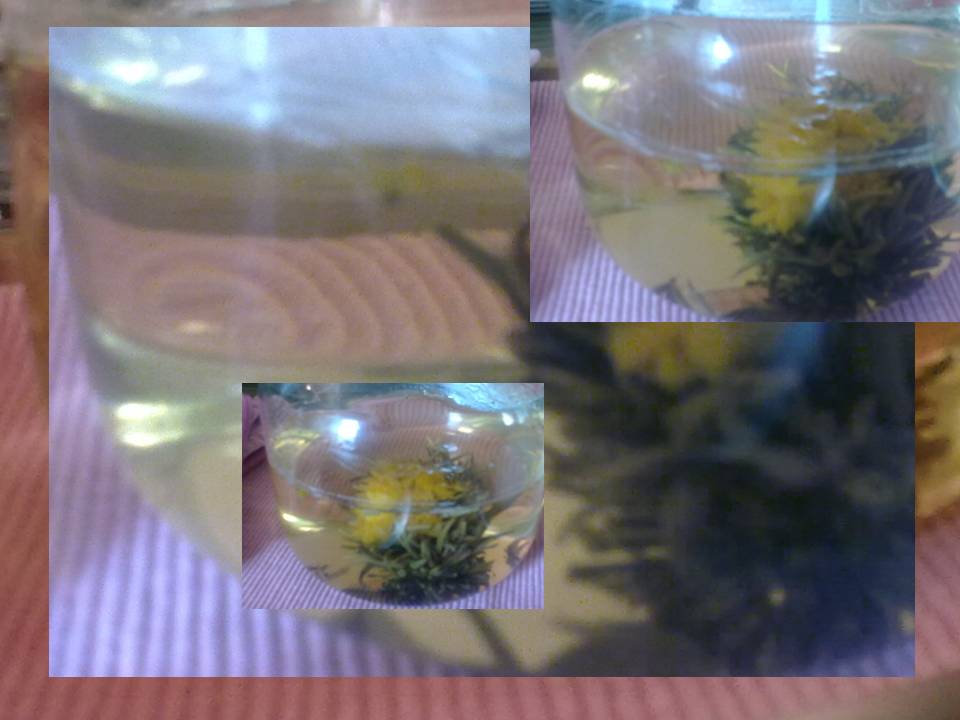
In some ways, it’s not unlike observing tea brewing in a glass tea-pot where leaves create patterns and the colour of the tray cloth also becomes part of the design. The way you look determines what you see.  Some of the photographs that I have taken hardly look like tea leaves at all. This may have something to do with the fact that in trying to get really close up with my ‘point and shoot’ Olympus camera, the image is blurred. Out of focus or not, they work well for me because it is not really watching tea brew that enchants – but looking at the scene, as if watching the inner landscape unfold. And in these photos, with the turquoise blue or pink ribbed handloom tray-cloth as a backdrop, the images seem almost ethereal.
 
 
 In the ceramic pot everything is eclipsed from the eye.  If I get absorbed in something else, the tea becomes too dark and bitter.  But when I can see through clear glass I enjoy watching the leaves swirling as they open up in the heated water, gradually infusing it with their hue and flavour, waiting till it’s just right before I take a sip. Sit back, my head leaning against the wall or chair, relishing the warm liquid coursing through me; cup nestled cosily between my palms as I savour the flavour of the moment. How often has life been this good, when you can sit back and reflect upon things achieved effortlessly, when everything happened exactly as you had imagined it, or better? 
 
I cannot see clearly enough inside the stoneware pot because its colour is similar to that of lightly brewed Darjeeling tea and can be deceptive. So I pour out a bit, take a sip and this has to be done at least two or three times before I am satisfied. It’s a plodding affair: remove the tea-cosy, open the lid and look inside. Does it look okay? Prod it a bit, stir it with the spoon; is it done yet? And I often equate this process with arguments or long dialogues we have with each other to ascertain what the other is thinking and where we stand in respect of them. And especially so, when you cannot get your point across, time is short and work needs to get done. But when one has the luxury of clarity: living with awareness and ease, watching thoughts unfold, heeding our own feelings, this dialogue is superfluous. Opportunities present themselves almost as if unbidden, yet are exactly what I needed and everyone seems to understand precisely what I want without elaborate discussions. Its bliss; an ideal state, but alas, nothing is permanent, is it?

When I embarked on this project on tea, observing the marks left behind in the tea cup I found them evocative of those feelings and thoughts that linger in embarrassment, guilt and pain. At that point, I would not have been able to acknowledge that I had been careless in my approach to life. But, as the creative process unfolded, a lot of things became clearer because it provided an objective perspective.

In the beginning, I took a lot of photos as I made my pot of tea each day and some were printed digitally onto fabric. For a couple of years this was how I contemplated the stains, until one day I decide to create actual tea stains onto fabric. And it was in the process of watching how I created the stains that I started making a correlation with being careless with my life - of doing things, that were punishing just because I wanted to achieve those ‘marks’ as it were.

In order to stain the fabric, I made tea and drank it. The used leaves or tea bags were then placed ad hoc on some muslin fabric. Hot water was poured over them and then left for as long as I felt like it.  This fabric and tea leaves were later placed in a baking tray, inside a hot oven. Sometimes I would forget about it altogether until I could smell the fabric burning. I found the dark burn marks most interesting and further ‘cooked’ this fabric with a fresh bunch of used tea leaves in the microwave oven. I punished the fabric as much as I dared. I loved the marks that emerged. I felt a certain empathy with them. They were evocative of what I had endured through life, what I felt like: burned, torn, stained and so fragile that some of the time all I seemed capable of was trying to make sense of what my life was and why it had turned out this way.

 I created these stains through sheer, utter carelessness. I didn't care what happened to the fabric. And in many ways I have realized that I didn’t really care what happened to me through life. I thought I did, but as life unfolded and I grappled with the pain of my carelessness, I realized just how uncaring I had been in terms of trying to understand myself. For some reason I had not thought much of what I wanted to be or do and why, but had been driven by the spoken or unspoken dictate of what was expected of me. This was not necessarily family pressure alone, but social constraints and expectations that brought into play cultural and gender conditioning and more besides. I am not alone in this; many of us are driven by these pressures until we begin to understand that it does not have to be this way. Being yourself, being different among your peers is a challenge that we are not necessarily geared to take on, which makes it harder to be what you are. 

When we accept that something we are embarking upon is challenging we prepare for it. Recently, I read an article on aerialist Nick Wallenda's plan to walk across the Grand Canyon in Colorado, USA, on a 2 inch wire, 1500 feet above ground, across a 1400 feet gorge, without a harness. He narrated the elaborate preparations he and his team had made for this event and I thought to myself: what if one approached living with the same attitude? We prepare for exams and job interviews and things one may do in the public domain because we know we are being watched, but when it comes to the personal sphere, these challenges – of relationships, parenthood and those of daily living, are left to pure chance - much like the stains I created on the fabric.

For the last 20 years, I have spent a lot of time watching myself think and focusing upon my feelings. It felt odd at first and I would often think that I was being self-indulgent, wondering how I would achieve all that I wanted to in the span of one life, if I spent so much time this way. However, when I try and push the pace, I succumb to the stress of doing rather than being and it feels like brewing tea inside the dense stoneware pot. I have to keep looking, mostly looking back on the day, analyzing things and arriving at all manner of insecure conclusions. Drinking this bitter tea only adds to the stress.
Mahipal breaking the old one has been fortuitous in reminding me of the tedium of life, when one doesn’t allow enough time to be effortlessly tuned into oneself. Despite know this, I do sometimes get caught up in the whirlwind of living. This also has its place in life but, I really must get myself another glass-tea-pot and start looking again. It is not nearly as much fun living without it.


for more about the stains: http://gopikanathstitchjournal.blogspot.com