A few weeks ago Mahipal broke my Borosil, glass tea-pot. I was
upset, but took out an old stoneware one from the cupboard and have been using
that since. I have not had the time to get another glass one, nor really felt
like it. I thought what the heck; it’s just a tea-pot, what I relish is the tea
and who cares what the tea pot looks like, ha!
 And that is the mistake I made. It does matter how you see the tea
being brewed. Not just because it makes a better cup of tea, but it’s like
living without being able to watch yourself, see how your thoughts create life
and its circumstances; witnessing your life unfold. When one is busy with the
world, it does seem tedious to live this way. Yet, when I am less restless - in
that relative quietude, at ease with myself, I tabulate the way my mind works.
I watch questions being answered effortlessly through intuitive leaps and have also
observed people do things even before I have asked them. It’s fascinating. In that space, conversations are like someone
telling me what I am feeling, even though they are expressing their own - like
looking into a thought mirror.

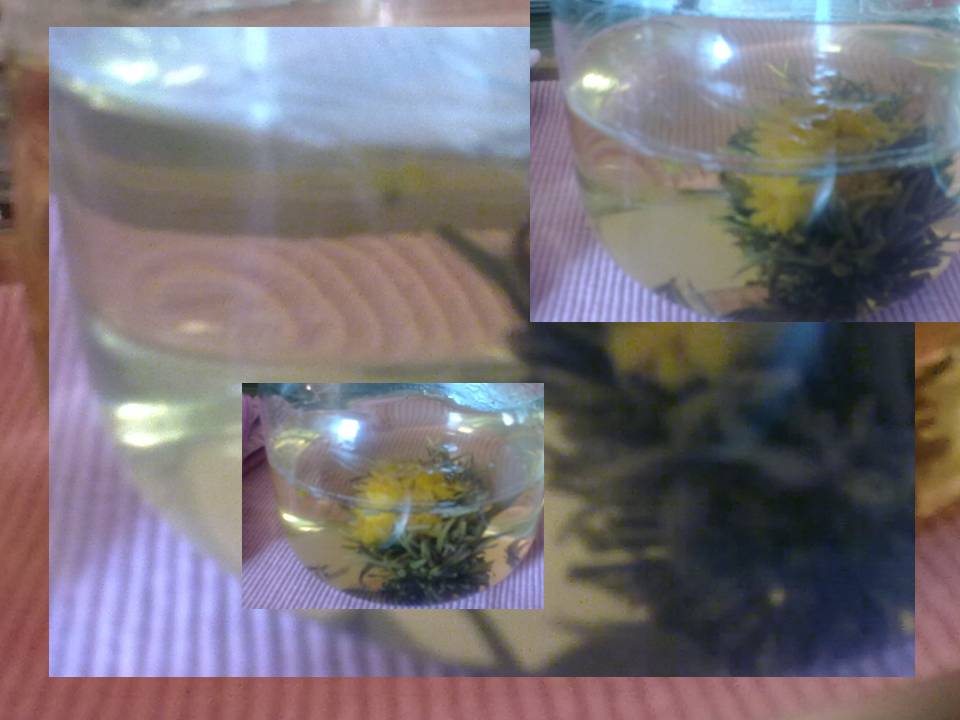
In some ways, it’s not unlike observing tea brewing in a glass tea-pot
where leaves create patterns and the colour of the tray cloth also becomes part
of the design. The way you look determines what you see. Some of the photographs that I have taken
hardly look like tea leaves at all. This may have something to do with the fact
that in trying to get really close up with my ‘point and shoot’ Olympus camera,
the image is blurred. Out of focus or not, they work well for me because it is
not really watching tea brew that enchants – but looking at the scene, as if watching
the inner landscape unfold. And in these photos, with the turquoise blue or
pink ribbed handloom tray-cloth as a backdrop, the images seem almost ethereal.
In the ceramic pot
everything is eclipsed from the eye. If
I get absorbed in something else, the tea becomes too dark and bitter. But when I can see through clear glass I enjoy
watching the leaves swirling as they open up in the heated water, gradually
infusing it with their hue and flavour, waiting till it’s just right before I take
a sip. Sit back, my head leaning against the wall or chair, relishing the warm
liquid coursing through me; cup nestled cosily between my palms as I savour the
flavour of the moment. How often has life been this good, when you can sit back
and reflect upon things achieved effortlessly, when everything happened exactly
as you had imagined it, or better?

I cannot see clearly enough inside the stoneware pot because its
colour is similar to that of lightly brewed Darjeeling tea and can be
deceptive. So I pour out a bit, take a sip and this has to be done at least two
or three times before I am satisfied. It’s a plodding affair: remove the
tea-cosy, open the lid and look inside. Does it look okay? Prod it a bit, stir
it with the spoon; is it done yet? And I often equate this process with arguments
or long dialogues we have with each other to ascertain what the other is
thinking and where we stand in respect of them. And especially so, when you
cannot get your point across, time is short and work needs to get done. But
when one has the luxury of clarity: living with awareness and ease, watching
thoughts unfold, heeding our own feelings, this dialogue is superfluous.
Opportunities present themselves almost as if unbidden, yet are exactly what I
needed and everyone seems to understand precisely what I want without elaborate
discussions. Its bliss; an ideal state, but alas, nothing is permanent, is it?
When I embarked on this project on tea, observing the marks left
behind in the tea cup I found them evocative of those feelings and thoughts
that linger in embarrassment, guilt and pain. At that point, I would not have
been able to acknowledge that I had been careless in my approach to life. But,
as the creative process unfolded, a lot of things became clearer because it
provided an objective perspective.
In the beginning, I took a lot of photos as I made my pot of tea
each day and some were printed digitally onto fabric. For a couple of years this
was how I contemplated the stains, until one day I decide to create actual tea
stains onto fabric. And it was in the process of watching how I created the
stains that I started making a correlation with being careless with my life -
of doing things, that were punishing just because I wanted to achieve those
‘marks’ as it were.
In order to stain the fabric, I made tea and drank it.
The used leaves or tea bags were then placed ad hoc on some muslin fabric. Hot
water was poured over them and then left for as long as I felt like it. This fabric and tea leaves were later placed
in a baking tray, inside a hot oven. Sometimes I would forget about it
altogether until I could smell the fabric burning. I found the dark burn marks
most interesting and further ‘cooked’ this fabric with a fresh bunch of used
tea leaves in the microwave oven. I punished the fabric as much as I dared. I
loved the marks that emerged. I felt a certain empathy with them. They were
evocative of what I had endured through life, what I felt like: burned, torn,
stained and so fragile that some of the time all I seemed capable of was trying
to make sense of what my life was and why it had turned out this way.
I created these
stains through sheer, utter carelessness. I didn't care what happened to the
fabric. And in many ways I have realized that I didn’t really care what
happened to me through life. I thought I did, but as life unfolded and I
grappled with the pain of my carelessness, I realized just how uncaring I had
been in terms of trying to understand myself. For some reason I had not thought
much of what I wanted to be or do and why, but had been driven by the spoken or
unspoken dictate of what was expected of me. This was not necessarily family
pressure alone, but social constraints and expectations that brought into play
cultural and gender conditioning and more besides. I am not alone in this; many
of us are driven by these pressures until we begin to understand that it does
not have to be this way. Being yourself, being different among your peers is a
challenge that we are not necessarily geared to take on, which makes it harder
to be what you are.
When we accept that something we are embarking upon is
challenging we prepare for it. Recently, I read an article on aerialist Nick Wallenda's plan to walk across the Grand Canyon in Colorado, USA, on a 2 inch wire, 1500 feet above ground, across a 1400 feet gorge, without a harness.
He narrated the elaborate preparations he and his team had made for this event and I thought to myself: what if one approached living with the same attitude?
We prepare for exams and job interviews and things one may do in the public
domain because we know we are being watched, but when it comes to the personal
sphere, these challenges – of relationships, parenthood and those of daily living, are left to
pure chance - much like the stains I created on the fabric.

For the last 20 years, I have spent a lot of time
watching myself think and focusing upon my feelings. It felt odd at first and I
would often think that I was being self-indulgent, wondering how I would
achieve all that I wanted to in the span of one life, if I spent so much time this
way. However, when I try and push the pace, I succumb to the stress of doing
rather than being and it feels like brewing tea inside the dense stoneware pot.
I have to keep looking, mostly looking back on the day, analyzing things and
arriving at all manner of insecure conclusions. Drinking this bitter tea only
adds to the stress.
Mahipal breaking the old one has been fortuitous in reminding me
of the tedium of life, when one doesn’t allow enough time to be effortlessly
tuned into oneself. Despite know this, I do sometimes get
caught up in the whirlwind of living. This also has its place in life but, I really
must get myself another glass-tea-pot and start looking again. It is not nearly as much fun living without it.

for more about the stains: http://gopikanathstitchjournal.blogspot.com