Showing posts with label yatras/ pilgrimage. Show all posts

Friday, 11 July 2014

I Walk The Path of Water and Skies [Guest Post by Seema Kohli]


I was introduced to the Shakti as Goddess, or better still, she introduced me to herself when I was very young. As a family we were believers of Advaita Vedic order (monistic order of one Supreme Consciousness, with no idol worship) with secular leanings - extremely progressive in our approach imbibing, the best of all faiths.  But, at the same time there was no idol worship. 

Somewhere in early 1970’s I visited Haridwar along with my parents and bought the idols of all the three gods Brahma (creator), Vishnu (purveyor) and Mahesh (destroyer) with the Goddesses Durga, Lakshmi and a small Deepam. I felt a strange affinity with these images. So much so, that on my own, I started a small ritual of lighting the lamp; on some days I also bathed these Gods and Goddesses.  I had even borrowed a small book of basic chants and aarti of the Goddess Durga.  Thus, I developed a relationship without any communication or understanding. I was very young, maybe 10 or 11 years old.

While growing up, the more I started to hear about her, I wanted to read about her. And the more I read about her, the mystery deepened and I wanted to understand her better. It was as if someone was holding my hand compulsively and I did not want to leave that. I just wanted to wander away with her to somewhere mysterious. There was no fear; I felt protected all along.

So here started my journey to decode this basic flow of energy, the energy that makes this whole world go around. Everything is moving and is synchronized even if we think it is not, everything rejuvenating, positively recycled; in spite of the apparent death or stoppage everything comes around anew, afresh. 

Chaunsath Yogini at Mitauli, nr Gwalior, Madhya Pradesh

I wanted to understand her (the goddess) more closely and started reading, exploring and experimenting by visiting various sites of this energy, connecting to its vortex. Is it not apparent everywhere? Is it not the main source of life, breath and continuation? So then why these special sites….. I was and am still intrigued. Did I want to be comforted by the domesticated feeling of going Home? A physical place maybe, which we created to perform rituals to feel her physical presence - Temples. I visited various Shakti peeth in Himachal, Punjab Uttar Pradesh, Uttar Kashi and Bengal, in order to understand this ethereal power which they say, makes this universe spin.

Beraghat, Jabalpur, Chattisgarh
I began visiting various Yogini sites - where no rituals were taking place and also some, where rituals were still being conducted. The concept of ritual is extremely important to me as this repetitive exercise or habit helps discipline the mind. It also helps us on the path to self realisation. But, to me, these various rituals should be understood and self-created according to our perception of energy. Along with this, a study of scriptures can be used as tools.

The first Yogini site I visited was in Beraghat, Jabalpur, in 2005. I knew I had to come back here again to understand my relationship, the overwhelming power of theses circular spaces, where by just going around the circumference my own vortex seemed to align with the energy forces prevalent there. These sites are extremely calming and balance your inner space. The sense of rhythm and movement along with the deep set faces of the Yoginis is intriguing. It is one of the largest Yogini sites which has 81 Yoginis instead of the usual 64. Though there is fencing around the idols we can still get a clear view of the Yoginis. What I understand about the Shiva Temple at Bheraghat is that it was installed to “remove the flow of the negative power” of the Yoginis. The inscriptions speak about a queen mother that patronized the construction of this ‘traditional temple’ after her sons recovered from an illness.   Probably, she believed that those female creatures had negative powers. Among the many stories I have heard, some legends depict the Yoginis as malevolent creatures that could take away children, transform men into animals, etc. Some other legends talk about the benevolent qualities of the Yoginis such as teaching their followers to realize the divine enshrined within the body. 
Behraghat, Jabalpur, Chattishgarh


In most of these sites the sculptures are defaced - as is the case in Beraghat. Maybe as humans we want to check out our power by defacing and demolishing these sites of faith and reverence. Mind you, this kind of showing of power is not there only in one community but as humans on the whole.

Though I had been working on the idea of feminine energies such as Hiranyagarbha, Saptamatrikas, Dusmahavidyas and Ashtanayikas for a while, a more full-fledged plunge into the visual representation of Yogini came only after I visited these spaces in 2012 and aligned my mind, body and soul to them. For me now, the Yoginis not only exist in a mere mystical, visual form but also in a physical form. 


 All these sites have a sense of peace and calm about them. They were all built in secluded places,  hidden from public gaze. It is believed practitioners used to go to these secluded sites to perform various rituals and conduct experiments on themselves - their bodies in order to achieve self-realization. In the process they acquired certain “siddhis” where they were depicted as a certain form of a bird, reptile animal, human or endogenous form having a human body.  A power to construct, reconstruct; destroy and reconstruct the material world around them.  They could perhaps walk on water or wonder off into the skies with or without their bodies!

Chausanth Yogini at Ranipur, Jharial, Odisha
The Chausath Yogini at Ranipur Jharial is on the top of a hill isolated from the village settlements nearby. The main Yogini temple shares remarkable topographical similarities with other Yogini sites like the ones at Mitauli and Bhedaghat in Madhya Pradesh. The rocky landscape, reminds me of intergalactic space and the presence of a water body nearby seems to present an ideal setting for female mendicants to meditate and practice austerities. The circular hypaethral form of the Yogini temples is said to allow the circulation of divine cosmic energy that inhabits these sites. This idea of the “circulation of divine energy” also exists in Sufism (with the circular dance of whirling dervishes) as well as in shamanic practices. 

Bhairava at Chausanth Yogini, Ranipur

Yogini, Ranipur, Odisha
I must mention an incident that took place here while we were attuning ourselves to the space. A Brahmin priest from the nearby temple came and touched the feet of Bhairava but left without acknowledging the presence of Yoginis. Some moments later, a family from the village came - mother, son and daughter-in-law, along with a new born. With the mother leading the way, they went around the Yoginis . And they did not acknowledge the Bhairava. I asked the mother  about it and she replied saying it was each one to their own  - “For me she does everything, Pandit ki Pandit jaane”. 

At the site, I also saw the ancient remains of a once existing “maze” – a series of concentric circles - a concept that is shared by numerous belief systems such as Sufism, Christianity and Buddhism. This “maze” allows entry of two people which is not just a physical encounter but also a spiritual union with the Higher Form. 

Chaunsath Yogini at Ranipur, Jharial, Odisha
This Tantric experimentation at these sites was not restricted only to the personal realisation of the eternal self, but also to gain spiritual power that would then enable these practitioners to help others on the path. Many Kings would install idols of these female goddess, especially Saptamatrikas, to attain fierce powers to win over enemies, which, however, is not a prescribed use of this divine energy. (Ellora Temples, Maharastra)

Today, there is a move to reinstate the mysterious science of the Yogini cult. In a pedagogical sense, Yoginis were a very important thought system and practiced forms of Tantric worship that centred on the perfection of the body to achieve perfection of the soul. Even in the fiercest form, we can see the serenity and rejoicing in their posture. The presence of Bhairava is indicative of a balance of the male and female energy within them.

Lingam at Mitauli nr Gwalior

Yoni, Naresar, Madhya Pradesh
The site of Naresar, near Gwalior, Madhya Pradesh, is interesting for a unique yoni sculpture which houses 15 smaller yonis within itself; this fascinated me. The Archaeological Survey of India is trying to restore the ancient temple complex at Naresar to its former glory as a secluded spot of meditative worship. There are several carved temple blocks, which they are trying to put together but sadly without much thought. The identity of a certain God or Goddess is confused by reconstructing their temples, by installing different vahanas for different deities.

During one of these visits I went to Chaunsath Yogini at Mitauli, near Gwalior, Madhya Pradesh, the original sixty-four Yoginis have now been replaced by sixty-four cement lingams without any pedestals or yonis from which the lingam traditionally arises. The yogini idols that were once placed within the temple niches have been stolen, damaged or transferred to the Gwalior Museum nearby. Under the given circumstances, filling the empty niches with cement lingams is not only a historical error and a false representation of the cultural practices of the past but also points to a deep neglect of the feminine form. It is clearly indicative of the state of woman in today’s time. In spite of the up- gradation of woman in social order through education, reservations and apparent political equality, replacing the lost idols with smaller replicas of Yogini sculptures, would have been a more thoughtful gesture. For me, this is a “rape of the sacred site.” (Stella DuPuis 'The Yogini Temples of India' Pilgrims Publishing, Varanasi, 2008, pg 67.) 

Chaunsath Yogini,Mitauli, nr Gwalior, Madhya Pradesh
Here too while walking through the village, I asked a little girl where the Yogini is?  She replied unabashedly “Neeche, rasoi main” (Downstairs, (at home) in the kitchen).  For me too, a Yogini symbolizes the nurturing aspect of woman, creating not only spiritual bliss but also material contentment.

Chaunsath Yogini at Mitauli, MP
Panchvarahi is located about 180km from Bhubneshwar. Varahi as Yogini, is one of the Saptmatrika’s and the consort and power of Varaha, which is one of the incarnations of Vishnu, the purveyor.  We drove from Bhubneshwar and then walked, took a boat then walked again and were lucky enough to hitch a ride till the site of the temple through remote villages, paddy fields and sea drenched barren lands. The site is absolutely magnificent with an old small temple on the virgin beaches of Bay of Bengal. The sea is extremely wild here with violent, roaring and high waves that snatch the earth beneath your feet, urging you to join the sea. According to hearsay about eight centuries ago there was a violent storm which plunged the entire kingdom under water, except this small piece of land where the present day community of Savana tribes stays. So, the king installed the idols of Varahis and requested the women of this tribe to conduct all the rituals of the temple. It was felt that since she is a female deity, women would take best care of her. Even till date, one of the twenty surviving families of this Savana tribe moves into the premises to conduct the rituals and look after their beloved Varahais, in rotation, every month. A woman priest conducts all the rituals and only she is allowed in sanctum sanctorum. It’s a rare site to see this female tradition upheld today, at the fringe of the male Brahamanical order.

Panchvarahi
What really excites me about these places is the parallel in these Tantric practices and other extinct faiths such as Sufism, Buddhism or Hinduism. At a time, maybe, when the concept of codified religion did not exist or was not as compartmentalized as today, personal identities and practices were much more fluid; where a constant borrowing and exchange of ideas took place. I feel that, today, when the urge to answer “Who am I’ or “Who are we?” and “Where do we come from?” is so strongly rooted in our religious identity, we tend to compartmentalize practices and beliefs into regimented and narrow frameworks which, according to me, is a practice much in vain.


My journey does not end there, it continues in the quest of trying to find the end of that cycle. Somewhere deep inside me I do know it does not exist but the journey continues without despair.

Seema Kohli is a painter. She lives and works in New Delhi.

Monday, 16 December 2013

The American Brush - Guest Post by American Painter Kathryn Myers

As I write this on the train to and from New York, it occurred to me that, in India, it would be unfathomable that I would spend time on a train looking at my computer screen rather than out the window.  In India, even the most seemingly mundane or incidental activity could be cause for active engagement, a chance to frame and share the experience. Facebook, which I had not regularly used before, became a daily diary that allowed me unfold my story slowly, morning by night, day by day.  Usually, I come home and people ask “how was India?” and I want to say, “Do you have six months to sit and let me tell you?” Away from my regular responsibilities, in India, the internal dialogue that is often detached from what is actually occurring around me, muted by familiarity and routine, became sharpened with a refreshed and heightened attention to the present. 
 
 Without constrictions of time, I could follow unlikely paths that beckoned, or wait out a storm in a tiny chai shop not annoyed at being lost or frustrated by a seeming waste of time.  I could see everything as an adventure, an opportunity, a chance to talk to a stranger, a chapter in time which, until nearly the moment I left for home, seemed filled without end. Without reason, destination, or errands to run, mostly relying on my feet than my car, I would go out to just look, and to look again, enjoying creating categories of imagery in an attempt to organise the uncontainable. Some of these, such as the palimpsest of layered signs, something I became aware - upon my return - does not exist in the US, where a “post no bills” sign actually is obeyed, have developed into upcoming projects for my studio art classes.
 
As I continue to deepen my knowledge about India and Indian art, inspired and motivated by the Indian art course I teach at UConn and the paintings and videos I create as a practicing artist, what  I am drawn to falls  into places both rooted in prior experience and seen anew. Recognising that my students have been particularly drawn to my sense of connection with India, I began to create a series of short videos of devotional activities that I lecture about in class, things I have seen dozens of times on prior visits.  An Aarti in the Swaminayaran temple in Ahmedabad, the haunting plaintive call to prayer at the Jama Masjid in Delhi, or a lyrical sacred song sung on Ganges. In these simple pieces, I am able to speak about history and tradition as well as how I experience it, primarily that which is so unusual in the Christian tradition which my students are most familiar with - the overlay of the sacred and every day, the ghats being shared with dhobi walls, chai vendors and pilgrims. How the Adhan or call to prayer envelops the bazaar neighbourhood of Old Delhi, how generations of people, aunties and young women with cell phones, gathered for the intense body-enveloping sound of the ringing bells of morning darshan.  They also allow me to recapture in a more abstract way, the sensations, sounds and sights that arrested my senses before my intellect that, opened doors to knowledge as well as the deeper recesses of my heart and soul. 
 
The sense of the mythic and ancient that many travellers are initially drawn to in India has always been paired, for me, with the intense force of the present.  As I engage more fully in the contradictions and coalescence of past and present, I no longer find them as uncomfortable contrasts, or interferences, as I once did. In Orissa, my long anticipated view of Chauthyogini temple, the goddesses’ sacred space of power invaded by a bevy of workmen, disrupted my long sought out and perhaps naïve desire for a “moment of transcendence.”  My feelings shifted from annoyance to amusement and, in the end, it was a far more memorable experience as a marker in my own time, rather than the mythic time of the monument.  By contrast, my visits to the tiny Chausatti Devi in Varanasi hidden away on a side alley in that teeming city where one never expects to experience anything in solitude, feels like my private temple, and has to my gratitude, grounded me in times of need. It is then that I find myself exceedingly drawn to India for reviving my lapsed Catholic ability to experience the occasional moments of serenity, wonder and transformation that, in India are often just an instant away from earthly chaos. 

 Returning to places I know well, such as Varanasi, Ahmedabad or Goa, offered the comfort of familiarity, spending time with friends that have become family, enjoying shared memories and the most recent gossip over Goan feni, Indian rum or countless cups of chai. The familiar in this sense allowed for a needed sense of “normalcy”, the chance to sustain a regular structure of work time, writing, painting and video editing that, countered the exhaustion, numbness and jadedness that extensive travel can cause. Starting from a place of familiarity pushed me to look beyond what I thought I already
knew, to a deeper level of experience and observation or to look at the familiar in a new way.  New adventures such as my road trip with Pradosh (whose family so enthusiastically embraced “auntie,”) from Varanasi to Bhubaneswar on to Andhra Pradesh, through painted villages, family porches, storms and two rainbows, kept alive the addictive sense of the unknown and unpredictable, as well as contending with contradictory feelings about that which is so rapidly changing with that which seems impervious to change. Delhi is my new New York, things always going on, with an art scene I feel like I have known since its awkward adolescence fifteen years ago and have seen grow into something quite astonishing that I feel connected to and proud of.
 
Along with unstructured time to absorb, collect and create, was the sense of purpose that has driven much of my work for the past two years, my “Regarding India” video series www.regardingindia.com.  With several rewarding opportunities to show this work, I overcame a sense of caution foreigners often have in India, of seeming naïve, patronising, or “out of it”. Rather I was moved, encouraged and energised by the response to my work. With concern in respect of adding to the bulk of still unedited work, I still added a few new interviews to the series. Perhaps it was faith in my ability to sustain this work and an increased sense of confidence for I enjoyed the process more this time. My inquiry was more focused and I felt as if the artists I met - Dinesh, Waswo, Meera,  Heidi and others - had become friends.  I enjoyed as much reconnecting with people I met for the first time during the interviews, spending time with Ravi and Dorothea, and Jyotibai and Jyotsna.
 
 I felt a significant shift as India ceased to be so much about place this time, and more about people. Surprisingly ambivalent with my decision to travel north, trips I so much enjoyed in the past, when it was time to depart, I started regretting not sitting out the May heat in the studios and kitchens of friends rather than negotiating the challenges and loneliness of solo travel. Loneliness used to be my frequent and comforting travel companion in India. I grew used to weeks of internal dialogue, but now I can choose not to be alone.  Even in the very last hours before I left for home, suddenly sick with a new flu, friends came to visit me, Shelly and then Sundeep, and the night before I had experienced a convivial gathering of friends and a studio visit with Gopika, the beauty of whose work can only truly be appreciated up close, and I felt grateful for the opportunity to have this and other friendships grow.  
 
It would have been tragic to not want to come home. When it was time to board the plane I was really ready as there is always a desire to unpack the experience, to regroup and plan for the next time.  Nobody can live vicariously or virtually in another world. I have friends, family, a house, garden, job and history that I love, and love to come back to.  But through my ability to come and go, I am inspired to try and make the best use of my dual sense of belonging by bringing what I can of India back here, and what I can bring from here, back to India, including art, friends, and the excitement of ideas.


Kathryn Myers is a Fulbright Scholar, a professor at University of Connecticut [UConn] and a painter, who has been a regular visitor to India, working on a video documentation of Indian Art and Artists. The video series can be see at www.regardingindia.com
Kathryn's paintings can be found on her website-
www.kathrynmyers.org


Saturday, 28 April 2012

Of Kaavads and Kanvarias

Each year during the month of Saawan, which usually falls in August, the long drive from Gurgaon to Delhi and back, is peppered with ‘Kanvariyas[i] bringing the ‘Kaavad’ or holy water carried on poles, from the Ganges, on the way back to their village temples in Gurgaon. Bhupinder, who drives my car, takes great pleasure in pointing them out to me; some barefoot, some in trucks with blaring music and others resting in the make-shift tents on the route. He delights in giving me details of their customs and the peculiarities of the ritual, where some I believe, do not put the pot of water on the ground through the entire journey on foot from Haridwar until they get home. Even when they take a nap, someone from their party of travellers is entrusted with the task of holding it on his shoulders. And Bhupinder insists that custom dictates that no one ever does this yatra[ii] only once; it has to be made at least twice in your life-time. The vagaries of sacrifice to challenge oneself, as presented through such religious rituals, never fails to amaze and fascinate me. 
 

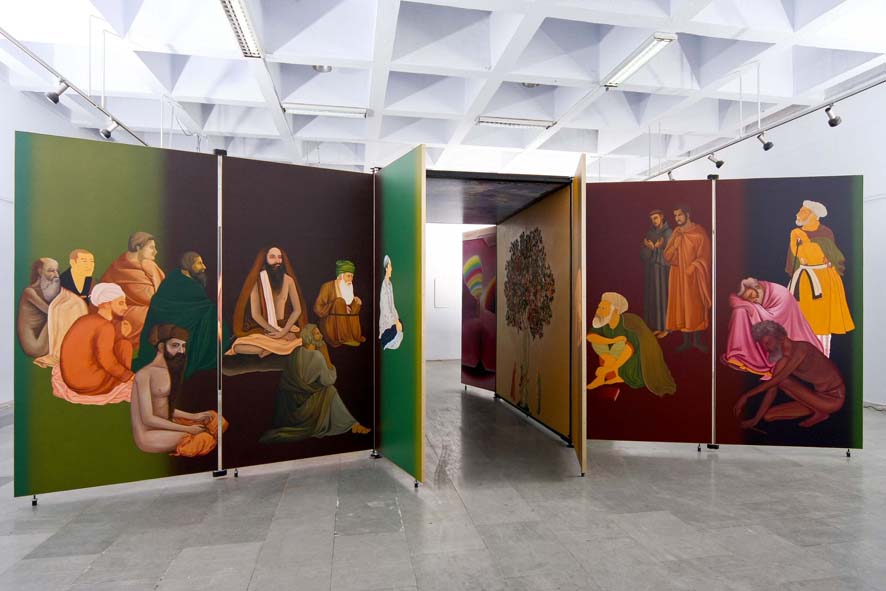
In October 2011, I walked through the glass doors of the newly furbished gallery at Lalit Kala Academy in New Delhi, into another experience with the Kaavad. This time it referred to a portable shrine, containing painted narratives which travelling performers, like the Kaavadiya Bhats of Rajasthan used as a prop for their storytelling, where the narrator would open each door of the Kaavad to reveal a new layer, building anticipation with each new painted one to finally enter the inner core. Using this concept, artist Gulammohammed Sheikh[iii] created a monument called ‘Home’. This life-sized, box-like structure with panelled doors opened out to enable one delve deeper into the central core of the shrine, ponder on various images on the way, as each panel or door was opened. It was constructed in part by paintings with acrylic and melamine on wood, and a digital and electrically lit roof of the central hall, depicting the Baroda sky-line with various buildings that crowd the city, inhabited and abandoned, surrounding the sky like a constructed wall. Floating in the middle of this pale greyish-blue expanse, were all manner of mythical characters drawn from various texts and traditions, across the globe.
 

 I felt like a novice, a first time Kanvaria; intimidated by the swirl of images and words of the artist’s painterly universe of cross-referenced imagery that I was not well acquainted with. Rama and the deer Maricha, an angel from the Renaissance art of Italy, figures from a South-east Asian version of the Ramayana, profound words from Kabir with painted images of this weaver saint, a Chinar tree presented as the tree of life where a burning car and refugees carrying their baggage on their head, were a part of this journey through life. In addition, images from the artist’s earlier works were also presented. Visuals of the nuclear cloudburst of Hiroshima, Gandhi, Hitler and much more were also presented in various forms; some in smaller shrines or Kaavad-like boxes, others in digitally printed accordion-style books and as large 3-D sculptural installations. At first, I did not relate to this exhaustive outpouring for I could not find an immediate, succinct message in its vast intellectual exploration, such as I needed, to feel reassured in its midst. But I was enchanted by the marvel of technology in the making of the digital books and the eighteen-minute, three-channel video, where the artist and his collaborator had played enchantingly with all these images, juxtaposing them in historically unprecedented ways,  where the imagined and the real, all came together in a kind of surreal fantasy. 


Viewing this exhibition of works by artist Gulammohammed Sheikh was akin to a pilgrimage; necessitating humility, reverence and silence to view, question, listen and understand. I was humbled by my ignorance of myths, lore, history and even some contemporary events, which Sheikh presented that I felt I should have been able to recall, but could not. I read Kavita Singh’s simple yet elegant essay, watched the videos of work-in-progress and sat through the three-channel video, alone. Watching clouds and Sheikh’s version of ‘Mappae mundi[iv] merge, as people from the past converged with the present, I saw through aerial maps from Google, what this, our corner of the earth looked like from the sky; where perhaps some unseen eye of God observed and judged, and then maybe not.

Sheikh explored notions of a world gone by through figures of the past. He also called into question, by juxtaposing them with the contemporary world, the way we live today. He brought into play the demolition of Babri Masjid, Godhra riots and the issue of ‘whose Kashmir’: to whom does this coveted land belong? Were the sweepers of Baroda, who sweep away the city’s dirt, also the very people instrumental in creating the violence that Gujarat has seen?  All this and more was referenced in a quest to find meaning or solace or some perspective. Searching for clarity, Sheikh sieved through years of human history, asking us to question the premise of our existence today and where we draw our ideas from.


He questioned not just parameters of contemporary life and historical ways of living, such as a possible parallel, in the traditional churning of the seas or samundra manthan and the bombing of Hiroshima; Sheikh also enquired into the all-encompassing notion of life itself. Is there a right way or a wrong way to live? Was Ravana’s deception, his disguise as the deer Maricha legitimate? Sheikh drew me into an internal dialogue with myself, compelling me to question my own exploration of these ideas, making me aware of deeper reaches of my cultural and philosophical past. Like the Kanvarias I had observed on NH8, I too did not put the quest to rest, but kept up this solitary conversation with the artworks, even after I had left the gallery space. And when I returned home, late in the evening, I went through my library of books, looking up all those characters and notions I lacked in knowing.  

In this vast, exhaustive and intellectually rich presentation, I felt over-awed by the legendary characters and events which Sheikh had chosen to speak through, but where the self-effacing artist had seemingly retreated into the background, leaving me to decide for myself.  I cannot claim mastery over this vast repertoire of intellectual icons. I have not really explored these specific facets of life, or read the books he has, nor pondered the profundity of these words. When humbled by my inept and limited knowing, how could I possibly decide what the truth was, what was right or wrong, if at all? But Sheikh did not tell us. He presented a gamut of ideas, lending direction, but implying that each one had to decipher the truth for themselves.  


This pilgrimage, my very own experience as a novice Kanvaria, of carrying the burden of my ignorance through Sheikh’s universe, reminded me with each step, of all the world’s literature, myths and lore I had yet to explore; of countless intellectual journeys I had yet to take, or as Bhupinder had told me that a Kanvaria must do, at least twice in my life-time. As I sipped a cup of tea the next morning, I wondered: if and when I have performed this gargantuan intellectual exercise, will I find some answers to the all-encompassing, paradoxical nature of life? Does anyone?


[i] The Kānvar Yatrā or Kavad Yatra  is the annual pilgrimage of devotees of Shiva, known as Kānvarias, to Hindu pilgrimage places of Haridwar, Gaumukh and Gangotri in Uttarakhand to fetch holy waters of Ganges River, Ganga jal, which is later offered at their local Shiva temples. It is named after the kānvar (काँवर), a single pole (usually made of bamboo) with two roughly equal loads fastened or dangling from opposite ends. The kānvar is carried by balancing the middle of the pole on one or both shoulders. This practice of carrying Kavad as a part of religious pilgrimage, especially by devotees of Lord Shiva, is widely followed throughout India

[ii] Pilgrimage to holy places such as confluences of sacred rivers and/or places associated with Hindu epics such as the Mahabharata and Ramayana, and other sacred pilgrimage sites

[iii] (b. 1937) is an artist, educationist and writer whose work has spanned more than five decades. He is a founder-member of Group 1890, which was founded in 1963 by a group of artists.

[iv] Mappae mundi were schematic and meant to illustrate different principles These diagrams were primarily meant to preserve and illustrate classical learning. The zonal maps were a kind of teaching aid—easily reproduced and designed to reinforce the idea of the Earth's sphericity and climate zones.