Showing posts with label patterns. Show all posts

Sunday, 3 July 2016

Bird-Signs in the sky


This evening in the pool, looking up into the skies, grey and cloudy. I chanced upon the flight of birds, up, up, up and up, flying really high. Black silhouettes against a darkening sky, I couldn't tell which specie of birds they were. They could have been pigeons and more than likely they were. The height at which they flew, however did make made me question the possibility that it was a flock of pigeons. I'm no ornithologist, nor avid bird watcher so, I really couldn't tell and besides, what the species was, wasn't relevant. 

What caught my attention and momentarily stemmed the flow of my breath, making me gasp with delight, was the perfect formation they flew in. It was like the ones we have heard of and seen in videos and photographs of migrating birds. I'd never seen anything like it before - not been a witness to an actual flight. 

The pigeon abounds in the crevices and eaves of my apartment building in Gurgaon and I've often seen them flying around. It's a lovely sight to see birds soaring high into the limitless sky. And very inspiring too! But, I'd never seen them fly in such a perfect formation and one which was sustained, by the flock of birds that drew it in the sky, for a considerable distance and length of time. Like a choreographed and well rehearsed performance, their movements were perfectly aligned and timed to perfection. 

One bird, in the centre, was pointing the way as others panned out on either side, a little lag behind each bird, followed another and another and many more - at least ten on each side. They flew in a near perfect 'V' formation that never quivered in their flight, nor was it disturbed by cloud or breeze. It was a flawless 'V'

I lay on my back, in the cooling aquamarine water of the pool below, watching them intently, without moving a limb. I was mesmerized by this unusual sight, so minuscule to my vision, on the earth, miles below their soaring height. They flew from South-West to North-East and as I delighted in the spectacle, I said to myself: yeah! It's a 'V' for vict.....stopping short of finishing the sentence. Remembering the recent spate of terror acts, adding to the atrocities that are enacted each day, somewhere or other, on some animal, place, person or thing, how could any creature living on this planet signal to alien beings, angels  or spirits that reside in universes parallel to and beyond ours, any sign of victory? 

What has anyone inhabiting this earth got to be victorious about? So, they must have been sending out a warning to everyone out there, above, below and around them. To anyone who was tuned into their frequency, it could well have been a signal to say that it was time to take flight; for this world, or the region of the universe they were leaving, was a dangerous place to live in. Not one where nature in all its munificence was resplendent in victory, but one where her beings were filled with the venomous 'V' of violence.

But, the more I thought about it, reflecting upon what I'd seen and how I'd gasped in delight. I couldn't equate this response as one that had read a signal of distress. Maybe, what the birds were telling us, was that if we rose high, transcending the baser tendencies of our being - that therein lay our victory.

Thursday, 17 October 2013

Threads of Punjab


Bakshi Rana
I met Lajwanti[i] Parvati Maasi[ii], Prito Aunty and Bakshi Rana in April 2013 at the Indira Gandhi National Centre for Arts in New Delhi. They had travelled from Tripri[iii]  in Punjab, to demonstrate the art of Phulkari embroidery. But while sipping chai with them and chatting,  hearing their stories, I realised that they had travelled much farther than that.
 
They had all learned Phulkari out of choice, to fulfil an aspiration but, none of them did this work today, for the love of embroidery. They said it was ‘majboori’[iv] that they had to do it to earn, to keep a roof over their heads. Parvati Maasi, as everyone referred to her, was the oldest and also the most forthcoming of them all, that is, apart from Lajwanti whom they all work for and who was miffed with the change in policy at the Punjab Emporium in Delhi because this had taken away a large chunk of her business. Each of them had stories to tell about errant husbands and hardships borne. Bakshi Rana and Parvati Maasi had come to India from Pakistan at the time of Partition and they had some stories to tell about that too, even though they were very young at that time. But, it was their journey through Phulkari, as women who spent their days working with needle and thread, that interested me.
 
 Phulkari, which literally means ‘flower work/craft’, is the embroidery of rural Punjab. It was traditionally passed on from mothers to their daughter.  “Ih phulkari meri maan ne kadhi, iss noo ghut ghut jhaphiyan paawan” [“My dear mother has embroidered this Phulkari, I embrace it again and again with affection”] is a song that refers to the tradition where mothers [and grandmothers] embroidered shawls for the young bride-to-be of the family.  Prito Aunty aka Pritam Kaur recounted how she had made her own dowry, yet also spoke of the work she did today as majboori. When I asked what she would do if she had all the money she could ask for. Her reply was ironical. She said she would like to buy these fabrics like she had seen us urban women do. It was disconcerting to note that she had the wealth she sought in her own hands but did not see it as such.  When I said as much, she just kept quiet.

Prito had embroidered chaddars  and dupattas  as well as woven punja  dhurries to take with her to her new home. She was born in Kinnaur village, district Patiala, around 1963; her parents were poor and did ‘majdoori’[labour],  mostly making ‘manjees’[beds made from rope] . Her mother earned through doing some embroidery work too. Although traditionally this art was practiced mostly as a personal pursuit and not something for profit or sale, it was not uncommon for wealthy families to get others to do it for them, even though they themselves had learned Phulkari work.
 
In an article for ‘Threads and Voices[x]’ published by Marg, Jasleen Dhamija spoke of the crafting of these chaddars with such affection, sense of romance and nostalgia for a time past and personal reminisces of family life in Abottabad that, I began wondering if there was any history of this craft in my own family.  I almost wanted there to be something to link me with it.  After all, I am a Punjabi by birth even if I have never lived in Punjab and, I work with embroidery.  My mother hadn’t lived in Punjab either, but my father migrated with his family to Bombay, at the time of Partition, from Multan. Parvati Maasi and Bakshi Rana also came from the same region and had seen this work being done around them, so it was plausible.

My Naani  was from Kapurthala which is in the heart of Punjab but she was married at fourteen years of age and moved to Delhi, so this connection to the traditions of Punjab was clearly not a strong one.  My mother also said that, from the age of ten, Bibijee [xii] showed a deeply religious inclination and did not do any kind of embroidery or much else aside from taking care of her home and family, adding that her own grandmother, did not do any embroidery either but, she was a fabulous cook.   Well, that put paid to hopes of any thread of interest that I had in embroidery being drawn from family tradition, at least from my mother’s side of the family. Although we are Punjabi’s, Phulkari embroidery had not been passed down through generations in my family and when I think about it, I cannot remember  seeing anyone in my family wear these embroidered shawls either.

 Phulkari and Bagh are really colourful, embroidered shawls worn by the women of Punjab[xiii] and were enormously popular from 1850-1950 AD. Their origin is lost in time but it is thought that the tradition came into India with the migration of the Jat peoples from Central Asia[xiv]. There are apparently no references to Phulkari in classical Indian literature[xv], nor are there any surviving pieces from before the 1850’s.

 History tells us that the plains of Punjab were rich cotton growing areas and almost every village had a settlement of weavers who wove the hand spun yarn provided by their farming neighbours, in exchange for agricultural produce. Spinning was a household occupation. The untwisted skeins called ‘pat’ that were used as embroidery thread were imported from Afghanistan, Kashmir and Bengal. This silk was expensive and therefore not wasted on the reverse of the cloth. The stitches were made by counting the threads of the woven structure of the cloth – typically stitches are made at right angles so that the embroidered patterns reflect light, according to the direction of the stitches. The basic stitch is a darning stitch and, a Holbein stitch is used for the Phulkari called Chope[xvi] but, several other stitches are also employed, for outlining motifs and edging the piece.

Traditionally, Phulkari was done on thick, almost coarse, cotton fabric known as khaddar[xvii] where each colour had its own significance[xviii]. This khaddar fabric embroidered with striking floral patterns is the basic Phulkari. The embroidered shawls that are fully covered with embroidery, where you cannot see the fabric beneath are known as ‘Bagh’ or a garden. Three to four narrow loom cloths were joined to form the complete shawl, typically 4 x 8 feet in size. In some areas, particularly West Punjab the strips were first embroidered and then joined. In East Punjab, the panels were usually joined first and then embroidered across the whole cloth, including the seams, for a more coherent design. The predominant colours of silk used were gold and ivory – referred to as marigold and jasmine, or wheat and barley – reflecting the agricultural tradition of the region.

In north Punjab, another tradition developed known as Thirma which was made exclusively by Hindus and Sikhs. Their colours range from rich raspberry red to pink. In some pieces, large-scale triangles interrupt the long border on opposing sides. Placing of these triangles is significant, for when worn by a bride, the triangle falls over her head, symbolizing the auspicious ‘tilak’ worn on the forehead.

Apart from regional differences there are also religious differences. The geometrical designs primarily associated with Muslim communities reflect the Islamic restraint on figurative work. Hindu and Sikh Phulkaris incorporate human figures animals, flowers  and birds, presenting a rich repertoire of designs including myths and legends but they can also be quite abstract such as patterns that recreate the ‘maze’. Another feature of Phulkari is the deliberate mistake:  because only God is perfect, so either black was added or a part of the design was left unembroidered. This was also done to avert the evil eye. After 1920, the tradition of Phulkari is said to have declined with the introduction of poorer qualities of material and fewer stitches employed. However, it is Partition that marks the greater decline of this tradition[xix].

Parvati came to India, from Pakistan, in 1948. She was six years old and does not remember much except that it was cold. A truck took all those leaving her village of Bhawalpur to Khanpur, from where they took a train to Abhor. Parvati and her family then came to Patiala and were given government quarters. Her mother worked in people’s homes, washing clothes and dishes, and Parvati would accompany her. In the evenings, they used to embroider things for themselves, one evening a Rajasthani baniya[xx] passed by their galli,[xxi] saw them working and asked them to make some pieces for him. He gave them  the ‘chaddar’, ‘golle’ and anchor-wale lacche[xxii]Usse hum hoshiyar ho gaye, kaam karne lag gaye,” [we became wise to the profitability] and started working freelance, earning five to twenty-five paisa per motif, making one to two rupees a day. Lajwanti is a distant relative and when she started her business Parvati began working for her.

The Parvati that I met was obese; she was old with failing eyesight and diabetic but full of stories. She had retired from active work but came along with the others because they are family[xxiii]. All the four women were above fifty years and had long-standing relationships with Lajwanti. Most of Parvati’s family used to spin thread -“Gandhi wala charkha”[xxiv]– her mother, Naani and Parvati did spinning, more than embroidery even though they did embroidery for a living : “mn badde chakkar khaunda hai, Na khushi na dukhi – velli nahin baith sakdi hu, mn bahut khush haunda hai, kadhai karde karde” [the mind goes round and around. I feel neither happy nor sad. I just cannot sit idle, but when I am embroidering my mind is at peace.]

In the Marg article Jasleen wrote: “Ghoo ghuoo would go the lacquered charkha which my grandmother carried, much to my father’s irritation, all the way from Abbotabad when we moved to Delhi” adding that, the charkha was intertwined with memories of her childhood. It was her Dadi’s companion and she would spin everyday while reciting the Gurbani[xxv] or Pothwari[xxvi] songs from her childhood - “ghoo ghoo charkeya main kata ya na?”[shall I spin or not]. In Abbotabad, their ancestral home, the thread was then given to the Hindu weaver to weave and the Muslim dyer to dye a deep maroon or russet, her Dadi never dyed the fabric black or blue. Jasleen then recounts her Dadi sitting with Hazra Bibi, an expert embroiderer, who also looked after Jasleen, discussing what embroidery to do. Old, empty, English biscuit tins were filled with colourful silk threads bought from itinerant Aghani thread-sellers. Colours were selected and matched and the Phulkari work commenced by Hara Bibi, who apparently produced the finest work in that region. 
 
She also recalls karva chauth[xxvii] when her mother would dress up, wrapping herself in her wari-da-bagh[xxviii], which Jasleen’s fathers Dadi[xxix] had made for her.  Jasleen however, never learned the art as they had already left Abottabad when she would have been old enough to learn and her Dadiji never taught her. However, traditionally, she says, a girl learned to embroider from her paternal grandmother and mother, beginning with using cotton thread, graduating to embroidering her own dowry, when the older women in the family or around her, would smile and say that she was embroidering her own garden of happiness.  It was a common sight to see women sitting in an open court-yard embroidering and singing: “Bharam koiya shant, sehaj, swami, Pargas bhaiya kauul khilia” [when doubt in the mind is gone, there is peace and quietude my lord. Just as the sun rises and the lotus blooms.]


Ah! What nostalgia, but there was none of this in the stories
of the four women I met that day. They had only pain and hardship to recount. Bakshi Rana was born in Khanpur Pakistan and came to India in 1948 when she was around nine years old. She began doing Phulkari embroidery when she was about fifteen years of age. Watching others, “ik umang jaag uthi”, a desire came into being and she thought she would like to do it too. Around the same time, she was married to her dead sister’s husband, her brother-in-law, and widowed five years later at the age of twenty. Of all the four women, she seemed the saddest and wore a really haunted look. Her sister had four or five children [their stories all lack accuracy and clarity in telling] whom she brought up as her own. As I listened, I couldn’t help thinking, what a life! There was this fifteen year old with that faint desire in her heart to do some colourful embroidery work, possibly to create her own dowry, when her sister dies and the responsibility of her sibling’s family falls on her young shoulders. She doesn’t have the luxury of choosing her spouse or the pleasure of bearing her own children, so where then is there the luxury of desires and aspirations? The mind possibly shuts down all its imaginative faculties when faced with such circumstance.

It’s no wonder then, that umang turned into majboori. I keep wondering whether things would have been different if Partition had not happened and they had stayed in Pakistan, in their villages. Would these women have had different stories to recount?  As if reading my thoughts Parvati Maasi started singing this song: “Bande teri zindagi Waghe nadiya da paani, chaar din di bahar, ho hoshiyaar bandeya, nahin toh royega zaro zaar bandeya” [your life is like the waters of the river Wagah, the precious days of bliss may flow without your realising it, so be present and enjoy each day, for otherwise you will shed tears in regret for the rest of your life]

Embroidery is a great stress buster and I experience this first hand. These ladies also agreed that doing this work helps them deal with their lives in various ways and “sukoon milda hai”[xxx] but without the ability to think creatively, cultivate the imagination of women like Jasleen’s grandmother and those before her, who made things for their families, recording events in the family life through subtle changes in colour and pattern; without the freedom to do this, out of choice, for themselves, the work cannot have the same resonance and energy.

The quality of workmanship has changed. It was Punjab that was most affected with the advent of Partition and it is possible that this played its part in the decline of the art of Phulkari. But, I think that basically the creative spirit of the subcontinent had been stifled much before this. The process was slow and subtle and difficult to perceive or comprehend until things came to a head.

Indian textiles were enormously valued in the maritime trade of South-East Asia. These fabrics were used as currency for trade in spices which were prized by Europeans. Getting monopoly over Indian textiles was a way to profit in this trade. For Indonesians, the people from India who made the textiles they prized were considered gods. But when the Europeans came they did not understand the significance of this beyond the money they could make and the British were especially ruthless in this regard. Gradually, they changed the way that these fabrics were created and started introducing designs brought from Britain which were then copied and exported back. They stopped trading fabrics that the local artisans lovingly crafted, in much the same way that the women of Punjab used to embroider the Phulkaris [even though Phulkaris were not part of this trade] with marks and patterns that reflected their personal histories, investing the fabric with the labour of love.

When you take creativity out of anything you virtually kill the spirit of the person doing the work. The art of living,  understanding the freedom to create life the way you imagine it can be, which was intertwined with the concept of crafting in ancient India, is further being eroded by this frenetic age of technology.

The once creative craftsmen/artisans have become reduced to skilled labour[xxxi]. These women cite majboori as the reason they do embroidery. There is no personal investment or sense of creativity and joy. Living in poverty, personal grief and a lack of education has stifled the spirit of creativity through which humans thrive and grow. Can any art flourish and grow this way?


[i] Lajwanti has been awarded a master-craftsman award for phulkari. Born in Patiala in1953, she learned from her naaani and has worked in this field since a child. Her husband left her with small children [3 boys 2 girls] when she started this work as a business.  All her children have worked with her and are national craftsman awardees too. She has 500 women working for her in Tripri.
[ii] Like mother – mother’s sister is traditionally called maasi
[iii] near Patiala
[iv] Necessity/compulsion
[v] shawls
[vi] Veils/ lighter shawls
[vii] Richly patterned Dhurries [rugs] where a tool, which draws it design from the five fingers of the hand, is used to push the weft thread down.  
[x] Marg Publication, Mumbai. Volume 58, NO:4, edited by Laila Tyabji
[xi] mother’s mother
[xii] We addressed my naani as Bibijee – a traditional Punjabi way of addressing the female elders in the family
[xiii] This work was also done in parts of neighbouring Haryana
[xiv] Ancient European historical records and archaeological findings support that the Central Asian people such as Scythians, Samartians and Alans are possible forefathers of the modern Jats, in part.
[xv] The Embroidered Shawls of Punjab. John Grisham. Asian Embroidery edited by Jasleen Dhamija. 2004.Crafts Council of India
[xvi] The Chope is quite distinct from form the Phulkari and Bagh embroideries where bold patterns of stylized peacocks are embroidered in Holbein stitch with gold thread on a red/maroon khadi background.
[xvii] Coarse, cotton fabric woven on a pit loom, in plain weave.
[xviii] Four colors of khaddar were generally used where each color had its own significance– white used by old women or widows, red used by young girls and brides-to-be, blue and black were kept for daily use.
[xix] The Embroidered Shawls of Punjab. John Grisham. Asian Embroidery edited by Jasleen Dhamija. 2004. Crafts Council of India.
[xx] Trader from Rajasthan
[xxi] lane
[xxii] ‘Anchor’ [brand name] floss
[xxiii] I imagine there was also some business prudence involved as Lajwanti did not want her younger karigars[xxiii] poached upon
[xxiv] Spinning wheel used by Mahatma Gandhi
[xxv] Word of the Sikh gurus, usually sung
[xxvi] a dialect of Punjabi spoken widely by the population of the Potohar Plateau in Northern Pakistan.
[xxvii]  is an annual one-day festival celebrated by Hindu women in North India in which married women fast from sunrise to moonrise for the safety and longevity of their husbands
[xxviii] Is embroidered by the groom’s paternal grandmother in golden yellow silk. The grandmother begins to embroider when the boy is born and it often takes her ten years. The random appearance of different colours or change in pattern is not careless mistakes but represent significant events in the life of the family. The embroidery mirrors the family’s joys and sorrows so when the young bride is wrapped in this she is symbolically entering her husband’s family’s history
[xxix] Paternal grandmother
[xxx] We find peace and solace.
[xxxi] As designers many of us go into the villages and give them our designs to make. And my own experience and that of others is that even when given a free hand to create, they hesitate and prefer to be told what to make.

Friday, 9 August 2013

Not Drinking Chai in Kutch - Guest Post by Australian Artist and Writer Maggie Baxter.


Zurra Village, Pakko hand embroidery is done here.
Or anywhere.
 
My ideal black, unsweetened coffee sits at the opposite end of the taste bud spectrum from the powerfully sweet and milky chai of the Kutchi palette. But here I am at Gopika’s invitation to Garam masala chai (and she knows my preference) to share my experience of working in Kutch

Young woman doing Maggie's embroidery
Twenty something years ago, I had never heard of Kutch and for those blog followers with the same question mark in their heads, it is the district with a very singular identity that sits at the northern end of Gujarat, next to the Pakistan border.

Neither did I have a burning interest in the craft sector – just a vague idea that traditional Asian textiles could be an interesting platform for contemporary art.
 
My induction into and subsequent fascination with the textile traditions of Kutch came about from a chance meeting in my home city of Perth, Western Australia with Indian designer Kirit Dave. He suggested I go there, and without much forethought, or research, I did.

Kutch is not an easy climate and terrain even now, but back then it was much more rigorous. The roads were poor, the electricity was off more than on, telephones barely existed, and travelling was in old Ambassador cars well past their retirement age.
 
 
Luckily I had travelled regional Australia. If I was hot, bothered and dusty, I was used to being hot, bothered and dusty in Australia too. If the village water was dodgy, I had thrown up on bore water in Australia too. But, at certain times of the year, Kutch is just one bit too challenging.

What draws me there? I have joked that it is like in being in a slightly dysfunctional long-term relationship. Old diary entries tell it all: the good, the bad, the endlessly frustrating, and the much-needed tranquillity.

The Good

Kutch has an amazing confluence of textile crafts stemming from centuries of migration from what are now Afghanistan, Pakistan, the Middle East, and other parts of India. There are weavers, printers working with four types of block printing and at least 16 different styles of embroidery done by different communities.
 
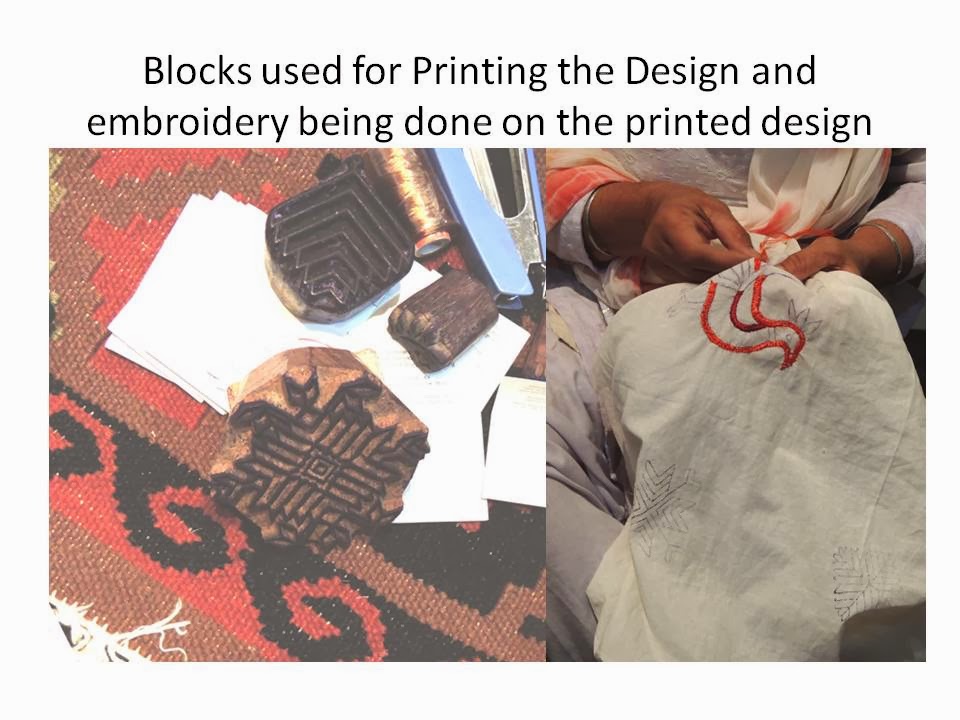
 What first intrigued me were the endless possibilities inherent in block printing – not within the existing traditions of exquisitely accurate registration of patterns, but more in the way of reproducing an abstracted form of drawing: lines and marks floating without symmetry on the fabric. I am still as excited by block printing, as I was when I started. It took me longer to decode embroidery and work out how to connect it with my linear mark making.

Monday 22 December 2003

‘Grid forms, and lines contained within grids are where I am starting. I have also used some photocopies of the structure of Japanese cloth as an impetus.

As I was drawing I started to think about using the blocks in simple, but strong graphic black and white, with a large border of brightly coloured embroidery. Maybe this will be left to Rabari[1] women, or maybe I will do the design and get it done with Sodha[2] women in Pakko[3]. This is in keeping with local odhnis [shawls], which have fields of black wool with simple tie-dye and then amazingly rich borders.

I am also keen to explore the same design in a number of different techniques…the rug design is about to be done in Ikat…’
 
The Bad

August 1991 (My first visit to Kutch -why did I ever go in oppressively humid August?)

The horizon began to fill up with a sinister, foreboding, dark heavy purple cloud….As we left [the main city] Bhuj, a powerful wind started to pick up dirt and debris, flinging it around unpredictably, reducing visibility to an impenetrable  pale red murk…The storm finally broke….great columns of lightning and torrential rain smashed to the ground…. Our car only had one windscreen wiper.

The road to the farm was a mess of fallen branches and mud. One large tree trunk had fallen across the road. The guys got out to shift it and I started to go with them but they stopped me…I told them later that they are more chivalrous than Australian men, who would have told me to get out of the car, roll up my sleeves and push hard.

When we finally got to the farmhouse there was no food left. The rain made the air even more clammy and humid. I sat on a bench and disturbed a cloud of insects, who retaliated by swarming down my blouse.’

The Tranquil

February 2004.

‘Sunday… Very quickly it has gone from winter to summer in Kutch. Just two weeks ago there was snow on the Himalayas and a biting wind hurried across the salt marsh deserts, through our clothes and right into our bones. Now the evenings are balmy and the air is perfumed with the scent of lime trees in flower….

Since 6.00 a.m. Rimalbhai, the farmer has been coaxing his bullocks and cows to wake up. His voice is louder than truck horns on the highway and has the same tone.

[In the morning] I sat on the verandah of my bhunga[4] eating breakfast and watching the passing parade of people. The farmer’s wife Leriben made bhakuri[5] on the griddle and, to escape the chai, I have Twinings ginger and lemon tea and coffee with me.

There is a constant flow of visitors [to the farm] from nearby Bhujodi village. Some of the women wear traditional clothing…. we have nicknamed one ‘Mrs Mix not Match’ because of the astonishing arrangement of colours and patterns displayed in all her outfits.

One day it was a loudly floral orange ghagra skirt over a red petticoat. A long turquoise odni [shawl] with a diamond print hung from her head, long enough to tuck into the ghagra forming another over skirt. Above the waist she wore a purple backless choli [blouse] with turquoise sleeves and a turquoise and orange hem. A choli is shaped a bit like a brassiere with two cups in the front for the breasts….gravity had triumphed and the cups were in one place and the breasts another. Big rolls of fat poured over the sides of the choli. But she was nicely unconcerned about any of this.

The
 
Frustrating                                                                                                                                     

Production September 2004

‘The fabric that I wanted from Devjibhai was a nice cotton and silk mix with a subtle texture that would suggest parchment. But as soon as this was selected, it turned out that the silk fibre was not available.
 
Unseasonal rains came. Block printing stopped at Ajrakhpur. They have no shelter for the fabric to dry out, which seems incredible in a village that relies entirely on printing and dyeing for its livelihood….
 
Tailors suddenly went into short supply. There is a huge pilgrimage in Kutch…70,000 people were estimated to be walking through... And in amongst this throng were all my tailors. Who cares about a Delhi deadline when the Mata[6] is calling? Let’s hope that when they return blessed, they are also refreshed and ready for the challenge I want to inflict on them’.
 
But, in that astonishing and miraculous Indian way in which disaster is averted at the 11th hour, collections do come together. What has strangely evolved over the years is that complicated, one-off pieces suitable for exhibition in art galleries work best and that is what we have been doing for the past decade.
 
None of this could happen without the extraordinary skill and willingness of all the artisans that I work with and I salute and honour them. Equally the work can only come together because of the mediation of Kirit Dave, who has over the years translated my ideas from English ‘artspeak’ to Gujarati, and his production manager Dhaval Raval, who, after I have left, ensures deadlines are met.
 
In Ahmedabad earlier this year I happened to have lunch with a group of women travellers, one of whom had taught at the Kala Raksha Vidhyalaya Design School for traditional artisans in Kutch. The exercise that she set her group was to design in response to music, letting their tie-dye or blocks flow over the cloth as the chords suggested. She told me one of the students in the class said ‘Ah, there is this Australian designer who has been coming for years and now we have designed to music I finally understand what she was doing’.
 
  Thank you, I really appreciate that you said that, and to all the artisans in Kutch, long may we continue to make music together. But it is still no to the chai.


Maggie Baxter is an Australian artist, writer, curator, and public art coordinator.


[1] Members of the Rabari or Rewari live throughout the Rajasthan and Gujarat states in India. There are some Rabari families who also live in Pakistan especially in the region of Sindh. Rabaris are also known by other names such as Desai, Dewasi, Hiravanshi, Rebari, Rebadi, and Rayka or Raika. The word "rabari" basically means the "Path breakers". This is because hundreds of Rajputs migrated to the desert in protection of the Jaisalmer state against the Mughals. Since then, they were left out of the Rajput community and were later known as Rabari. The Rabari's main business has been to be raise cattle, camels and goats; for some traditional-minded families this is still the case. However, the new generation, as they become better educated, are slowly moving away from this way of life.
 
[2] Sodha Rajput migrations to Kutch started in 1971 after the Indo-Pak war. Originating from Thar Parkar in east Sindh, Pakistan they had relatives in Rajasthan, Gujarat, and Kutch, hence, they settled here and have led a contended life in Kutch. There are 32 Sodha villages in Kutch about 25,000 members of the group with 4,000 artisans among them
 
[3] Pakko embroidery is done by the Sodha, Rajput and Megwar communities. Pakko literally means solid.  The designs and motifs are very similar to Aahir, but slightly more geometric. The outline is done with a square chain-stitch, but the filling is a dense variation of a buttonhole stitch, which gives a raised appearance. Mirrors are used frequently. The original design is drawn freehand and then transferred to the cloth through a stencil
 
[4] Bhungas are closely linked to the identity of Kutch desert areas. They are single cylindrical structures put close to each other to form a house. In common terminology, each bhunga would be equivalent to a room in a house. As per one story, after the 1819 earthquake, all building craftsmen from Sindh and Kutch region got together to discuss the damage caused to the houses in the region by the earthquake. After a series of discussions, they came up with the circular house-form design of bhungas which is in practice since then. Even after the earthquake of 2001, it was observed that most of the bhunga houses survived the earthquake despite being very close to the epicentre of the earthquake, while many other constructions failed.
 

[5]Bhakri are a dense form of roti made from coarse wheat flour and ghee. They are found throughout the western states of India and can be either soft or hard. In Kutch they are hard and biscuit like and can be eaten at any meal  with sabzi,[veggies] curd and pickles. I eat them for breakfast with fruit and honey, but this is not traditional.
 

[6] Goddess