Showing posts with label faith. Show all posts

Tuesday, 25 September 2018

Mynapi Waterfall Trek - Negotiating the Rivers of Human Terrain


I'm totally zombied out. Sitting in bed, looking at the sun dappled bamboo outside my window, I'm finding it difficult to express the experience I underwent yesterday. All through the drive back home, I kept checking in to figure out what I was feeling and drew a blank. Such as I often do when any event is overwhelming or extremely challenging. It had been a long and arduous day but I wasn't tired, even though my body was hurting. I was in a nirvanic – a beyond words, kind of space.
 
I woke at 5am to leave for Panjim by 6am, to meet Bianca and Bjorn and their team from Off-trail Adventures by 7am. I had to park my car at Patto Plaza, walk across to the other side of the Panjim-Ponda Road, meet the other trekkers at Heera Petrol pump and board the bus that would transport us to the location.
 
 
Strapped with a ten litre backpack, a fanny pack with my phones and emergency essentials, and carrying yet another bag with a change of clothes, more water and food, I ambled across, the ten minute distance, without demur. Ordinarily, I would have scouted for help, but I had signed up for a day long trail where I was supposed to traverse 18 kms, so this was just the start.
 
 
Picking up people along the way at Cortalim Junction, Verna and Margao, we reached Quepem at 8.40 am for a quick breakfast. Before leaving for the final hour-long bus lap towards the Netrawali Wild Life Sanctuary, where the expedition officially begins.
 
 
 Goa is so green in the monsoon that it's a delight for the eyes. And the emeraldic-leaf green of the paddy is a very special colour. Unlike any hue in my paint or thread palette. But, this agrarian landscape wasn't a patch on the virgin forests that unfolded as we tread the terrain of the Western Ghats.


It was my first hike of this kind and that too as I completing sixty years of age. It was ambitious but I had no idea of the agony my frame would go through as I negotiated smooth rocks, wet and slippery with slime, the possibility of leeches shimmying up my flesh unseen to suck warm blood and more. And, when I got home at 9 pm, fifteen hours later, the top of my thigh muscles were stiff – more like rigor mortis rigid, but it was my big toes that were wailing louder than the cicadas of the forest. Even the gentle touch of the light quilt I sleep with, was evoking yowls of pain. And to top it all, grasping at crevices to find a grip, at the very edge, before we glimpsed the Mynapi waterfall, I think I may have cracked the middle finger on my left hand. Or at the very least pulled a muscle. I had to put the full weight of my 65kg on hands and knees to scramble up. They're not used to it.
 
 
Today, I've tried to get up and about as I would a normal day, but if I sit or stand, it's really painful. My shoulders are speaking of their burden (which wasn't much more than a litre of water, light trekking sandals, a sandwich, a light raincoat-which was pointless to wear) and 10gms of salted Kaju. But, I'm inclined to think the load has more to do with feeling exhilarated by an situation and occurrences that tested me at so many levels and left me relatively immobilized. And, it is my inability to put this entire venture into any comprehensive perspective that’s keeping the mind in a spin. I've not really wanted to get on with my usual day or do anything other than look at the pictures and re-live those moments. Or search online for things like shock-proof sticks and dry bags so that I'm better prepared next time. And a better pair of shoes too!
 
 
 Yes, there has to be a next time. Being so close to nature, without the trappings of urban behavioural niceties, I felt the rawness of fear. I faced the power of the resolve: ‘I have to find a way’. I grappled on all fours, heaving myself up or slithering down on my butt. All very ungainly and un-lady-like, and in full view of strangers – all of them, mostly youngsters in their late twenties or early thirties. It was a no-holds barred episode. It was a getting in touch with yourself encounter like nothing else I have associated with. A revealing confrontation at that.


As we entered the sanctuary, leaving the bus behind, we strolled along a tarred, regular road but within minutes turned off to the left, towards the Mynapi falls. The signpost said 4.5 kms. Very doable I thought. Since the age of 34 years, when I'd become aware of the merits of some exercise, I've been striding exactly this much each evening - down Walkers Lane in Friends Colony (East), in New Delhi- topping it up with swimming and cycling, so I thought it was going to be par for the course. Yes, uphill for sure, because we were going to the waterfalls, but just a couple of years ago I'd done the haul from Gethia up to Nainital and back and also climbed up and down Matunga Hill in Hampi, at the crack of dawn, wearing plastic Crocs without a strap. That had been quite scary too because it had rained and the boulders in Hampi, well they’re something else. So I thought I was prepared. Doubt hadn't even entered my head.


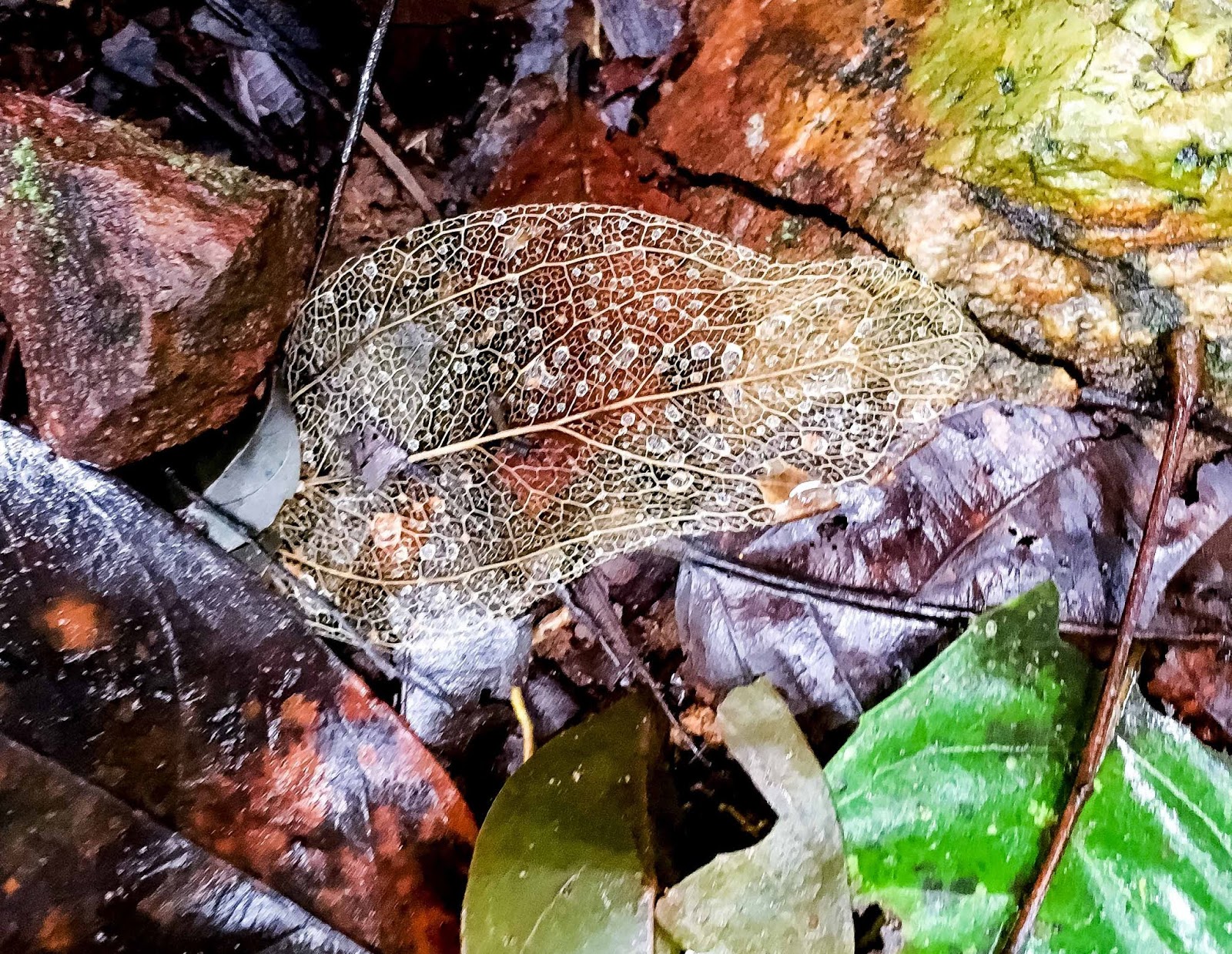
As we entered the forested area, I could hear an uprising of some insects. It was as if they were wailing that their coveted greens were being invaded. I was told they are the cicadas – extremely small but very noisy. And yes, they could really cook up a racket. I was looking around eagerly, at flowers and the tall foliage, growing higher than us. Reminding myself to keep my gaze focussed on whoever was ahead of me lest I lose sight. We bent lower than low, crouching under boughs and leapt over fallen or felled tree trunks lying in the path. Trampled over a seemingly unending carpet of leaves, red, green, brown, blackening as they composted themselves back into the earth. The light on them glinting as if shining off silver. It was an overcast day, but no rain yet. I couldn't imagine what they'd look like on a sunny day. Even as the tall forestation probably doesn't let in much light anyway. But the mulching leaves fascinated me – especially the blackened ones.


An adept trekker classmate of mine had shared a few tips. She'd suggested changing into sandals as we crossed the rivers and streams, advising that it's best not to keep your feet in wet shoes and socks all day long. But we came upon a narrow rivulet within fifteen minutes and it was barely four feet wide, so I didn't change. I couldn't bring myself to stop to change and revert back into Keds after a minute’s stride. My socks and shoes were now wet and we later strode 3-4 kms in the river itself. With uneven rocks, often jagged and pointed, where I needed to lodge my feet in whatever gaps I could find, I cannot envision the state of my feet without the protective covering of my socks and shoes. Even though the wet and confined feet did eventually lead to unbearable pain and a mild infection necessitating antibiotics and loss of toe-nail. t didn’t make sense then, to fiddle around with footwear mid-way.


At first we rambled alongside the river. Vicinal to the soothing resonance of water rushing downhill. Gurgling and splashing as she fluidly opposes boulders and mud banks, insistently carving a path despite all the obstacles in her way. I was loving every minute so far. Then we crossed to the other side because the topography was relatively easier. At one point all we had, to place our feet on to cross a hilly edge, was a thick vine. Bianca kept encouraging us, saying it's very strong, don't be scared. But I was. Having her at hand-holding distance, should any of us topple or if it gave way, was little consolation but as I put one foot on it and then the other and crossed that two-foot space, and it didn’t break with my bulk nor after ten or more who came before and  after, I realised just how strong they were. And later, grappling for support among the boulders, as the flow of the watercourse got rougher,  I scanned the foliage on my side, looking for these vines to hold on to.


We kept crossing the gushing stream back and forth - guided by Bianca at the front, Prashant in the middle and Bjorn at the tail. I chose to stay with Bjorn. I couldn't contemplate attempting the hazardous slog through the water, flowing with quite a strong current at points, all on my own. I'd already slipped once and his strong, youthful arms had saved the day. So this is what I banked upon the rest of the way.
 
 
Every time he thought there was some stable ground, and let go of my hand. I took a dunking. I must have fallen at least five times. But being at the end, also gave me time to stop and take some photos. It was dicey taking my iphone out of its protective cover.  I only attempted this once in a while. The photos I have are mere trinkets of what I saw with my eyes, endured with my body and the unbounded beauty which gave me the strength and spirit to keep on track.


The youngsters that were part of this group didn't think this old aunty, would actually manage that final steep cliff which led up to the water fall. And honestly, if I'd thought about It, I wouldn't have. And when I do reflect back on the trek, it's this moment that keeps coming back.  I'm filled with such a sense of daunting. It was treacherous, to say the least. I'd be terrified attempting it again, knowing what a close call it is. That hard rocks and fast flowing water, awaited my fate some fifty metres or more down below.
 
 
But Bianca had come back for Priyam and me, the stragglers who were being assisted by Bjorn and Prashant. Just thinking that she's gone up with the others, descended, back-tracked to find us, then scaled up ahead of me, showing me how to do it, gives me the shivers. We were so close to the waterfall, in its full flow at the monsoon. I could hear the flowing waters, I was wet with its far-reaching spray And so was the almost ninety degree vertical cliff-rock we ascended – without any mountain-climbing skill or gear. It was just a short stretch but what a task it was!


At an extremely crucial point, one foot lodged as firmly as one can on a  narrow and precarious crevice and the other reaching to find its foothold, from behind me Prashant says "look up, look up, you’ll get a sneak preview”. I didn't want to take my eyes off the risky geography I was tackling. I didn’t have a secure foothold either but, I'm a sucker for waterfalls. There is something so magical about this cascade of water pouring down from the height of hillsides. Be it the Canadian Niagara or the famed milky Dudhsagar on the Goa-Karnataka border, I have made my way to them delighting in their majestic watery vistas. So I did look up - just one moment of perilous viewing before Bianca urged me to take the next few steps up, hold onto her hand and heave myself up to see it, in all its cascading glory. A bride’s lushly crocheted lacy veil, trailing through the steep rocks covered on either side - a mossy carpet of green, a vertical and hazardous church aisle with a deliciously refreshing aqueous pool at its base.


We had been walking for over three hours at this point. It had been arduous to say the least. Not because the hike was taxing in the physical capacity, but because it had required every vestige of courage, presence and sheer utter focus -  such that is not factored into the rituals of daily living. At one point Prashant and a few others pulled a log of wood, from the water, for us to move from one point to the next. And in one of my photos I can see him giving a young man a push to garner enough height to rise up. It was tough. I was relieved to have reached the scenic spot. I was ravenous and drained. So the first thing I did was to eat my egg and cheese sandwich, gulp down some Electral before I off-loaded my backpack and fanny pack to crawl my way down into the water. I wanted to get right under the fall but was advised not to as, being so forceful at this point, it also carries small stones down from the mountain.
 
 
I bathed and crawled back onto the mud splattered, wet and slithering rocks, on all fours. It was a kind of primordial reconnecting with one's animal self. Uncaring of anyone's gaze, of the mud on my butt and drenched hair- looking nothing like the carefully crafted urban visage I'm accustomed to recognising as myself. It didn't matter. I sat on a stone-free muddy spot, momentarily  secure of my seat and gawped at the flow of water, conjecturing with Joan and Jaffrey as to its height. Was it 300 metres, was it 200 or more, we couldn't decide but it was beautiful. Not as awe-inspiring as the Niagara, nor as wide and as gushing a river of milk as Dudhsagar, but tucked away in this nook, away from the prying eyes of the casual passer-by; away from the reach of those that don’t value nature’s bounty enough to refrain from despoiling, it was a sight to behold. Especially since one had trudged a difficult path to do so. I was exhausted but enthralled. I was mesmerized by this proximity to nature that had compelled a propinquity to my own  - that sense of provocation I have always been prone to. That never giving up attitude - no matter what. That slow but steady stride and this love for being among rivers and mountains and the grace of green that surrounds it - the natural habitat of the planet. Facets of my own nature that,  I don't often recollect, nor consider much, unless life mirrors them back to me, this way.


Priyam and I had taken our time getting there, so we had less rest than the others, before Binaca herded us off again. No, we didn't go back the way we had come. I think I would have died had we to do that, but the ascent up from the base of the waterfall was steep. Ultra-steep and there was barely enough mud to give our feet traction. At one point, unable to muster the spirit to haul myself up with the depleted strength of beleaguered thigh muscles and leaning on equally dog-tired arms, from behind me, Nalita gave a push up from my bums. It was effective and a relief not to rely on my fatigued form alone. It was an extremely narrow track and we had to keep moving single file. I was in the middle, not the end as before, so had no option but to keep travelling. But my vitality was flagging. I hadn't eaten much breakfast because not only was it early, I wasn't sure of how I'd fare in a bus through the Ghats on a full stomach. A sweet bun (local Goan bread) and tiny glass of tea had been enough. And with sips of water and the occasional salted Kaju, it had brought me to the falls.


 Lunch was going to take time to create its own energy. And the muscles were beginning to ache. Not to forget the toes. My god they hurt. But I kept moving until the trail widened a bit and the others could pass. When we stopped, Bianca took one look at me and said my lips were white. My remaining water was turned into Electral in a jiffy and I sat on a jutting rock, resting and sipping. I relaxed enough to see the misty view of the Ghats through the vines and took a picture from that spot. Too tired to lift my butt and move ahead of the dangling vines, I let them define the view – that was after all as I was seeing them, wasn’t it.
 
 
Joan, Lucy, Prashant, Jaffrey and Bjorn stayed with me till I felt able to resume the track. My legs and hands were trembling. They said we're half-way there. It's downhill now and that gave me courage. But I realised this wasn't true. Bjorn used the half-way there phrase three times later and when I said “but that's what you said an hour ago”. He smiled, telling me only right at the end, that is the only way to keep people going. If you think the end is in sight, you muster strength. And it's true. That was probably how I kept proceeding. Even after a massive cramp in my feet and legs, when I finally changed into my sandals and gulped some salts. It was only then that I  took a longish break. So long, in fact, that when we reached the bus, Bianca was beginning to wonder if she needed to get some medical facilities to us.


But the snails and flowers and unbelievably beautiful caterpillars and millipedes that dotted the landscape diverted attention from the rigour and pain. And then at the last lap it started to rain quite heavily, but the tree cover was so dense that I didn't feel much on me. We reached the bus dripping wet from head to toe. We'd crossed a few more brooks and gushes. Washing my face with the cooling freshness of the water, even our feet felt great to wade through them. It took some of the tiredness away. And the entire journey was dotted with such, always available refreshing, moments - even in the midst of hardship. It was quite an eye-opener to see just how much of what one needs is really always at hand.
 
 
 Tired, relieved, but mostly chuffed at having completed the journey in one piece, I changed my clothes and got onto the bus when everyone burst into applause. Joan sat down next to me and said "can I please take a selfie with the legend" and she's got one of me looking wan and exhausted - my hair like nothing I'd ever dare post in a photo. But then I didn't care. I couldn't. These social niceties were out of place where one's endurance, grit and resilience had been tested. When the body strong was more valid that body beautiful. When triumph was an obstacle course completed and not how presentable I looked at the end of it. If only one could make this more relevant in terms of the rigours of living. Not to care what experience does to our self-image, was a profound realization.


At the end of the whole journey, when we got off the bus at Panjim, Yogesh, Priyam and I sauntered up towards Panjim bus stand. Yogesh is a young strapping lad and he was the first one to reach Mynapi. He'd been so pickled by it that he told everyone again and again. Clearly all of us had markers of achievement along the way, each one a personal triumph. I shared that my limbs were aching but that I wasn't tired and Priyam exclaimed that's exactly what she was feeling too. A question of mind more thrilled than the body could cope with, said wise Yogesh.


It was Priyam' s first trek too. She’d come from Mumbai to hike up to Mynapi. But she was much, much younger and it reassured me to know that she was experiencing similar pangs of discomfort as I. She also shared that while she watched and waited as I struggled with the last leg but extremely treacherous and precarious ledges before reaching the waterfall, she’d thought to herself, this may well be her last day on this planet. Thankfully I hadn’t had the time to think about this, that I had preceded her, and urged by Bianca, didn’t stop to fear. Those tremors came as an afterthought.


We'd walked on the edge of experience. We'd staggered on the very ledges of life. Our accomplishment lay in embracing the foreboding that nature posed on our way and reaching home safe and sound. Barring a few leeches that had sucked the blood off Lucy and Jaffrey, the soon to be wedded couple, and a few others,  there had been nothing untoward and tragic that occurred. We all carried that sense of elation within – a palpable excitement of living through it - a shared journey, shared rigour and shared joys.


As I mulled over this extraordinary happening - I considered why this has been so rewarding but the other challenges where we have had to touch our primate selves in similar ways - the emotions that life can evoke in us, that others can raise in us - the rigour of relationships and more, why don't we feel this same sense of exhilaration, accomplishment and sense of our own power in them? Why do we cower and demur from these triumphs; making these expeditions in nature  hallowed goals. Quite honestly, it has to be the daily march through the dark alleys of being, traversing the rivers of human terrain which are the quintessential encounters we undertake that, test the spirit equally, if not more. Requiring as much of a leap of faith. Don’t they, every day?


Wednesday, 15 June 2016

मैंने तो इसे use ही नहीं किया


Laxmi is pint sized, not even four feet tall and is thin as a stick. She barely speaks. She's very shy and nervous and yet, paradoxically, she works in a quietly self-assured sort of way.  She came to work for me about two years ago and I wasn't sure she was old enough to be working but was told that she was 18 years old and that everyone in her family was extra petite. The man who brought her to me was her cousin brother-in-law and he said she'd done a stint at the Ansal's club, here, in Palam Vihar. I figured they must have got their paper work in order to put her on their rolls, so it was all right to take her on. Not having been to school there was no way to verify and I don’t think that in the villages they bother with things like a birth certificate, so I had no choice but to just take his word for it. .She was raw from the point of experience of working in a home. Training her was Mahipal's job because she was really green and I couldn't have done it. She basically cleans the apartment and other chores like washing clothes and dishes that don't really require her to be educated.

For the better part of two years, I have really had very little to say to her and vice versa. Gradually, I noted, every time Mahipal was on leave, she had really picked up quite a lot of other chores and was doing them quite adequately. She's learned to make the beds, dust and even lay the table for lunch. She doesn't speak much, not even in response to questions. She has this terrified posture all the time that I've often wanted to (but I don't) take hold of her tiny frame and shake her up - everything is so tightly held within that she just can't speak.

She's a decent enough worker. Although sometimes a bit of a shirker, quite unpredictable and she does things is a maddening way without using her brain. A shelf was wobbling in my meditation room so the music player had been left on the bed. A carpenter willing to undo and re-install the shelf took a while to find as Ansal's, the builders, have built very kaccha walls. So it sat on the bed for over a year. Last month the shelf was repaired and I put the music player back on it. For a week, I found that when she went to clean the room each morning, she'd remove it from the shelf to put it back on the bed. I'd put it on the shelf in the evening and she'd do it again the next day. It went on for a full week because each day I'd forget until I saw it removed from the shelf in the eveing, and by then she had left for the day. I had to make special note tell her that its rightful place was on the shelf and not on the bed! It's something I took for granted that she'd have understood, since the shelf was repaired in her presence; common sense? But she didn't figure that out.  That's how limited is her capacity to think. And adding to this, her lack of communication skills also really irks. She's totally illiterate. She cannot read numbers or even count change accurately.

These past two months Mahipal has been away so I have been very short staffed and had to do a lot of housekeeping chores I would not otherwise deal with. The persistent doorbells with delivery of stores and supplies are very disturbing, not to mention the numerous phone calls that I have to make to order them. So, each day I make an effort to teach her to a to tell the vendors who do the deliveries at home that she cannot read and ask them to show her what they have brought - “क्या लाये हो”  and where is the item mentioned in the bill and how much do they have to be paid – “बिल में कहाँ लिखा है और  कितने पैसे देने है” and somehow we've come to a point that she has understood the merit of doing this and tells them she's अन्पड़ [illiterate] so please do the needful. They don't really have a choice, so when she does ask, they take her through each item in the bag and thankfully we've figured it out such that I don't have to open the front door with every doorbell and she's now learning to take on this responsibility - more relevant is that in talking to the vendors, she's more confident about dealing with them. It's quite sweet how they oblige and show her. I actually watched the sabziwala [vegetable vendor] do it the other day, taking out one thing at a time and pointing it out to her on the bill. Today, she actually came with a vitamin I normally take, to check if it was the right one, because the packaging was different and she didn’t recognise it.  So, it works. I am not certain that she does follow this process of checking all the time, but at least some of the time I have proof of her conscientiousness in this regard.

But, despite all the strides we've taken, the lack of language skills and her innate reservation about speaking is intimidating. I'm scared to leave her alone in the apartment because if there's a mishap she cannot even call the guard on the intercom as she doesn't know how to use the phone and can't read numbers. And I don't like her leaving the front door open when no-one else's around because however safe the condominium may be, she's still a young girl who just can't stand up for herself well enough.

However, there are times when this near-mute, unlettered, intense, well-intentioned girl surprises me. She'll remember to make my tea on time every afternoon and bring it on the dot at 4 pm sharp, on a tray that's perfectly laid.  She'll show the new staff the ropes even when I'm not reassured that she knows them herself. And yesterday was the icing on the cake.

I like my morning tea light and it needs precisely four minutes to brew. When she looks at the clock in the kitchen, each day, it ends up an approximation of the necessary 4 minutes, so it's a different shade of brew with too much flavour or too little. So, I got her, what I thought would be, a foolproof kitchen timer. You had to turn it anti-clockwise to wind it up and then clockwise to 4, and it would ring an alarm in 4 minutes. On Sunday, I'd taken to using it myself. A pale blue, plastic teddy bear shape with a nice round tummy it was a cute toy in the kitchen and I always smiled when I set it up. This Sunday, the one just gone by, I found something was not quite right with the timer. The alarm didn't go off.  The next day I asked Laxmi what had happened why the timer wasn't working. Had she broken it? She said something in her usual muffled incomprehensible nothingness. I got a bit stern and repeated myself. Sometimes that's the only way to get her to open her mouth and get the words out coherently. What I heard stopped me in my tracks.

This unlettered, village girl, who frustrated me with her unfathomable ways, confounded me with her irrational fear and more said to me: “मैंने तो इसे use ही नहीं कियाI” I was stunned. I wasn't sure I'd heard right, so I asked her to repeat what she had said. And she said it again: “मैंने तो इसे use ही नहीं कियाI” [I haven’t even used it] Uneducated as she was she’d somehow picked up and used an English word, constructing a sentence using two languages, perfectly. How was that possible?  I was flabbergasted. It really made me think about the idea of intelligence versus education.

How does it work that someone so unlettered, who didn’t know the meaning of words could use them with such accuracy?  And then, what causes her to feel so much fear despite this innate intelligence that enables language skills in the absence of any formal education? It says a lot for our capacity to be present and channel the flow of our natural intelligence. Of how, when we want to learn things we pick them up with ease and when the same things become a chore, then we plod and make the stupidest of mistakes. I’ve observed this even with myself that when something comes from the heart, where there is passion, it not only flows but comes forth in the most brilliant ways, which I know that I could not have managed had I used my mind and its limited knowing.

I do realise the value of education in whatever field one pursues for this engenders confidence to enable the higher intelligence to come into play, especially in challenging scenarios. I find it particularly true with spiritual principles which most of us do not study and where most of it is innate. But when you hear people talk about it, because you may not have analysed it for yourself in quite the same way, confusion reigns and the urge to study and figure it out through observation of oneself and correlation with what the masters say becomes a must, just to enable a conscious understanding of what actually comes very naturally to all us. There are other benefits, but this facility to correlate is crucial to one’s confidence levels, even though the actual process is innate. And illiterate Laxmi with her competent usage of language in saying “मैंने तो इसे use ही नहीं किया”, provides a perfect example of how the absence of formal learning does not preclude intelligent comprehension and use of complex dual language skills through observation and application.

How she learned to use this word in this way, where and when, is something that I will probably never know because asking her would be expecting the impossible – because even if, even if she understood my question, which was highly unlikely, but even if she did understand, she would, more than likely, silently walk away because articulating was always such an effort.Soon after she'd joined, I found she that was an अँगूठा छाप। So I asked her if she'd like to learn to sign/write her name. In her predictably unpredictable way, she'd hesitated and then agreed and so I requested Mahipal to teach her. The next month, when it came to pay day, instead of the stamp pad to put her thumbprint on the receipt, Laxmi came with a ballpoint pen in her hand. I was impressed. I waited patiently - she took aeons to sign. I finally left her alone to do it as she was shaking with nervousness. When I got back to my desk, I found that she'd signed LAXMI in bold capitals, in English, across the page. Trembling letters that didn't stand up straight in a line. And, some two years later, they shake and wobble as much, even though she's more confident about signing and does it as quick or slow as anyone else.

But “मैंने तो इसे use ही नहीं किया” is something else, isn't it? I still cannot fathom how she manages to get some things right and sometimes does the craziest things that defy the possibility that she can use her mind intelligently. Not unlike the rest of us who may be highly educated and lettered, this seems a perfect reminder that education does not necessarily facilitate intelligence and neither is a degree in any subject a prerequisite for intelligent enquiry into it. It’s innate; if only we have the confidence to channel it.

Friday, 11 July 2014

I Walk The Path of Water and Skies [Guest Post by Seema Kohli]


I was introduced to the Shakti as Goddess, or better still, she introduced me to herself when I was very young. As a family we were believers of Advaita Vedic order (monistic order of one Supreme Consciousness, with no idol worship) with secular leanings - extremely progressive in our approach imbibing, the best of all faiths.  But, at the same time there was no idol worship. 

Somewhere in early 1970’s I visited Haridwar along with my parents and bought the idols of all the three gods Brahma (creator), Vishnu (purveyor) and Mahesh (destroyer) with the Goddesses Durga, Lakshmi and a small Deepam. I felt a strange affinity with these images. So much so, that on my own, I started a small ritual of lighting the lamp; on some days I also bathed these Gods and Goddesses.  I had even borrowed a small book of basic chants and aarti of the Goddess Durga.  Thus, I developed a relationship without any communication or understanding. I was very young, maybe 10 or 11 years old.

While growing up, the more I started to hear about her, I wanted to read about her. And the more I read about her, the mystery deepened and I wanted to understand her better. It was as if someone was holding my hand compulsively and I did not want to leave that. I just wanted to wander away with her to somewhere mysterious. There was no fear; I felt protected all along.

So here started my journey to decode this basic flow of energy, the energy that makes this whole world go around. Everything is moving and is synchronized even if we think it is not, everything rejuvenating, positively recycled; in spite of the apparent death or stoppage everything comes around anew, afresh. 

Chaunsath Yogini at Mitauli, nr Gwalior, Madhya Pradesh

I wanted to understand her (the goddess) more closely and started reading, exploring and experimenting by visiting various sites of this energy, connecting to its vortex. Is it not apparent everywhere? Is it not the main source of life, breath and continuation? So then why these special sites….. I was and am still intrigued. Did I want to be comforted by the domesticated feeling of going Home? A physical place maybe, which we created to perform rituals to feel her physical presence - Temples. I visited various Shakti peeth in Himachal, Punjab Uttar Pradesh, Uttar Kashi and Bengal, in order to understand this ethereal power which they say, makes this universe spin.

Beraghat, Jabalpur, Chattisgarh
I began visiting various Yogini sites - where no rituals were taking place and also some, where rituals were still being conducted. The concept of ritual is extremely important to me as this repetitive exercise or habit helps discipline the mind. It also helps us on the path to self realisation. But, to me, these various rituals should be understood and self-created according to our perception of energy. Along with this, a study of scriptures can be used as tools.

The first Yogini site I visited was in Beraghat, Jabalpur, in 2005. I knew I had to come back here again to understand my relationship, the overwhelming power of theses circular spaces, where by just going around the circumference my own vortex seemed to align with the energy forces prevalent there. These sites are extremely calming and balance your inner space. The sense of rhythm and movement along with the deep set faces of the Yoginis is intriguing. It is one of the largest Yogini sites which has 81 Yoginis instead of the usual 64. Though there is fencing around the idols we can still get a clear view of the Yoginis. What I understand about the Shiva Temple at Bheraghat is that it was installed to “remove the flow of the negative power” of the Yoginis. The inscriptions speak about a queen mother that patronized the construction of this ‘traditional temple’ after her sons recovered from an illness.   Probably, she believed that those female creatures had negative powers. Among the many stories I have heard, some legends depict the Yoginis as malevolent creatures that could take away children, transform men into animals, etc. Some other legends talk about the benevolent qualities of the Yoginis such as teaching their followers to realize the divine enshrined within the body. 
Behraghat, Jabalpur, Chattishgarh


In most of these sites the sculptures are defaced - as is the case in Beraghat. Maybe as humans we want to check out our power by defacing and demolishing these sites of faith and reverence. Mind you, this kind of showing of power is not there only in one community but as humans on the whole.

Though I had been working on the idea of feminine energies such as Hiranyagarbha, Saptamatrikas, Dusmahavidyas and Ashtanayikas for a while, a more full-fledged plunge into the visual representation of Yogini came only after I visited these spaces in 2012 and aligned my mind, body and soul to them. For me now, the Yoginis not only exist in a mere mystical, visual form but also in a physical form. 


 All these sites have a sense of peace and calm about them. They were all built in secluded places,  hidden from public gaze. It is believed practitioners used to go to these secluded sites to perform various rituals and conduct experiments on themselves - their bodies in order to achieve self-realization. In the process they acquired certain “siddhis” where they were depicted as a certain form of a bird, reptile animal, human or endogenous form having a human body.  A power to construct, reconstruct; destroy and reconstruct the material world around them.  They could perhaps walk on water or wonder off into the skies with or without their bodies!

Chausanth Yogini at Ranipur, Jharial, Odisha
The Chausath Yogini at Ranipur Jharial is on the top of a hill isolated from the village settlements nearby. The main Yogini temple shares remarkable topographical similarities with other Yogini sites like the ones at Mitauli and Bhedaghat in Madhya Pradesh. The rocky landscape, reminds me of intergalactic space and the presence of a water body nearby seems to present an ideal setting for female mendicants to meditate and practice austerities. The circular hypaethral form of the Yogini temples is said to allow the circulation of divine cosmic energy that inhabits these sites. This idea of the “circulation of divine energy” also exists in Sufism (with the circular dance of whirling dervishes) as well as in shamanic practices. 

Bhairava at Chausanth Yogini, Ranipur

Yogini, Ranipur, Odisha
I must mention an incident that took place here while we were attuning ourselves to the space. A Brahmin priest from the nearby temple came and touched the feet of Bhairava but left without acknowledging the presence of Yoginis. Some moments later, a family from the village came - mother, son and daughter-in-law, along with a new born. With the mother leading the way, they went around the Yoginis . And they did not acknowledge the Bhairava. I asked the mother  about it and she replied saying it was each one to their own  - “For me she does everything, Pandit ki Pandit jaane”. 

At the site, I also saw the ancient remains of a once existing “maze” – a series of concentric circles - a concept that is shared by numerous belief systems such as Sufism, Christianity and Buddhism. This “maze” allows entry of two people which is not just a physical encounter but also a spiritual union with the Higher Form. 

Chaunsath Yogini at Ranipur, Jharial, Odisha
This Tantric experimentation at these sites was not restricted only to the personal realisation of the eternal self, but also to gain spiritual power that would then enable these practitioners to help others on the path. Many Kings would install idols of these female goddess, especially Saptamatrikas, to attain fierce powers to win over enemies, which, however, is not a prescribed use of this divine energy. (Ellora Temples, Maharastra)

Today, there is a move to reinstate the mysterious science of the Yogini cult. In a pedagogical sense, Yoginis were a very important thought system and practiced forms of Tantric worship that centred on the perfection of the body to achieve perfection of the soul. Even in the fiercest form, we can see the serenity and rejoicing in their posture. The presence of Bhairava is indicative of a balance of the male and female energy within them.

Lingam at Mitauli nr Gwalior

Yoni, Naresar, Madhya Pradesh
The site of Naresar, near Gwalior, Madhya Pradesh, is interesting for a unique yoni sculpture which houses 15 smaller yonis within itself; this fascinated me. The Archaeological Survey of India is trying to restore the ancient temple complex at Naresar to its former glory as a secluded spot of meditative worship. There are several carved temple blocks, which they are trying to put together but sadly without much thought. The identity of a certain God or Goddess is confused by reconstructing their temples, by installing different vahanas for different deities.

During one of these visits I went to Chaunsath Yogini at Mitauli, near Gwalior, Madhya Pradesh, the original sixty-four Yoginis have now been replaced by sixty-four cement lingams without any pedestals or yonis from which the lingam traditionally arises. The yogini idols that were once placed within the temple niches have been stolen, damaged or transferred to the Gwalior Museum nearby. Under the given circumstances, filling the empty niches with cement lingams is not only a historical error and a false representation of the cultural practices of the past but also points to a deep neglect of the feminine form. It is clearly indicative of the state of woman in today’s time. In spite of the up- gradation of woman in social order through education, reservations and apparent political equality, replacing the lost idols with smaller replicas of Yogini sculptures, would have been a more thoughtful gesture. For me, this is a “rape of the sacred site.” (Stella DuPuis 'The Yogini Temples of India' Pilgrims Publishing, Varanasi, 2008, pg 67.) 

Chaunsath Yogini,Mitauli, nr Gwalior, Madhya Pradesh
Here too while walking through the village, I asked a little girl where the Yogini is?  She replied unabashedly “Neeche, rasoi main” (Downstairs, (at home) in the kitchen).  For me too, a Yogini symbolizes the nurturing aspect of woman, creating not only spiritual bliss but also material contentment.

Chaunsath Yogini at Mitauli, MP
Panchvarahi is located about 180km from Bhubneshwar. Varahi as Yogini, is one of the Saptmatrika’s and the consort and power of Varaha, which is one of the incarnations of Vishnu, the purveyor.  We drove from Bhubneshwar and then walked, took a boat then walked again and were lucky enough to hitch a ride till the site of the temple through remote villages, paddy fields and sea drenched barren lands. The site is absolutely magnificent with an old small temple on the virgin beaches of Bay of Bengal. The sea is extremely wild here with violent, roaring and high waves that snatch the earth beneath your feet, urging you to join the sea. According to hearsay about eight centuries ago there was a violent storm which plunged the entire kingdom under water, except this small piece of land where the present day community of Savana tribes stays. So, the king installed the idols of Varahis and requested the women of this tribe to conduct all the rituals of the temple. It was felt that since she is a female deity, women would take best care of her. Even till date, one of the twenty surviving families of this Savana tribe moves into the premises to conduct the rituals and look after their beloved Varahais, in rotation, every month. A woman priest conducts all the rituals and only she is allowed in sanctum sanctorum. It’s a rare site to see this female tradition upheld today, at the fringe of the male Brahamanical order.

Panchvarahi
What really excites me about these places is the parallel in these Tantric practices and other extinct faiths such as Sufism, Buddhism or Hinduism. At a time, maybe, when the concept of codified religion did not exist or was not as compartmentalized as today, personal identities and practices were much more fluid; where a constant borrowing and exchange of ideas took place. I feel that, today, when the urge to answer “Who am I’ or “Who are we?” and “Where do we come from?” is so strongly rooted in our religious identity, we tend to compartmentalize practices and beliefs into regimented and narrow frameworks which, according to me, is a practice much in vain.


My journey does not end there, it continues in the quest of trying to find the end of that cycle. Somewhere deep inside me I do know it does not exist but the journey continues without despair.

Seema Kohli is a painter. She lives and works in New Delhi.