Showing posts with label block printing. Show all posts

Sunday, 15 February 2015

Textile Traditions of Kutch - [Part I]I . Guest Post by Archana Shah, Founder-owner of Bandhej

The art of block-printing on cotton cloth has been practised for over 5,000 years. Excavations at the Indus Valley sites (Kutch has over 26 Harappan sites, Dholavira being one) provide evidence that block-printing on cotton cloth in geometric patterns was practised during that period. 

The Ashmolean Museum, Oxford, has more than a thousand pieces of resist-printed and mordant-dyed fabrics, dyed in madder and indigo from the 11th century. These were found at Al Fustat near Cairo. The designs have a basic geometric pattern similar to the prints from Kutch. 

Kutch is known for the resist printed Ajrakh prints, worn only by men, the Maldhari communities of Banni and Pachcham. The unique feature of Ajrakh is that the fabric piece is block-printed on both sides, with the block impression matching exactly, making it a reversible cloth. This requires exceptional skill. The fabric goes through some 16 stages and it can take three to four weeks to complete the process of creating an Ajrakh. 

Maldhari wearing Ajrakh
This multipurpose cloth, greatly cherished by the pastoral Maldharis of Kutch and Sindh, is wrapped around the head as a safa, worn around the waist as a lungi, or used as a shoulder cloth. When it gets old and worn out, it is commonly used as backing for patchwork quilts. Apart from the Ajrakh, the block-printers of this region printed and dyed fabrics for the women of various communities living in Kutch.

In 1977, I had an opportunity of working with an Ajrakh artisan, Khatri Mohammad Siddik. NID was offered a design project by the Gujarat State Handloom and Handicraft Corporation, which had started a chain of retail stores called Gurjari.

The brief was to design a collection of printed surfaces using the traditional printing techniques from Dhamadka, a village known for its ancient art of Ajrakh printing. I was sent to Dhamadka with Sulekha to learn from this experience. We were to stay for a fortnight with Mohammad Siddik and his family to study their printing technique, work with them and design the collection.    

Sulekha and I were the first outsiders to have ever come to this village to produce a collection of textile products for an urban market. No one from Dhamadka had ever visited an urban centre or interacted much with people from the city. Having two young unescorted city women in their midst was a source of great curiosity. The people of the village were initially apprehensive about our living with a Muslim family. Luckily, Mohammad bhai, a well-respected man, was able to pacify the local people.

At that time, the village had no electricity, so the day started at sunrise and ended at sunset. Mohammad bhai’s workshop was across the road from his home. Early morning, he would go there to start preparing the colours for the day’s production. Through the day we worked at the workshop, gaining practical knowledge about the printing process and after dinner, Mohammad bhai would tell us stories about their history, his work and life in the village. Through these storytelling sessions, we also gathered a wealth of information about the process of block-printing, the preparation of vegetable and natural dyes, and their traditional designs.

Mohemedbhai's-Sons,-Jabbar,-Ismail-and-right-Razak
Living with Mohammad bhai’s family at Dhamadka was a great learning experience and it became the foundation for a lot of my future work, an association that continues even today.

Over the years, Mohammad bhai was invited by many museums to demonstrate his craft and received my honours. His three sons, Abdul Razak, Ismail and Jabbar, continue the tradition. They have mastered the art of natural dyeing and have taken the craft to new heights of excellence.

It is very hearting and a great honour that Mohammad bhai's son Ismail, who is not educated in the conventional sense, was awarded an honorary degree of Doctor of Arts by the De Montfort University, UK, for deep understanding and knowledge of his traditional craft of dyeing and printing.  

Bandhini

Three years later, the same university honoured Amitabh Bachan.
Bandhani, or Bandhej, derived from the Sanskrit word bandh, to tie, is a resist-dyeing process of creating a dot pattern. The tie-dye method is a simple technique, which ensures that the dye is prevented from reaching certain portions of the fabric which is tied, stitched or crumpled. This is one of the most basic of all textile arts and, for centuries, different forms of tie-dyeing have been practised in many parts of the world, including India, Japan, China, Southeast Asia and the various African countries.

The processes involved in tie-dyeing in India are basically the same today as those that have been practised since ancient times, with the exception of chemical dyes and bleaching, introduced in the late 19th century. 

Tying the Fabric - creating the dots

The most widely used element in bandhani fabrics is the simple dot or ring. Complex dot patterns are created by pinching and tying the fabric following a prescribed pattern before dyeing. Bandhanis are considered auspicious and worn by both Muslim and Hindu brides. An intricately patterned saree can take over eight to ten months to tie before dyeing, requiring great patience and skill.

During my trip to Mandavi in 1976, while walking through the old market area, I first discovered the fascinating bandhani technique. It was at a narrow, crowded lane, full of shoppers from various local communities, each wearing a different bandhani odhana, a head covering. As we made our way along the road, we chanced upon an elderly man tying knots on a white fabric as he sat waiting for customers outside his shop. 
  
This seemed rather unusual and we paused to see what he was doing. Khatri Alimamad Hasan Nironawala welcomed us to his small shop and showed us many odhanis and chundadis used by the local communities.   

As we were curious, he explained the process of making bandhani fabric and added that, though the women of all communities wore chundadis in the same combination of red and black, the designs and the colour distribution was unique to each community.

Meghwal

From the odhani worn by a woman, one could identify her community, while the colour and style of her clothing revealed much more, such as her marital status and age. Noticing our keen interest, Alimamad bhai invited us to visit his house where his son, Ismail, demonstrated the process of creating bandhanis. 

We were amazed to see how very basic tools were used to produce the most precious bandhani fabrics. The tying of the knots is done using a pointed thimble and the tip is used to push the fabric, which is pinched and tied. The cotton thread is passed through a fine glass tube, in order to prevent the thread from getting entangled.

In the Khatri community, a young girl contributes to the family income from the time she is nine or ten by tying the bandhani dots. In most cases, the family does not use her earnings, but puts it aside for her wedding expenses. The birth of a girl or boy child is equally celebrated by the Khatri community. It was heartening to hear a Khatri, Haroon bhai, say, ‘Amari chhokri koi divas bhare na pade.’ (Our daughters are never a burden.)

More than 25,000 people in Kutch today earn from bandhani. Seeing the potential for earning a livelihood while working within the comfort of one’s home, women of other communities have also started learning these skills.

With the traders demanding cheaper and cheaper goods, the quality of bandhani production has, unfortunately, deteriorated. There are a few hundred artisans who continue doing very fine work. With an urban patron willing to pay high prices for exceptional quality, there is hope that the craft will survive.

Meghwal-girls,-work-given-by-NGO

I was so inspired by all that I saw in Kutch and particularly the bandhani technique, that in the early 1980s, when I started my company to design and manufacture handcrafted clothing, I named it Bandhej – which celebrates my ties and bonds with this region. I incorporated some of the clothing styles that I had seen in Kutch into my designs, which continue to be popular.

Collaborating with craftspeople has been one of the most fruitful experiences of my life and I have learnt as much about human relationships as about craft processes and techniques. It has become the base for my design vocabulary and has had an immense impact on my visual language and design practice.

Meghwal-woman with godadi


Over the years I have strove hard to work with artisans towards improving their crafts, building upon their skills and knowledge by suggesting contemporary design directions and providing a market for their produce. In the process, Bandhej has played a modest role in rejuvenating many dying traditional crafts. I personally take it as a challenge to innovate and find new design directions for the same craft, season after season, year after year and we continue to work with artisans we once start interacting with, an association that in many cased has continued for over 30 years. Our efforts have had a rolling effect. Seeing the economic viability, many young artisans are encouraged to continue working with their tradition skills.

Apart from the beauty, craft offers a sustainable livelihood to many, next only to agriculture. A little intervention, support and exposure can revive crafts while offering a meaningful and dignified livelihood to many million. Over the years when great craftsmanship prospered, there was a patronage to support such production. Local communities used the artefacts produced by local artisans. The royalty and wealthy clients commissioned the production of high quality textiles. There was an appreciation and a market to support craftsmanship. With the disappearance of these traditional patrons, for the crafts to flourish today, the artisan needs new consumers.

Bhujodi - weaving
In the past, the artisan was in close contact with the users and understood their needs and requirements. The fashion conscious urban market regularly needs something new, a concept alien to the traditional craftsman. There is an abundance of skill but applications have changed and the artisan is at a loss as what to produce. In this situation, it is heartening to know that a few craftsmen continue their old tradition. Participating in exhibitions at urban centres has given the young artisans an exposure to new urban markets. Many continue to work within the parameter of their traditional skill, developing new products without diluting their inherent technique and identity.

The European Union has a new slogan: The future is handmade. To make this a reality, and for craft skills to survive and blossom, apart from a massive commitment from the  government to support such initiatives, it would require innovative and sustained design and marketing intervention by professionals who understand the needs of this new, ever-changing market while respecting the skills and labour of the artisans. India has a wealth of rich craft skills but it needs a new direction, a new application and a new patron.

Bhujodi - weaving


Archana Shah is a graduate of NID. Inspired by all that she saw in Kutch and particularly the bandhani technique, in the early 1980s, when she started her company to design and manufacture handcrafted clothing, she named it Bandhej – thus celebrating her ties and bonds with the Kutch region. 

She has also written a visually sumptuous book on Kutch titled ‘Shifting Sands’ published by Bandhej. To buy the book at a special discount, contact: archana.bandhej@gmail.com

Saturday, 10 January 2015

Textile traditions of Kutch [Part I] - Guest Post by Archana Shah, Founder-owner of Bandhej

Rabaris
The first image of Kutch that I remember seeing was the face of Puphli on the cover of a calendar, shot by Dashrath Patel. As students of design studying at the NID, we had heard many stories about this exotic land, but it was this picture that had captivated my imagination and roused desire to visit Kutch. Encouraged by our teacher, Helena Perhentupa at the NID, in the summer of 1976, I visited Kutch for the first time, with two dear friends, David Abraham and Sue Mace - little knowing that this would be the start of a life-long affair with this mysterious land and amazing people. 

During that trip, we were mesmerised by all we saw and experienced - the landscapes, mud architecture, the vast variety of embroideries and their very fascinating costumes. But what amazed us most was how people had spontaneously opened their hearts and homes to us, to complete strangers from the city, whose ways were totally alien to them. 

Bhungas/mud architecture


The people of Kutch have produced an incredible wealth of knowledge and skills to survive in the midst of sustained scarcities and natural disasters. They evolved a way of living that had great respect and concern for the land and its scarce natural resources, harnessing them with ingenuity and using them wisely.

The word Kutch comes from kachchha, meaning a turtle that has come out of the sea.  It is believed that, in the last 30,000 years, the land of Kutch had twice dipped into the sea and probably stayed under water for a few thousand years before it resurfaced. People continue to believe that Kutch is a temporary landmass and will, one day, return to the sea.

It is difficult to study Kutch in isolation. It needs to be understood in the context of a broader, composite culture of the Thar Desert, including Sindh in Pakistan and the Barmer region in Rajasthan. Despite the political boundaries that divide it, the region's cultural identity prevails because of a shared history, common physical environment and similarities between the various communities in their physical features, their dwellings, clothes, food, embroideries, crafts and music. The Kolis and the Bhils are the oldest inhabitants of Kutch. Over the last 600 years, many migrant communities from Central Asia, Baluchistan, Afghanistan, Sindh and Marwar have settled in Kutch adding cultural richness to this region. 


Bandhini


The Great Rann of Kutch, which includes Sindh, has had a reputation for producing some of the finest embroideries in the world. Embroidery, as a means of ornamentation, has existed for thousands of years. Traditional cultures all over the world have used elaborate embroideries to decorate their own clothing as well as their living spaces    

Kutch has also produced some of the finest resist dyed textiles
Ajrakh
such  as the block printed Ajrakh and tie-dyed bandhanis - and a variety of textile crafts such as woven textiles such as  the mashru-brocade and extra weft blankets, wax printing, rogan painting, camel belt braiding, namda felt rugs and many others.

During that first visit, we had stayed with Gulbeg Miya Hussain, known as the king of Banni. In the few days we stayed with his family, he introduced us to the various communities living in Banni, the traditional grass lands, home to the many pastoral, Maldhari communities.


Maldhari wearing Ajrakh

Unlike the farming communities, women of the pastoral communities such as the Rabaris, Ahirs, Bharwads, Meghwals and the Muslim Maldharis of Banni and Pachcham had a lot of leisure time. After completing their daily chores like collecting water and firewood, cooking, cleaning and feeding the children, the women would sit together and create embroideries for themselves, their men and children and for their homes and cattle.

Meghwal Woman
 
Costumes and embroideries of each community were distinctly different and it was easy to identify communities from the clothes they wore. The women used a lot of embroideries...... often, seeing them in their finery, I would think they were dressed for a special occasion only to discover that this is how they dress in their daily lives. Most of their savings were invested in jewellery, worn by their women at all times. 


The embroidery pattern was sketched by hand or marked with a needle or stick dipped in mud or they counted the warp and weft threads to embroider their designs. The women embroidering the piece would improvise the design as they went along, using a number of small mirrors, to highlight their bright, colourful creations. Their patterns were also reproduced on the walls of their circular bhungas, in mud relief work, in-layed with small mirrors. With no electricity, a single oil lamp would brighten the interior of their homes. 
                                                                                                                                
Cholo - bandahni kapda, zardozi embroidery
The distribution of motifs created different patterns. The person embroidering the piece added her own personal touches and interpretation with the choice of colours, making small variations as she went along. Each piece had a distinct character and no two embroidered pieces ever looked the same.  Depending on the pattern, it could take months to embroider a blouse. The embroidered backless blouse - the kanjari or cholo - is worn only after marriage. Young girls wear a long multi-panel tunic with no embroidery.

For these women, embroidery was not only an expression of creativity but also an occasion for social interaction and emotional bonding, as they sat together and chatted with one another while doing their embroidery. This, in many ways, became an important repository of their traditions. The nuances of the craft were passed on from mother to daughter, and thus an age old tradition continued within families. 

Tying Badhani dots before dyeing
 
Since embroideries were part of the dowry of a girl, she, with the help of her mother would start creating embroideries from the time she was seven or eight years old. By observing their mothers and the other women in the family, the young girls learned about the distribution of colour and creating traditional patterns.

 An Ahir woman once explained to me,  “Our embroidery has 
Ahir Woman
remained unchanged because, through the ages, there were women who guarded the rules, enabling the tradition to be passed on, safe and secure, from one generation to the next.” She continued, “What I like most about tradition is its promise of constancy. There is a sense of order and rhythm that can be depended upon. I like the fact that certain customs that we follow today were practised by my grandmother and great grandmother and will continue to be followed by my granddaughter and great granddaughter. I draw strength and comfort from the timeless nature of tradition.”
 
 
The embroidery done by the Ahir women is one of the most striking features of the community. Distinctive embroideries and appliqué embellishments are extensively used on all their clothing especially for the young, and to decorate their homes. As the woman grows older her clothing becomes more subdued with sparser embroidery. The old women wear no embroidery and prefer to use deep tones of red and maroon.


Rabaris
The Rabaris are also very fond of embroideries. Their work is very dense and time-consuming, and the motifs and patterns reflect aspects of their culture and environment. They have a repertoire (repetwaar) of motifs that include the camel, peacock, parrot and scorpion, and trees like the baval and amba. Each woman arranges these motifs in a style of her own, creating a unique design that reflects her personality, talent and creativity.Apart from their elaborate embroideries, the young Rabari girls wear a lot of bead decorations.  For their men, they embroider kediyas  and bukanis, and decorate the seams of their woollen blankets. 


Rabari Girl

The Rabari women in Kutch dress in black wool which insulates and helps maintain the body temperature, keeping them cool in summer and warm in winter.

It is believed that, a few hundred years ago, the Rabaris migrated from Jaisalmer in Rajasthan to Kutch. At that time, Jaisalmer had a Muslim ruler. Once, passing along the road, he saw a marriage celebration in full swing. The ruler heard the music and decided to visit the wedding mandap (tent). He was so completely captivated by the young bride that he expressed his desire to marry her. This was not acceptable to the Rabaris, as they never marry outside their own community. But they found it difficult to refuse the king’s request. After much thought, the elders informed the king that he should come the next day to claim the young bride, as that was the auspicious day for the wedding.

The king was pleased but the families of the bride and groom were distressed by the turn of events. It was decided that a few young men along with the couple should escape, while the dancing and music continued. The next day when the king arrived with his wedding procession to take back his beautiful bride, he discovered that the young girl had disappeared. He was so furious that he ordered the entire Rabari clan to be tortured and put to death. Since that day, Rabari women wear black in mourning.

The Rabaris marry on Janmashtami, the birthday of their deity, Lord Krishna. The boy goes to the bride’s house for the marriage to bring back his bride. 

Kediya [Ahir]
The Rabari bridegroom is elaborately dressed in an embroidered kediya and chorani, and is decked with gold, silver and bead-work ornaments.

In 1983, my friend Hiroko and I attended Rabari celebrations at Mindiyara village where 52 weddings took place in a single night. As we stood at the village square, every few minutes a wedding procession passed us on the way to the bride’s house.

Even today though child marriages have been prohibited by law, they do take place in Kutch.  The two fathers carry their children, and walk around the fire to take the wedding vows. At one such wedding, the bridegroom wore a peacock feather with a bulb that flickered on and off as the fathers walked around the fire with the bride and groom fast asleep in their arms.

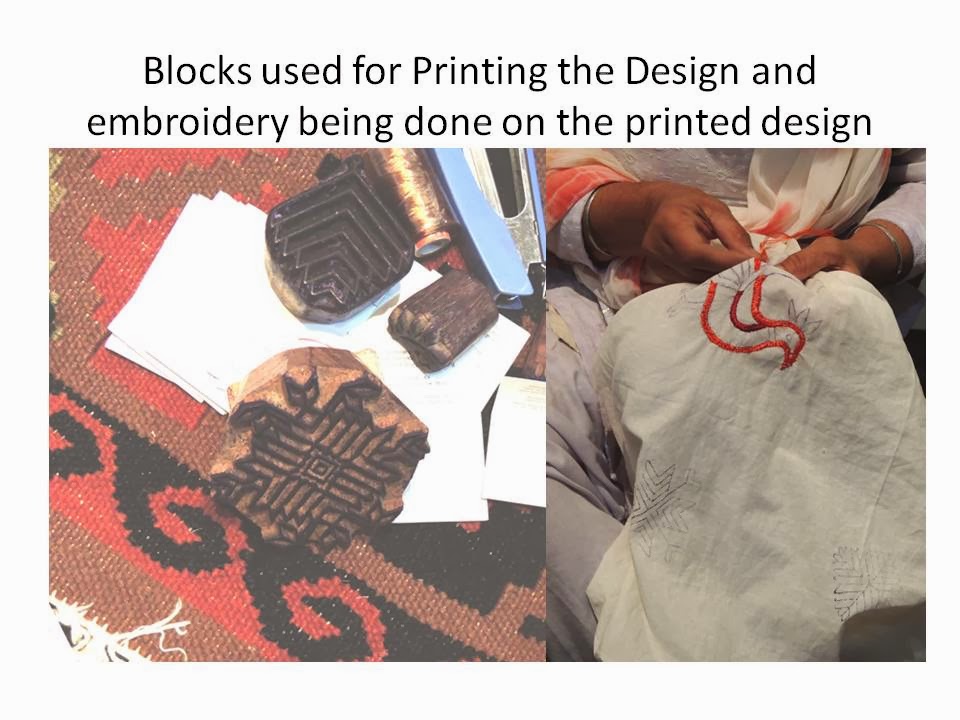
The embroideries, which were once created for personal use, are today made to earn a living. Far from reflecting their own creative sensibilities, the embroideries feed the demands of the urban traders who provide patterns printed on fabric pieces along with the thread required for the embroidery.

Exquisite embroidered textiles were also commissioned by the royalty, religious institutions and rich patrons. Influenced by Mughal karkhanas, in the early 18th century, Ramsinh Malam, under the patronage of Maharao Lakhpatji, set up many workshops in Bhuj and Mandvi to produce textiles and artefacts.

Highly skilled craftsmen were employed to create intricate embroideries and woven textiles, paintings, lacquer-work, enamel-work, jewellery, silverware and other artefacts. Under the royal patronage, vast quantities of superbly crafted pieces of art, architecture and textiles were created, which provided regular livelihood to a large number of artisans.

Hindu Mochis were employed to create the finest silk embroideries, while the Muslim artisans created grand, embossed gold thread embroideries. Mochis, the cobbler community artisans employed by the royal karkhanas, created intricate chain-stitch embroidery. They used a long awl to embroider on fabric. The embroideries were done mostly on satin silk, with threads of silk floss imported from China, which came in through the port at Mandvi.

A ghaghara piece in yellow satin silk, embroidered in chain stitch by a Mochi artisan was first exhibited at the Great Exhibition, in London, in 1851, and drew international attention to the richness of Kutchi embroidery. This was the first in a series of World Trade Fair exhibitions on culture and industry, the largest trade show the world had ever seen. Several varieties of Indian textile techniques were shown at the fair and Indian artisans were brought to Europe to demonstrate their skills.

From Kutch, embroidery, leather-work, silverware and jewellery were showcased at this exhibition. Owen Jones, one of the collectors for the exhibition, commented: ‘The Indian and Tunisian articles were the most perfect in design compared to any other that appeared in the exhibition. The Indian work, in particular, showed all the principles, all the unity, all the truth, for which we had looked elsewhere in vain.’  In this he echoed a broader admiration for Indian arts, crafts and textiles.
 
Personally, collaborating with craftspeople has been one of the most fruitful experiences of my life and I have learned as much about human relationships as about craft processes and techniques. It has become the base for my design vocabulary and has had an immense impact on my visual language and design practice.

 
Archana Shah is a graduate of NID. Inspired by all that she saw in Kutch and particularly the bandhani technique,  in the early 1980s, when she started her company to design and manufacture handcrafted clothing, she named it BANDHEJ – thus celebrating her ties and bonds with the Kutch region.


She has also written a visually sumptuous book on Kutch entitled ‘Shifting Sands’ published by Bandhej.


To buy the book at a special discount
contact: archana.bandhej@gmail.com

Thursday, 17 October 2013

Threads of Punjab


Bakshi Rana
I met Lajwanti[i] Parvati Maasi[ii], Prito Aunty and Bakshi Rana in April 2013 at the Indira Gandhi National Centre for Arts in New Delhi. They had travelled from Tripri[iii]  in Punjab, to demonstrate the art of Phulkari embroidery. But while sipping chai with them and chatting,  hearing their stories, I realised that they had travelled much farther than that.
 
They had all learned Phulkari out of choice, to fulfil an aspiration but, none of them did this work today, for the love of embroidery. They said it was ‘majboori’[iv] that they had to do it to earn, to keep a roof over their heads. Parvati Maasi, as everyone referred to her, was the oldest and also the most forthcoming of them all, that is, apart from Lajwanti whom they all work for and who was miffed with the change in policy at the Punjab Emporium in Delhi because this had taken away a large chunk of her business. Each of them had stories to tell about errant husbands and hardships borne. Bakshi Rana and Parvati Maasi had come to India from Pakistan at the time of Partition and they had some stories to tell about that too, even though they were very young at that time. But, it was their journey through Phulkari, as women who spent their days working with needle and thread, that interested me.
 
 Phulkari, which literally means ‘flower work/craft’, is the embroidery of rural Punjab. It was traditionally passed on from mothers to their daughter.  “Ih phulkari meri maan ne kadhi, iss noo ghut ghut jhaphiyan paawan” [“My dear mother has embroidered this Phulkari, I embrace it again and again with affection”] is a song that refers to the tradition where mothers [and grandmothers] embroidered shawls for the young bride-to-be of the family.  Prito Aunty aka Pritam Kaur recounted how she had made her own dowry, yet also spoke of the work she did today as majboori. When I asked what she would do if she had all the money she could ask for. Her reply was ironical. She said she would like to buy these fabrics like she had seen us urban women do. It was disconcerting to note that she had the wealth she sought in her own hands but did not see it as such.  When I said as much, she just kept quiet.

Prito had embroidered chaddars  and dupattas  as well as woven punja  dhurries to take with her to her new home. She was born in Kinnaur village, district Patiala, around 1963; her parents were poor and did ‘majdoori’[labour],  mostly making ‘manjees’[beds made from rope] . Her mother earned through doing some embroidery work too. Although traditionally this art was practiced mostly as a personal pursuit and not something for profit or sale, it was not uncommon for wealthy families to get others to do it for them, even though they themselves had learned Phulkari work.
 
In an article for ‘Threads and Voices[x]’ published by Marg, Jasleen Dhamija spoke of the crafting of these chaddars with such affection, sense of romance and nostalgia for a time past and personal reminisces of family life in Abottabad that, I began wondering if there was any history of this craft in my own family.  I almost wanted there to be something to link me with it.  After all, I am a Punjabi by birth even if I have never lived in Punjab and, I work with embroidery.  My mother hadn’t lived in Punjab either, but my father migrated with his family to Bombay, at the time of Partition, from Multan. Parvati Maasi and Bakshi Rana also came from the same region and had seen this work being done around them, so it was plausible.

My Naani  was from Kapurthala which is in the heart of Punjab but she was married at fourteen years of age and moved to Delhi, so this connection to the traditions of Punjab was clearly not a strong one.  My mother also said that, from the age of ten, Bibijee [xii] showed a deeply religious inclination and did not do any kind of embroidery or much else aside from taking care of her home and family, adding that her own grandmother, did not do any embroidery either but, she was a fabulous cook.   Well, that put paid to hopes of any thread of interest that I had in embroidery being drawn from family tradition, at least from my mother’s side of the family. Although we are Punjabi’s, Phulkari embroidery had not been passed down through generations in my family and when I think about it, I cannot remember  seeing anyone in my family wear these embroidered shawls either.

 Phulkari and Bagh are really colourful, embroidered shawls worn by the women of Punjab[xiii] and were enormously popular from 1850-1950 AD. Their origin is lost in time but it is thought that the tradition came into India with the migration of the Jat peoples from Central Asia[xiv]. There are apparently no references to Phulkari in classical Indian literature[xv], nor are there any surviving pieces from before the 1850’s.

 History tells us that the plains of Punjab were rich cotton growing areas and almost every village had a settlement of weavers who wove the hand spun yarn provided by their farming neighbours, in exchange for agricultural produce. Spinning was a household occupation. The untwisted skeins called ‘pat’ that were used as embroidery thread were imported from Afghanistan, Kashmir and Bengal. This silk was expensive and therefore not wasted on the reverse of the cloth. The stitches were made by counting the threads of the woven structure of the cloth – typically stitches are made at right angles so that the embroidered patterns reflect light, according to the direction of the stitches. The basic stitch is a darning stitch and, a Holbein stitch is used for the Phulkari called Chope[xvi] but, several other stitches are also employed, for outlining motifs and edging the piece.

Traditionally, Phulkari was done on thick, almost coarse, cotton fabric known as khaddar[xvii] where each colour had its own significance[xviii]. This khaddar fabric embroidered with striking floral patterns is the basic Phulkari. The embroidered shawls that are fully covered with embroidery, where you cannot see the fabric beneath are known as ‘Bagh’ or a garden. Three to four narrow loom cloths were joined to form the complete shawl, typically 4 x 8 feet in size. In some areas, particularly West Punjab the strips were first embroidered and then joined. In East Punjab, the panels were usually joined first and then embroidered across the whole cloth, including the seams, for a more coherent design. The predominant colours of silk used were gold and ivory – referred to as marigold and jasmine, or wheat and barley – reflecting the agricultural tradition of the region.

In north Punjab, another tradition developed known as Thirma which was made exclusively by Hindus and Sikhs. Their colours range from rich raspberry red to pink. In some pieces, large-scale triangles interrupt the long border on opposing sides. Placing of these triangles is significant, for when worn by a bride, the triangle falls over her head, symbolizing the auspicious ‘tilak’ worn on the forehead.

Apart from regional differences there are also religious differences. The geometrical designs primarily associated with Muslim communities reflect the Islamic restraint on figurative work. Hindu and Sikh Phulkaris incorporate human figures animals, flowers  and birds, presenting a rich repertoire of designs including myths and legends but they can also be quite abstract such as patterns that recreate the ‘maze’. Another feature of Phulkari is the deliberate mistake:  because only God is perfect, so either black was added or a part of the design was left unembroidered. This was also done to avert the evil eye. After 1920, the tradition of Phulkari is said to have declined with the introduction of poorer qualities of material and fewer stitches employed. However, it is Partition that marks the greater decline of this tradition[xix].

Parvati came to India, from Pakistan, in 1948. She was six years old and does not remember much except that it was cold. A truck took all those leaving her village of Bhawalpur to Khanpur, from where they took a train to Abhor. Parvati and her family then came to Patiala and were given government quarters. Her mother worked in people’s homes, washing clothes and dishes, and Parvati would accompany her. In the evenings, they used to embroider things for themselves, one evening a Rajasthani baniya[xx] passed by their galli,[xxi] saw them working and asked them to make some pieces for him. He gave them  the ‘chaddar’, ‘golle’ and anchor-wale lacche[xxii]Usse hum hoshiyar ho gaye, kaam karne lag gaye,” [we became wise to the profitability] and started working freelance, earning five to twenty-five paisa per motif, making one to two rupees a day. Lajwanti is a distant relative and when she started her business Parvati began working for her.

The Parvati that I met was obese; she was old with failing eyesight and diabetic but full of stories. She had retired from active work but came along with the others because they are family[xxiii]. All the four women were above fifty years and had long-standing relationships with Lajwanti. Most of Parvati’s family used to spin thread -“Gandhi wala charkha”[xxiv]– her mother, Naani and Parvati did spinning, more than embroidery even though they did embroidery for a living : “mn badde chakkar khaunda hai, Na khushi na dukhi – velli nahin baith sakdi hu, mn bahut khush haunda hai, kadhai karde karde” [the mind goes round and around. I feel neither happy nor sad. I just cannot sit idle, but when I am embroidering my mind is at peace.]

In the Marg article Jasleen wrote: “Ghoo ghuoo would go the lacquered charkha which my grandmother carried, much to my father’s irritation, all the way from Abbotabad when we moved to Delhi” adding that, the charkha was intertwined with memories of her childhood. It was her Dadi’s companion and she would spin everyday while reciting the Gurbani[xxv] or Pothwari[xxvi] songs from her childhood - “ghoo ghoo charkeya main kata ya na?”[shall I spin or not]. In Abbotabad, their ancestral home, the thread was then given to the Hindu weaver to weave and the Muslim dyer to dye a deep maroon or russet, her Dadi never dyed the fabric black or blue. Jasleen then recounts her Dadi sitting with Hazra Bibi, an expert embroiderer, who also looked after Jasleen, discussing what embroidery to do. Old, empty, English biscuit tins were filled with colourful silk threads bought from itinerant Aghani thread-sellers. Colours were selected and matched and the Phulkari work commenced by Hara Bibi, who apparently produced the finest work in that region. 
 
She also recalls karva chauth[xxvii] when her mother would dress up, wrapping herself in her wari-da-bagh[xxviii], which Jasleen’s fathers Dadi[xxix] had made for her.  Jasleen however, never learned the art as they had already left Abottabad when she would have been old enough to learn and her Dadiji never taught her. However, traditionally, she says, a girl learned to embroider from her paternal grandmother and mother, beginning with using cotton thread, graduating to embroidering her own dowry, when the older women in the family or around her, would smile and say that she was embroidering her own garden of happiness.  It was a common sight to see women sitting in an open court-yard embroidering and singing: “Bharam koiya shant, sehaj, swami, Pargas bhaiya kauul khilia” [when doubt in the mind is gone, there is peace and quietude my lord. Just as the sun rises and the lotus blooms.]


Ah! What nostalgia, but there was none of this in the stories
of the four women I met that day. They had only pain and hardship to recount. Bakshi Rana was born in Khanpur Pakistan and came to India in 1948 when she was around nine years old. She began doing Phulkari embroidery when she was about fifteen years of age. Watching others, “ik umang jaag uthi”, a desire came into being and she thought she would like to do it too. Around the same time, she was married to her dead sister’s husband, her brother-in-law, and widowed five years later at the age of twenty. Of all the four women, she seemed the saddest and wore a really haunted look. Her sister had four or five children [their stories all lack accuracy and clarity in telling] whom she brought up as her own. As I listened, I couldn’t help thinking, what a life! There was this fifteen year old with that faint desire in her heart to do some colourful embroidery work, possibly to create her own dowry, when her sister dies and the responsibility of her sibling’s family falls on her young shoulders. She doesn’t have the luxury of choosing her spouse or the pleasure of bearing her own children, so where then is there the luxury of desires and aspirations? The mind possibly shuts down all its imaginative faculties when faced with such circumstance.

It’s no wonder then, that umang turned into majboori. I keep wondering whether things would have been different if Partition had not happened and they had stayed in Pakistan, in their villages. Would these women have had different stories to recount?  As if reading my thoughts Parvati Maasi started singing this song: “Bande teri zindagi Waghe nadiya da paani, chaar din di bahar, ho hoshiyaar bandeya, nahin toh royega zaro zaar bandeya” [your life is like the waters of the river Wagah, the precious days of bliss may flow without your realising it, so be present and enjoy each day, for otherwise you will shed tears in regret for the rest of your life]

Embroidery is a great stress buster and I experience this first hand. These ladies also agreed that doing this work helps them deal with their lives in various ways and “sukoon milda hai”[xxx] but without the ability to think creatively, cultivate the imagination of women like Jasleen’s grandmother and those before her, who made things for their families, recording events in the family life through subtle changes in colour and pattern; without the freedom to do this, out of choice, for themselves, the work cannot have the same resonance and energy.

The quality of workmanship has changed. It was Punjab that was most affected with the advent of Partition and it is possible that this played its part in the decline of the art of Phulkari. But, I think that basically the creative spirit of the subcontinent had been stifled much before this. The process was slow and subtle and difficult to perceive or comprehend until things came to a head.

Indian textiles were enormously valued in the maritime trade of South-East Asia. These fabrics were used as currency for trade in spices which were prized by Europeans. Getting monopoly over Indian textiles was a way to profit in this trade. For Indonesians, the people from India who made the textiles they prized were considered gods. But when the Europeans came they did not understand the significance of this beyond the money they could make and the British were especially ruthless in this regard. Gradually, they changed the way that these fabrics were created and started introducing designs brought from Britain which were then copied and exported back. They stopped trading fabrics that the local artisans lovingly crafted, in much the same way that the women of Punjab used to embroider the Phulkaris [even though Phulkaris were not part of this trade] with marks and patterns that reflected their personal histories, investing the fabric with the labour of love.

When you take creativity out of anything you virtually kill the spirit of the person doing the work. The art of living,  understanding the freedom to create life the way you imagine it can be, which was intertwined with the concept of crafting in ancient India, is further being eroded by this frenetic age of technology.

The once creative craftsmen/artisans have become reduced to skilled labour[xxxi]. These women cite majboori as the reason they do embroidery. There is no personal investment or sense of creativity and joy. Living in poverty, personal grief and a lack of education has stifled the spirit of creativity through which humans thrive and grow. Can any art flourish and grow this way?


[i] Lajwanti has been awarded a master-craftsman award for phulkari. Born in Patiala in1953, she learned from her naaani and has worked in this field since a child. Her husband left her with small children [3 boys 2 girls] when she started this work as a business.  All her children have worked with her and are national craftsman awardees too. She has 500 women working for her in Tripri.
[ii] Like mother – mother’s sister is traditionally called maasi
[iii] near Patiala
[iv] Necessity/compulsion
[v] shawls
[vi] Veils/ lighter shawls
[vii] Richly patterned Dhurries [rugs] where a tool, which draws it design from the five fingers of the hand, is used to push the weft thread down.  
[x] Marg Publication, Mumbai. Volume 58, NO:4, edited by Laila Tyabji
[xi] mother’s mother
[xii] We addressed my naani as Bibijee – a traditional Punjabi way of addressing the female elders in the family
[xiii] This work was also done in parts of neighbouring Haryana
[xiv] Ancient European historical records and archaeological findings support that the Central Asian people such as Scythians, Samartians and Alans are possible forefathers of the modern Jats, in part.
[xv] The Embroidered Shawls of Punjab. John Grisham. Asian Embroidery edited by Jasleen Dhamija. 2004.Crafts Council of India
[xvi] The Chope is quite distinct from form the Phulkari and Bagh embroideries where bold patterns of stylized peacocks are embroidered in Holbein stitch with gold thread on a red/maroon khadi background.
[xvii] Coarse, cotton fabric woven on a pit loom, in plain weave.
[xviii] Four colors of khaddar were generally used where each color had its own significance– white used by old women or widows, red used by young girls and brides-to-be, blue and black were kept for daily use.
[xix] The Embroidered Shawls of Punjab. John Grisham. Asian Embroidery edited by Jasleen Dhamija. 2004. Crafts Council of India.
[xx] Trader from Rajasthan
[xxi] lane
[xxii] ‘Anchor’ [brand name] floss
[xxiii] I imagine there was also some business prudence involved as Lajwanti did not want her younger karigars[xxiii] poached upon
[xxiv] Spinning wheel used by Mahatma Gandhi
[xxv] Word of the Sikh gurus, usually sung
[xxvi] a dialect of Punjabi spoken widely by the population of the Potohar Plateau in Northern Pakistan.
[xxvii]  is an annual one-day festival celebrated by Hindu women in North India in which married women fast from sunrise to moonrise for the safety and longevity of their husbands
[xxviii] Is embroidered by the groom’s paternal grandmother in golden yellow silk. The grandmother begins to embroider when the boy is born and it often takes her ten years. The random appearance of different colours or change in pattern is not careless mistakes but represent significant events in the life of the family. The embroidery mirrors the family’s joys and sorrows so when the young bride is wrapped in this she is symbolically entering her husband’s family’s history
[xxix] Paternal grandmother
[xxx] We find peace and solace.
[xxxi] As designers many of us go into the villages and give them our designs to make. And my own experience and that of others is that even when given a free hand to create, they hesitate and prefer to be told what to make.