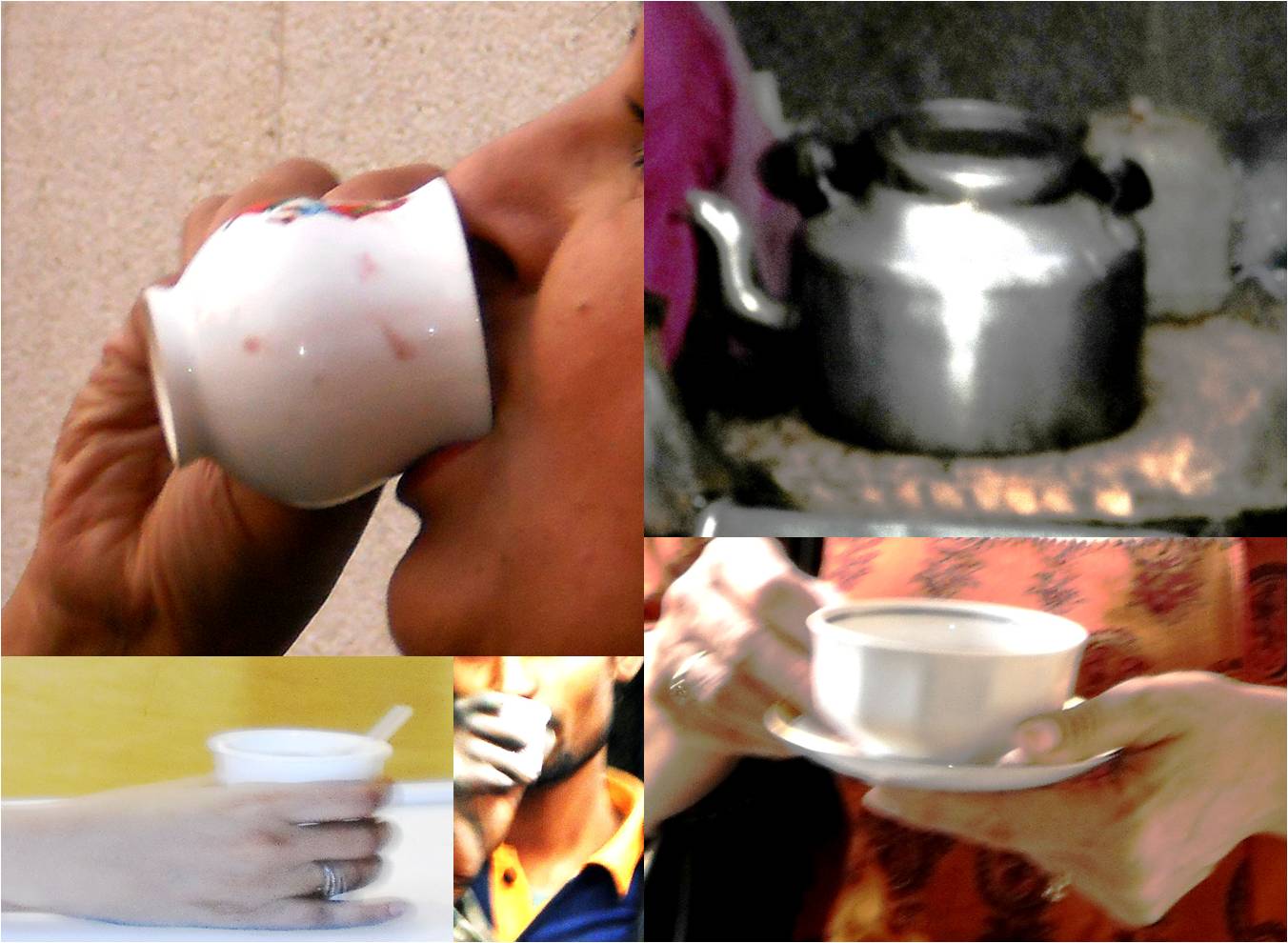
Wednesday, 4 January 2012

Voting Right

 Election time is when the circus comes to town. Auto rickshaws with banners and loudspeakers start blaring unintelligible gobbledy-gook, drowning the Koel’s lilting ‘cuhoo’, ‘cuhoo’ with unnecessary noise. The phone beeps incessantly with sms’s asking me to vote for the glass, spectacles, cycle, radio and other such symbols, Most, I didn’t even bother to read. The ex-sarpanch[i] of a nearby village, whose symbol was the glass, even though he professed to represent the Congress party [whose official symbol is the hand], announced his candidature for the Municipal Elections in Gurgaon with drumbeats that deafened. And his supporters seemed to do little more than litter the street in front of the building that I live in.  When I pointed out the mess to him, he said “Oh, don’t worry, we clean up everyday!” “Wouldn’t it have been better to provide dustbins for them to throw their litter, in the first place? “ I asked.

I take pride in exercising my franchise and always talk to my domestic help about fulfilling their civic obligations and this time was no exception. Taking cue from the drumbeats, which made it impossible for me to do any work, I walked into the kitchen. Isha, Mahipal and Priti had just made themselves a steel tumbler of tea each. It seemed like a good time to chat, so I asked what they thought about the upcoming elections. I expected to be greeted with the usual glum silence and downward, evasive glances and after persisting, hear the usual, “what’s the point, we don’t count” along with a host of complaints and excuses which I am no stranger to, or be told that they had not been able to register as voters. However, to my surprise, I found them not only looking forward to the election, but that they had devised a rather ingenuous system in their respective colonies to ensure their right was not subverted by the financial might of various candidates, unashamedly tempting them in return for their votes.
 
The day after elections when they came to work, I asked who they had voted for. Both Isha’s and Mahipal’s ‘teams’ had voted for the same candidate. Religion and caste had not been considered but what the candidate had done to better their locality. He had won, so excited at their victory, they opened up to reveal how they had been wooed by the various candidates.

They divide the area by ‘Jaati’[ii] which is not necessarily healthy, but it’s clearly a system that works. So Isha said that their ‘team’ had all the Muslims from the area and his wife was the ‘agent’ of the candidate they had decided to support. Mahipal added that his ‘team’ had been meeting for the last three Sundays, to debate who to vote for. And when campaigning started in earnest, they had to ensure that no member of their ‘team’ succumbed to temptation. Something had really changed. I had never heard any of this before. Maybe it was the municipal elections where they felt they had greater clarity, but I also considered that the propaganda via television had contributed to this changed attitude and maybe the recent spate of scams from telecom to the commonwealth games had made them want to take greater responsibility in governance. I was impressed.

Isha is a decent, honest guy. Mahipal is too, but he’s more complex. He likes to be the leader and often bullies me as well as the rest of the staff. Isha and his family didn’t take any of the gifts offered, but Mahipal did. He had told me a few days before that they were being feted in all sorts of ways and ‘sharaab’[iii] was being freely distributed. He likes to have a peg or two over the week-end, so I said, “one doesn’t know what kind of booze it is, so please don’t take chances”. With palpable excitement in his voice, he replied: “Madamji, English sharab hai, ‘Bagpiper’ baant rahe hai![iv] I shut up because did I really know of what went on at that level. No-one ever came to give us such stuff. The only candidate, who did campaign visibly, came a year ago to assist in the processing of our voter identity cards. The initial attempt failed, but he persisted and finally it’s thanks to his effort that I was able to vote this year.
 

There is clearly a distinction in the mind of the politicians with regard to what passes muster where. In addition to the whiskey, they were also offered unlimited Pepsi’s and money. And for about six to eight weeks prior to Election Day, some of the settlements were distributed free drinking water. Given that water in Gurgaon is virtually undrinkable unless you process it and for most, water is a scarcity, drinkable or not, it was a wonderful idea that dried up the day after elections because the said candidate lost.

I had listened to Isha and Mahipal regale me with stories that seemed so unreal but Priti my maid, corroborated. She and her husband are registered voters in U.P. and therefore were not offered or took any gifts, but witnessed many receiving them.

Mahipal got four bottles of Bagpiper whiskey. I was quite appalled to hear all of this, but I wanted to know more, so I asked Mahipal how much money he had received. He replied saying that he did not take any. I asked why not, if he could take the whiskey he could take the money too. He had been considering investing in a second-hand air-conditioner, [which he’d estimated would cost about two thousand rupees] so I said that the ten thousand rupees offered would have taken care of that and the running costs for a while too. Mahipal is what I would call a very strange mix. He likes the good things of life, owns a cooler, a TV, family-sized fridge, DVD player, a mobile phone that has two sim cards and also a TV. He drives a ‘Scooty’ wearing sun glasses, not the prescribed helmet and dresses in the latest fashion, albeit from the local bazaar. He must possess at least 6 pairs of jeans, with their back pockets all embroidered in different ways. He does not like hand-me-downs and has a lot of pride in accepting help even when needed. However, he is not so keen on education and although has studied till class 8 himself, has been diffident about adding to this or his son joining school, even though I’ve offered to pay.  
                                                                                         
I reiterated my question. Both Isha and Mahipal chorused in unison. “Money is another matter altogether and those who give money employ thugs to ensure that you cast your vote for them”. I said “How can they? No-one can know who you’ve voted for.” Mahipal replied, “Yes, but if you take money, you are bound, but booze and other stuff does not make you beholden”. I asked “How, what’s the difference?” He replied very quietly but firmly, “Paisa paisa hota hai, Madamji.  Imaan bhi toh koi cheej hoti hai![v]

He’s worked with me for almost twenty years and neither he nor Isha is more than 35 years old. They live in rented rooms, which often don’t have a proper roof but what they call a kacchi chath,[vi] problematic in the rains, the blistering summer heat or bitterly cold winters. They both earn about eight thousand rupees per month, accrued through moon-lighting in addition to their regular day-time jobs. Both work 12-14 hours a day, seven days of the week. I give them Sundays off to rest but they prefer to work  elsewhere instead.  
                             
 
They enjoyed being feted. With great pride, they outlined the system whereby they keep vigil on members of their designated ‘team’ to see that no-one defects from the plan and votes only for the candidate they have all decided upon. The man they voted for this year had worked to get the street lights and roads in order. They defined their priorities; often had heated discussions and worked hard to ensure no-one was bought over.  If someone had been thus inclined, they all worked to convince him or her of the larger interest.


We live in a country that is developing haphazardly. Technology and a growing consumer oriented culture have challenged traditional values and modes of communication. There is aspiration in everyone’s heart, including people like Mahipal and Isha. They may own mobile phones and that ilk, but they still can’t afford better housing. They are not well educated, barely literate at that, but they seem to have moral values that could put many to shame. They know that election time is the only time politicians pay any attention to them, but they voted for what benefited the larger interests of the community and not what enhanced their personal wealth by being bribed to vote with notes. They may not be rich but neither are their votes for sale to the highest bidder.
 
These were the people I probably interacted with the most, for I depended upon their daily presence and effort to cook, clean and take care of my plants and home but I had not been able to stand back and see them for who they were. Times had changed and they no longer needed me to educate them. They had a strong sense of what they considered right and wrong and were willing to take part in something that earlier didn’t interest them. Development may be disorganized; the technological revolution may be crowding our minds with information we cannot process adequately, but these factors, however chaotic, had empowered them in small, but definitive ways. They had found a voice. They were, it seems, standing up for themselves.


[i]Village elder
[ii] Caste [in this case religion]
[iii] alcohol
[iv] distributing
[v] Money is money, madamji, self-respect also counts for something
[vi] Temporary structure/roof

Monday, 28 November 2011

What Does Water Mean to You? [Yamuna-Elbe Art Project]


Wild grass and the Loha Pul 
[entrance to Project Y]
I was given a transparent, glass bowl of water from the Elbe River in Germany to hold in my hands. Another, identical bowl containing water from the River Yamuna lay on the table. I was then asked to think of what water meant to me. For a moment, I just went blank but slowly the memories came.
The first memory that I recounted to Ines was of a holiday we took as a family in 1971 to Manali and stayed in a log hut in the mountains, overlooking the roaring River Beas. I remember the sound as much as I do the way the water rushed down stream because I had spent hours, even days trying to capture its waters swirling around a huge boulder, on my canvas. It was a child’s painting; an inadequate representation of the awesome power of water. The roar of its force as a billion gallons ran down the mountainside at such speed is something I still listen out for whenever I am in the vicinity of mountains. But, have to confess that I have never found the experience to be quite as enthralling as this one, when I was twelve years old. What had drawn my attention was the way this fearsome, rapid water, ran over a huge boulder effortlessly, without stopping or struggling. Its ability to silently circumvent obstacles that came in its path, rather than bludgeon through, destroying them with wrath, is another facet I remember not being able to bring to life on the canvas. Much to my embarrassment, this painting hung on my father’s office wall, behind his desk for years, visible to every visitor or colleague. I have no idea why he was so proud of it but, being there, it reminded me again and again of my inadequacy to represent what I had felt and seen. 
Ines Lechleitner during
her performance [with me]

When Ines asked me to recount, I was unable to say all of this, but her art performance triggered this memory and I became curious.   Why did this particular recollection come to the fore? And not those of many afternoons spent on the Shikaras[i] on Dal Lake in Srinagar or the Thames in London on whose banks at Cheyne Walk I had lived for more than four years, as a student. I recollect standing on Battersea Bridge, in the freezing cold at night, to draw the night lights on Albert Bridge. I also remember visiting the Niagara Falls, again in winter, and walking through icicles. There have been so the many water bodies I have encountered on my travels, in Scotland or even on the Okinawa islands in Japan, but it was this early memory that was foremost, not the others.
When we moved to Delhi from Calcutta in 1969, we lived in Maharani Bagh and then later in Friends Colony [East], both of which are close to the River Yamuna. I remember one year, I think it was 1977 or maybe 1978, when the Yamuna almost flooded. We would go to the embankment every evening to see the level the water had risen to. One day when it reached just about 1” below the wall in Kalindi, we were told that even a millimetre above the wall would cause massive flooding.  Everyone moved all their furniture to the first floor, but thankfully the flood never came. The water receded and somehow the Yamuna has never been quite the same again.


Atul Bhalla's Installation against
the Loha Pul
Recently, an afternoon in November, looking at the Yamuna-Elbe public art project, at the DDA Jubilee Park, near Old Delhi, on the banks of the River Yamuna, I wandered through Atul Bhalla’s installations of massive off-white, opaque, cloth and papier mache structures shaped like water bottles, embedded at all angles into the grey sand of the river bed. Each had a question beside it, drawn from the epic Mahabharata when the Yaksha or river spirit had asked the Pandava brothers why they should be allowed to drink from her resource. Atul posed some of these questions in Hindi. A small font below this, giving the English translation asked: “What should my revolt be, what is my place, what is my insanity?”   He posed the questions in reference to the river but without spelling it out, so the question could be about you too.

Sheba Chachhi's Installation on the
River Yamuna

I thought of myself as the River Yamuna and wondered what she would think of her place in contemporary society.  A river, people now, only visit to immerse ashes of their dead; she is no longer the water body that was once revered. Her revolt seems to be in evidence. Her water is undrinkable. Most localities in Delhi do not have sufficient potable water, but we have not yet learned. We still dump our waste in this. Later, as I took a motor boat to see Asim Waqif's installation in the water and also Sheba Chhachhi’s  white, unidentified, almost-abstract, floating form that could have been a yoni, or two legs or even two arms with hands held together in prayer, the stench was devastating. It smelt of sewage and, as Atul put it, all the drains of Delhi lead into the Yamuna; therefore it’s really no better than a sewer.  Her insanity was in evidence too; she endured, had endured for centuries and that she still flows is testimony to this. It reminded me of the River Beas I had tried to capture in all its fury running down huge boulders, gently caressing the surface, circumventing the rocks as if in complete understanding and acceptance of their role in the eco-system, however irksome to the river’s flow. 
Black water reflects the
sunset to perfection

The Yamuna water looked black, reflecting the sunset to perfection and had it not been for the stench, silhouettes of the birds that flew overhead would have made a wonderful picture, on this dark surface, reflecting a pinkish-russet sunset. The many faces of nature are baffling indeed, making me consider whether we can ever fully grasp this.
Atul on the motor-boat ride,
Asim Waqif's installation behind him

 Environmentalists and now artists are crying about an imbalance in the eco-system, implying we are not taking cognisance of its fragility and, I wonder, whether it’s the fragility of nature at stake or the fragility of man to accept his own power of harnessing nature with the same grace that this water seems to accept our offerings of plastic bags, waste and marigold as well as ashes of cremated bodies. I recollect Art of Living’s Sri Sri Ravi Shankar had spoken about a campaign for cleaning up the Yamuna, so asked Atul who accompanied me on the motor-boat ride, what happened to that project and was told: “All these campaigns are mere theatrics. We need massive sewage treatment plants to clean up this river.”
Gigi Scaria's Tower

Gigi Scaria’s tower, meant to purify the water threw up a fountain of really dirty water – the tower spouted a darkish liquid, which was anything put purified.  Showing us just how putrefied this water had become. Yet the bowl of water that Ines had collected was not that bad. It was not quite as clean as the water she had carried from the Elbe, but just slightly hazier than this, not the muddy fountain that was being spewed from Gigi’s purification tower. Leaving yet another trail of thought and questions about the real state of its being and also about our perception of things: how a glass bowl, with its own transparency, seemed to clarify what looked immensely black when I rowed its depth and equally dark and threatening as it seemingly refused to be cleansed by an artist’s endeavour, as if mocking his attempt.
Chappals and the keechad

What the future holds in respect of our natural resources, whether nature will inflict her fury or man will self-destruct are questions no-one has answers for.  Project Y did however make me question various parameters of existence, recollect memories, roam uninhibitedly on the sand, letting the reta mitti[ii] sift through my chappalled[iii] feet, walk among the wild, uncultivated foliage - mostly rushes and weeds, and through  keechad[iv], feeling liberated from the otherwise constraining factors of urban living. I was blissfully able to disconnect with this, let go of the need to control the emotions in order to get by. Inspired by the water and her philosophy I re-discovered compassion; however insane it may seem in a world where being ruthless is admired and goodness is seen as naive and foolish.


Still from Vivan Sundaram's video
Finishing off my exploration with a cup of tea, I chatted with Deeksha Nath, her mother, her seventeen month old son and husband Kabir, Meera Menezes and Atul Bhalla. Rounded off the experience watching Vivan Sundaram’s video of his homage to the Yamuna showing a raft made of thousands of ‘Himalaya spring water’ plastic bottles, the caps all the same tone of bright, chameli [v]pink being lowered onto the waters of the Yamuna and rowed with a priest seated on it, dressed in full regalia. As the journey was deemed finished, the raft of plastic water bottles was ruthlessly broken into pieces, on camera.  It was a visually seductive video with the pink bottle caps and the Loha Pul[vi] in the background. A major landmark of the Jubilee Gardens, the iron railway-cum-motor bridge carries, to this day, trains and cars to and from Old Delhi railway station. In all the years I have lived in Delhi, I have no recollection of this bridge or, for that matter even taking a train from Old Delhi Railway Station. However, I did reach there today by travelling on this bridge; a novel experience indeed.
Asim Waqif's Installation
against the Bridge

Inside the car on the Loha Pul
en route to Project Y
The River Yamuna was there when the Mughal’ s built their forts, the British came to trade and stayed to rule and also when they went and the blood of partition brought   thousands from Pakistan who settled in Delhi. She was there when the Pandavas of the Mahabharat were in exile and she is there today.  This river has been able to endure much more than we give nature credit for. Maybe the fear we have of eroding her resources is just a perception based upon a limited exploration of our own expandable and enduring nature? It’s not that I condone the filth and stench. We certainly have to find the means to cleanse this water body; we must re-pay the debt of her life-sustaining water. But for me this exploration on the banks of the Yamuna has been more of an inspiration than a lament. The River has seen interesting times. Her nature is enduring, her muteness seems foolish yet, is also wise in thus accepting her designate role in life; flowing from one state to the next. Isn’t this the stuff that all our lives are made of?


[i] Kind of boat
[ii] Grey sand
[iii] Slipper[ed]
[iv] sludge
[v] Fuchsia pink
[vi] Iron bridge


Monday, 14 November 2011

Earl Grey and Other People

Earl Grey has a mildly citrus flavour and that fragrance of bergamot I so love. I’m referring to Earl Grey the tea and not Earl Grey who was the British prime minister in the 1800s, after whom this tea is named. Each tea bag has been filled with a specific quantity and variety of tea leaf, cultivated using a particular soil, grown in a particular climate and blended in a particular way to provide a specific flavour. We can have the same tea-leaf plucked at differing seasons to give a different flavour and blend of tea. The whole process of growing and blending tea is quite complex but I know what I like to drink. On most mornings it’s ‘Twinings Earl Grey’ that graces my tray.  I could write eulogies about its flavour and whatever else but I cannot change its nature and particular taste, nor expect it to do anything other than make tea. Well, soak in the heated water, so that I can make a cup of tea. 
 
Morning tea-time is inevitably a time of reflection on the previous day, unresolved thoughts left over from earlier in the week, and more. Tea, like most people and things around me, has become a kind of reference point to deal with many issues. I enjoy a variety of teas but when I pick Earl Grey, I know what to expect and do not expect it to taste like Japanese Sencha or Echinacea, nor want it to.

 
But, that is not what I seem to do with myself and also with other people. I have an inherent need for everything to be orderly and rational; expect everything to get done with a minimum of fuss. And most of all, in a state of being that is calm, never disturbed. It is when this does not happen, that I chide myself, wish things were different, that I had greater control over my emotions and the power to just breeze through life. I also wish that people around me [the way they behave] were other than what they are. There have been times when I’ve expected people to respond to circumstance in the way I would, thinking there cannot be another way, that as humans beings we must be the same. And if they didn’t, which inevitably did happen, I’d dissect the whole thing and after venting, when the mind was calmer, I’d see how my expectations were not reasonable. Gradually I started realizing that the beauty of life actually lay in this diversity of being. And others were only reflecting ideas that lay latent in my mind, surprisingly unknown to me.
 
Even as we are essentially the same, the nature of being human appears to be a complex phenomenon. We are different aspects of the same, have the same essential spirit, but are never the same. Being so, would defy the very nature of the duality of being. Just as tea comes basically from the two main species of the Camellia family, grown in China and India, we are all of the same species of Homo sapiens. But just like there are many hybrids of these two tea bushes, we humans too have differing characteristics within the same species. Not everyone is sensitive, compassionate, stubborn or selfish. Some of all human tendencies must be prevalent in each one of us, but in varying degrees, and each of us has certain defining characteristics. Some of which are genetic, some are learned, and some are cultural and environmental. It can get quite confusing because each of us has so many layers of familial and cultural histories that frame our being and thinking, but drawing this parallel with tea enables one to look at things more objectively.  And this morning, it was a refreshing reminder to start off the day. 

Taking this analogy with tea a little further, I thought, if I do not like someone – the way they taste, what I mean is - the experience of being with them, then all that is required is to not drink that flavour again. Seems simple ha!


But with people it is another story altogether. It’s been said that what occurs in life is what we have manifested by virtue of our feelings. Now that is a tough one. There’s no-one to blame for the people you bring into your life, including the family you were born into. We have supposedly felt a certain way, harboured certain ideas and therefore these people are there to create that particular experience. And unlike dumping a tea bag into the bin, or leaving a cup of tea half-drunk if I don’t like it, with people it pans out differently. We have to go through the experience. Understand its significance in our lives and in defining us by looking at the reflection it presents: of what I appear to be and think or feel and so on and so forth. Each experience has been a process in realizing the deeper truths of my being; understanding people better and handling life with less anxiety. Watching oneself live is a fascinating process. It’s also hard work. And even though this has been a daily discipline for years, the process is not quite fool-proof yet. I still lament having to extricate myself out of painful circumstances. And I ask myself, why? Why do you keep doing this? Asking no-one in particular, but perhaps my deeper sub-consciousness, whether it ever stops: these mistakes – the missed-takes that I don’t seem to get past?

Tea is an important ritual in my life, a refreshing drink at best, sometimes nourishing too. However, I can live without tea. But people, on the other hand, are not so easy to dismiss. Some yogis and spiritual aspirants do seem to eschew involved relationships but as long as one lives [unless you retire into some remote forest with only wild animals for company] human relationships seem to be the fulcrum of life. Without them there is nothing to do. Just imagine being born on earth and there being no-one else around. Who would teach you how to walk or talk, prod you into yelling, allowing you to experience that emotion of anger? Who would move you to tears, to write verse of love and longing? Compare yourself with? Compete with and more? Who would you fight with? [Imagine there being no Mahabharata, especially its sagacious wisdom on the art of asserting your truth/dharma as outlined in the Gita]. Seems pretty awesome, to consider this emptiness: the futility of a life without the noise one usually bitches about. But then the question arises: why is living with people such an arduous experience? A life-time can go past and one still doesn’t quite know what to make of people, even those close to you, with whom you may have spent the better part of your life.
 
It’s not easy for most, but when you are sensitive and intense, it’s especially hard to succinctly communicate the fullness of what you see and feel in any given circumstance. So one’s emotions tend to get into a mess. In order to extricate one self from this, most of us have to argue, discuss, think and re-define ideas before we can move on. This I have to confess I do find irksome. Why does it take so much time and energy just to get simple points across? But there is no question of avoiding these confrontations. Sometimes, we think we do: we all talk of moving on but the fact is that we re-create circumstances that generate similar feelings unless we have dealt with them. The faces may change but unless realization dawns of what it is that we do and why, things never really change.
 
Sometimes, strangely, I’ve forgotten what I have been capable of feeling in relation to a particular situation and or person and returned with gusto that I’ve regretted. When there is a distance, when the pain or irritation is a dull memory, it seems as if I’ve dreamt up the whole thing. But people don’t change, most don’t even grow up. What I mean is that we all age, but don’t necessarily become emotionally mature. Overcoming our pain and negative feelings is hard work. So at best our cries get muffled, consequently creating complex, un-de-code-able, irrational behaviour patterns that are difficult to live with. Living without people is not an option; living harmoniously with them takes a great deal of skill; balancing the inner, emotional landscape while also managing our interactions on the physical plane. Living together, I have realized is an art, perhaps the greatest of all human endeavour. 
 
If the teas leaves bound together in this small, almost opaque paper bag, whose brew I now sip, could speak, I wonder what they would say about their experiences of dealing with the logistics of compassion and compromise, so essential to a happy co-existence in any limited space.


This story is also available as an audio recording on You Tube, recorded by Suraj Andrews       https://youtu.be/jGa2jDI1HzQ


Tuesday, 18 October 2011

Gera Lagella Re

It was sometime around 1993/94 that I walked into an exhibition at the Shridharani Gallery at Triveni Kala Sangam to see its walls hung with quaint water-colour and gouache drawings of everyday things. One was of a brightly coloured chair almost floating in space [I think it may have been in shades of red.] It did not evoke a Van Gogh-like angst, but was a light-hearted presentation of a young girl’s view of things. The work and the artist’s effervescent personality stayed with me. We met again a few years later. She had married and her work had grown from the charming intimate details of the world around her, to large canvasses and elaborately detailed but quasi-abstract paintings on expensive Japanese paper.

We remained in touch but it was only when we both moved to Gurgaon, she some three years after I had, that we renewed the earlier connection. Strangely, both had similar stories to tell, of how living in Gurgaon had somehow shaken us out of our complacency and sense of self.

Early June 2011, I went to see her at her home on the 8th floor of Central Park in DLF. She was dressed casually, no make-up, wearing a skimpy, pink T with spaghetti straps and a pair of white Bermuda pants. She answered my door-bell, welcoming me to her new home with their pet dog, a Boxer named Rustom and two lanky young boys in tow. I had never met Angad her younger son and Amir was a toddler when I last saw him, but they both gave me a delightful, tight hug. Her apartment is a veritable art gallery; every nook has a hook from which hangs a prized work of art belonging to friends and other artists. Works by Nasreen Mohammedi, Ramchandran, Shiela Makhijani, Mrilani Mukherjee, Christine Michael and many, many others adorn the walls along with collected stones and Japanese tea cups to gravel, artefacts, sculptures and a bowl full of very tempting, rich and dark, sticky-jaw toffees; adding to that sense of plentiful.

We had tea and chatted. The not-so common, deep rusty-brown mugs with glistening blue dimples on the surface and a bright cobalt glaze on the inside, that we drank from, with their matter of fact, grip-me-tight handles, had a distinct reflection of the Manisha I know: ebullient, sensual, colourful, earthy; a no-nonsense girl with natural grace. She darted between the kitchen and living room area, tending to a sick maid, looked in to see if her parents, who were visiting were comfortable, hollered at the boys and the dog. Persuaded them to go down and play and then relaxed effortlessly as if all that had been just a teeny-weeny blip on the screen of her mind. I looked at the work she was currently doing, reflecting back to the early paintings.. However, as we talked I began realizing that as mother, wife, daughter, artist and now writer too, her attention was divided and she was looking within rather than at the external world to grapple with the growing complexity of her life.

Manisha’s work has changed. She mentioned feeling cut off from her life-style and friends in Delhi for whom the distance is a deterrent to come visit. Maybe this was reason for the change? Despite the crowding she had spoken of in terms of physical space [of a smaller home] and also of time, certain quietude has entered her visual language Bright colours no longer dominate the paper.


Delicate pencil lines evocative of long strands of hair blowing in a gentle breeze; held together tenderly with an exotic band, tied at a point nearing its ends, caught my eye. Two milky-white pages of coarse-grained, expensive water-colour paper that were joined were judiciously filled with gentle marks, confined to the centre of the page, running across it horizontally. The rest was left blank.  The pencil rendering had a meditative quality.

On another sheet, vertebrae-like forms, in a similar rendition, using pencil and very little colour, looked like they were being skewered. The skewer was upright, going through the centre of the page and looked like the spine of someone seated. “A strange kind of ‘shashlik[i]’ that would make” I thought; but the bottom-most one was wrapped in a lushly painted maroon pouch, as if it was something precious. “Protecting it from the heat of the oven, it would eventually get cooked in?” I murmured to myself. Despite my rather visceral imaginative musings, the drawing itself was subtly nuanced and almost stark by comparison, with its delicate pencil markings and sparing application of colour.

I saw in her attachment to what had been, denoted by the preciously wrapped, first vertebrae, [which traditionally symbolizes the first step on the spiritual journey], as a reflection of my own reluctance to willingly go deeper within, often needing the crush of experience and engagement to compel introspection.

For me too, it’s not been easy settling into Palam Vihar, on the other side of DLF. This experience has been fraught with anger and frustration and making friends even harder after moving from Friends Colony in Delhi, where I had lived for more than 20 years. Also, the cultural events that I enjoy happen mostly in Delhi. Palam Vihar is culturally barren. Aside from a ‘Big cinema’ that usually shows only Hindi movies, there is nothing I find to do here and feel quite isolated both intellectually and socially. This has meant I have to frequently make the hour-long trek into Delhi to keep in touch with people and the world of art. This along with other issues like noise pollution and handling the vagaries of condominium living and its management has demanded greater mental efficiency. It can get quite chaotic inside my head, creating the necessity of learning to handle life and people with greater detachment. Taking me deeper inwards, working more and more on the turmoil of emotions created by a more interactive life, to try and achieve this.

I know it is a futile endeavour to resist change. However, when one has the energy to breeze through the daily up’s and downs, it becomes hard to wilfully bring in change, disturbing a hard-earned equanimity. Moving to Gurgaon had done this to both of us in differing, yet not so different ways. For whatever the situation or circumstance that arose, both had been pushed to question our sense of self. It seemed that we challenged ourselves with this circumstance, to compel us enter deeper recesses to discover a hitherto unknown ambition and the potential to work towards its fulfilment, restructuring our lives in ways that would earlier have been unimaginable.

Was there any other way, I wondered? I imagine only few very adventurous people would knowingly take a plunge into the unknown. It needs a lot more than simple courage to change your life-style, welcome a whole truck-load of people, strange places, customs and an altered routine. It was at this point in my thought-filled meandering that I caught sight of cars piling up on the Golf Course Road just in front of Manisha’s apartment building and hurried home to avoid being stuck in Gurgaon’s famed office-hour traffic jam.


[i] Skewered kebabs

Wednesday, 14 September 2011

Jehangir

April was quite pleasant this year so I decided to walk to my singing class; camera in hand, looking out for chai wala’s. I found one on the kerb opposite Ansal Plaza in Palam Vihar, and promptly focussed the lens, capturing details of the cart, kettle, glass and utensils. The biscuit canisters and sachets of gutka that hung like a curtain around the cart, didn’t give a clear view of the person’s face. When he emerged from behind this to serve a customer, I zoomed in, and it dawned upon me that ‘the person’ was a child, no more than ten or twelve years old.

Dark brown skin, coal-black hair locks brushing sweat droplets on forehead, a gently furrowed brow and narrowed eyes looked at me. There was none of that expectant, wide-open child-like curiosity nor was he willing to have his photograph taken, as children usually do. With small hands, barely able to clutch the black handle, he lifted a large aluminium kettle filled with tea, pouring the hot liquid into a ridged, short glass  held with the other hand. A pouting lower lip and the beads of sweat were the only signs that this was not such a simple task. Long eye-lashes and this face of innocence almost lost, stopped my tourist-like voyeuristic photographing. I felt disturbed.

Just then a big man came into the frame. I asked, “Is he your son” to which he replied “you could say that”. I could not restrain myself, and said “do you realize that he is under age and making him work for you is against the law?” This was greeted with silence, but I saw a glint in the boy’s eyes which emboldened me to continue, saying that if he is like a son, he should educate the boy. “He could go to evening school”, I suggested tentatively. The boy beamed, but the burly man was silent. I had probably opened Pandora’s Box; this made me feel guilty.

I was not very happy with myself and didn’t quite know what to do now, so walked on. About ten yards from this tea stall a Police Gypsy was parked under the shade of a tree; I stopped and addressed the officers Jaichand and Bhagwan Dass, asking why they permitted this man to employ a child. Very politely they said “Ma’am, it is not quite so simple; their parents send them to earn. It’s a question of survival. This boy is probably the oldest and there are more mouths to feed at home.” I was not unaware of such practices. A maid I had once employed told me, she had started working aged nine years, caring for a six year old child, while its parents went to work. So I knew there was truth in what they said; but persisted nonetheless, asking them to prevail upon the owner of the tea-stall, to at least do something to educate him.

For days I thought about the boy and the law which decreed that employing a child under fourteen was a crime. How was one to implement this in the face of the situation I had encountered? I spoke to some people who engage in social work and they all said it really was a very complex situation to which there were no easy answers. Gradually, I started looking at it from a different perspective. I thought about the fact that this child and all the people who work on the street do so because they have custom. They provide cheap tea for those who can’t pay more. They do it for a living, working in gruelling conditions that I could never withstand. I started appreciating his courage. I saw a spiritedness that I now admired, rather than feeling sorry for him. I felt that instead of wanting to change the world, what one possibly needed was to accept it for what it was; see people in difficult situations as an inspiration; appreciate facets of their existence rather than seek to change this to fit some ideal that I may deem appropriate.

For a couple of hours I was at peace and managed to get some work done, but grew restless again. I felt inadequate, powerless. What was the point of having a law if it couldn’t be implemented? What was the point of my privilege and education if all I could do was observe? Wasn’t this really just another way of saying look the other way, because I was reluctant to get involved? If I admired the courage and spirit in a child who laboured in hostile conditions, where was my courage and spirit, if the best I could do was to only change my perspective? So I went back to the tea stall outside Ansal Plaza and talked to the boy, asked if he would like to study.

The first time that I’d seen him he was dressed in a clean, gold, grey and white, horizontal striped T-shirt and looked different. Today, he wore a dirty white one, looked really scruffy and despite pouring over his photo for days, I found it hard to recognize him. He greeted my question with silence. Then went to the burly man and said something but didn’t come back to me, so I went up and reminded the man that I’d been here a couple of weeks ago, taking pictures. He assured me good-naturedly, that he remembered me well. I said that if the boy wanted to study, I would like to help.

The principal of a government school lived in the same condominium as I did and one of the women in my tower ran a small school for servant’s children, so I was hopeful of being able to help. The boy murmured something to the big man, who informed me that he has a father and has to ask him. So I said, “You do that and I shall come again”. I came home and made some phone calls and was told that by law no school could refuse to enrol him if he was less than fourteen years of age. I felt reassured that I hadn’t raised his hopes for nothing.

The next day, en route to Delhi, I stopped by to ask what they had decided. His father, a cycle-rickshaw-wala, had apparently refused my offer to help educate him. On asking the boy what he wanted to do, I got no response. I persisted, so he said they were returning to their village in Bengal. I asked when he’d be back; to be informed that they may not return. I promised to look out for him and take up the matter again, adding that he should think about it.
Till then I had not asked his name. He was Jehangir. When Bhupinder, the driver heard him tell me, he promptly said “Ma’am yeh mussalman hai, yeh nahin padenge![i]” I was stunned to hear this generalized and prejudiced view but realized that our social structure is very complex and people like Jehangir and Bhupinder have grown up with different values. Their ideas, however inappropriate I think them to be, are not going to be easy to change. In their view of the world, my ideals could well be misplaced.

Frankly, I had not been too surprised at Jehangir’s father’s response. It was not the first time I had offered to educate someone and been turned away. Even those who were willing didn’t persist beyond a couple of days. Something clearly intimidated them and none had been willing to share. But Mahipal, one of my servants, put it into some perspective when he said that he’d studied up to class VIII, but was still a servant, so what had education done to change this? It’s not an argument I accept, but do see that a great deal needs to change for education to be valued beyond being the means to an enhanced livelihood or life-style.

Although I felt better for trying, I am not certain that Jehangir will take up the challenge. It’s possible that the tea-stall owner, however amiable he may have seemed in the face of my probing, may have compelled Jehangir’s father to refuse the offer. A number of factors could be at play that I would never know of. I asked myself how far I was prepared to go with this. Could I really invest the energy it would require to push this through? Would it be appropriate if he and his family were not willing?


[i] Ma’am  he’s Muslim, they won’t study [not interested in education]