Tuesday, 25 September 2018

Mynapi Waterfall Trek - Negotiating the Rivers of Human Terrain


I'm totally zombied out. Sitting in bed, looking at the sun dappled bamboo outside my window, I'm finding it difficult to express the experience I underwent yesterday. All through the drive back home, I kept checking in to figure out what I was feeling and drew a blank. Such as I often do when any event is overwhelming or extremely challenging. It had been a long and arduous day but I wasn't tired, even though my body was hurting. I was in a nirvanic – a beyond words, kind of space.
 
I woke at 5am to leave for Panjim by 6am, to meet Bianca and Bjorn and their team from Off-trail Adventures by 7am. I had to park my car at Patto Plaza, walk across to the other side of the Panjim-Ponda Road, meet the other trekkers at Heera Petrol pump and board the bus that would transport us to the location.
 
 
Strapped with a ten litre backpack, a fanny pack with my phones and emergency essentials, and carrying yet another bag with a change of clothes, more water and food, I ambled across, the ten minute distance, without demur. Ordinarily, I would have scouted for help, but I had signed up for a day long trail where I was supposed to traverse 18 kms, so this was just the start.
 
 
Picking up people along the way at Cortalim Junction, Verna and Margao, we reached Quepem at 8.40 am for a quick breakfast. Before leaving for the final hour-long bus lap towards the Netrawali Wild Life Sanctuary, where the expedition officially begins.
 
 
 Goa is so green in the monsoon that it's a delight for the eyes. And the emeraldic-leaf green of the paddy is a very special colour. Unlike any hue in my paint or thread palette. But, this agrarian landscape wasn't a patch on the virgin forests that unfolded as we tread the terrain of the Western Ghats.


It was my first hike of this kind and that too as I completing sixty years of age. It was ambitious but I had no idea of the agony my frame would go through as I negotiated smooth rocks, wet and slippery with slime, the possibility of leeches shimmying up my flesh unseen to suck warm blood and more. And, when I got home at 9 pm, fifteen hours later, the top of my thigh muscles were stiff – more like rigor mortis rigid, but it was my big toes that were wailing louder than the cicadas of the forest. Even the gentle touch of the light quilt I sleep with, was evoking yowls of pain. And to top it all, grasping at crevices to find a grip, at the very edge, before we glimpsed the Mynapi waterfall, I think I may have cracked the middle finger on my left hand. Or at the very least pulled a muscle. I had to put the full weight of my 65kg on hands and knees to scramble up. They're not used to it.
 
 
Today, I've tried to get up and about as I would a normal day, but if I sit or stand, it's really painful. My shoulders are speaking of their burden (which wasn't much more than a litre of water, light trekking sandals, a sandwich, a light raincoat-which was pointless to wear) and 10gms of salted Kaju. But, I'm inclined to think the load has more to do with feeling exhilarated by an situation and occurrences that tested me at so many levels and left me relatively immobilized. And, it is my inability to put this entire venture into any comprehensive perspective that’s keeping the mind in a spin. I've not really wanted to get on with my usual day or do anything other than look at the pictures and re-live those moments. Or search online for things like shock-proof sticks and dry bags so that I'm better prepared next time. And a better pair of shoes too!
 
 
 Yes, there has to be a next time. Being so close to nature, without the trappings of urban behavioural niceties, I felt the rawness of fear. I faced the power of the resolve: ‘I have to find a way’. I grappled on all fours, heaving myself up or slithering down on my butt. All very ungainly and un-lady-like, and in full view of strangers – all of them, mostly youngsters in their late twenties or early thirties. It was a no-holds barred episode. It was a getting in touch with yourself encounter like nothing else I have associated with. A revealing confrontation at that.


As we entered the sanctuary, leaving the bus behind, we strolled along a tarred, regular road but within minutes turned off to the left, towards the Mynapi falls. The signpost said 4.5 kms. Very doable I thought. Since the age of 34 years, when I'd become aware of the merits of some exercise, I've been striding exactly this much each evening - down Walkers Lane in Friends Colony (East), in New Delhi- topping it up with swimming and cycling, so I thought it was going to be par for the course. Yes, uphill for sure, because we were going to the waterfalls, but just a couple of years ago I'd done the haul from Gethia up to Nainital and back and also climbed up and down Matunga Hill in Hampi, at the crack of dawn, wearing plastic Crocs without a strap. That had been quite scary too because it had rained and the boulders in Hampi, well they’re something else. So I thought I was prepared. Doubt hadn't even entered my head.


As we entered the forested area, I could hear an uprising of some insects. It was as if they were wailing that their coveted greens were being invaded. I was told they are the cicadas – extremely small but very noisy. And yes, they could really cook up a racket. I was looking around eagerly, at flowers and the tall foliage, growing higher than us. Reminding myself to keep my gaze focussed on whoever was ahead of me lest I lose sight. We bent lower than low, crouching under boughs and leapt over fallen or felled tree trunks lying in the path. Trampled over a seemingly unending carpet of leaves, red, green, brown, blackening as they composted themselves back into the earth. The light on them glinting as if shining off silver. It was an overcast day, but no rain yet. I couldn't imagine what they'd look like on a sunny day. Even as the tall forestation probably doesn't let in much light anyway. But the mulching leaves fascinated me – especially the blackened ones.


An adept trekker classmate of mine had shared a few tips. She'd suggested changing into sandals as we crossed the rivers and streams, advising that it's best not to keep your feet in wet shoes and socks all day long. But we came upon a narrow rivulet within fifteen minutes and it was barely four feet wide, so I didn't change. I couldn't bring myself to stop to change and revert back into Keds after a minute’s stride. My socks and shoes were now wet and we later strode 3-4 kms in the river itself. With uneven rocks, often jagged and pointed, where I needed to lodge my feet in whatever gaps I could find, I cannot envision the state of my feet without the protective covering of my socks and shoes. Even though the wet and confined feet did eventually lead to unbearable pain and a mild infection necessitating antibiotics and loss of toe-nail. t didn’t make sense then, to fiddle around with footwear mid-way.


At first we rambled alongside the river. Vicinal to the soothing resonance of water rushing downhill. Gurgling and splashing as she fluidly opposes boulders and mud banks, insistently carving a path despite all the obstacles in her way. I was loving every minute so far. Then we crossed to the other side because the topography was relatively easier. At one point all we had, to place our feet on to cross a hilly edge, was a thick vine. Bianca kept encouraging us, saying it's very strong, don't be scared. But I was. Having her at hand-holding distance, should any of us topple or if it gave way, was little consolation but as I put one foot on it and then the other and crossed that two-foot space, and it didn’t break with my bulk nor after ten or more who came before and  after, I realised just how strong they were. And later, grappling for support among the boulders, as the flow of the watercourse got rougher,  I scanned the foliage on my side, looking for these vines to hold on to.


We kept crossing the gushing stream back and forth - guided by Bianca at the front, Prashant in the middle and Bjorn at the tail. I chose to stay with Bjorn. I couldn't contemplate attempting the hazardous slog through the water, flowing with quite a strong current at points, all on my own. I'd already slipped once and his strong, youthful arms had saved the day. So this is what I banked upon the rest of the way.
 
 
Every time he thought there was some stable ground, and let go of my hand. I took a dunking. I must have fallen at least five times. But being at the end, also gave me time to stop and take some photos. It was dicey taking my iphone out of its protective cover.  I only attempted this once in a while. The photos I have are mere trinkets of what I saw with my eyes, endured with my body and the unbounded beauty which gave me the strength and spirit to keep on track.


The youngsters that were part of this group didn't think this old aunty, would actually manage that final steep cliff which led up to the water fall. And honestly, if I'd thought about It, I wouldn't have. And when I do reflect back on the trek, it's this moment that keeps coming back.  I'm filled with such a sense of daunting. It was treacherous, to say the least. I'd be terrified attempting it again, knowing what a close call it is. That hard rocks and fast flowing water, awaited my fate some fifty metres or more down below.
 
 
But Bianca had come back for Priyam and me, the stragglers who were being assisted by Bjorn and Prashant. Just thinking that she's gone up with the others, descended, back-tracked to find us, then scaled up ahead of me, showing me how to do it, gives me the shivers. We were so close to the waterfall, in its full flow at the monsoon. I could hear the flowing waters, I was wet with its far-reaching spray And so was the almost ninety degree vertical cliff-rock we ascended – without any mountain-climbing skill or gear. It was just a short stretch but what a task it was!


At an extremely crucial point, one foot lodged as firmly as one can on a  narrow and precarious crevice and the other reaching to find its foothold, from behind me Prashant says "look up, look up, you’ll get a sneak preview”. I didn't want to take my eyes off the risky geography I was tackling. I didn’t have a secure foothold either but, I'm a sucker for waterfalls. There is something so magical about this cascade of water pouring down from the height of hillsides. Be it the Canadian Niagara or the famed milky Dudhsagar on the Goa-Karnataka border, I have made my way to them delighting in their majestic watery vistas. So I did look up - just one moment of perilous viewing before Bianca urged me to take the next few steps up, hold onto her hand and heave myself up to see it, in all its cascading glory. A bride’s lushly crocheted lacy veil, trailing through the steep rocks covered on either side - a mossy carpet of green, a vertical and hazardous church aisle with a deliciously refreshing aqueous pool at its base.


We had been walking for over three hours at this point. It had been arduous to say the least. Not because the hike was taxing in the physical capacity, but because it had required every vestige of courage, presence and sheer utter focus -  such that is not factored into the rituals of daily living. At one point Prashant and a few others pulled a log of wood, from the water, for us to move from one point to the next. And in one of my photos I can see him giving a young man a push to garner enough height to rise up. It was tough. I was relieved to have reached the scenic spot. I was ravenous and drained. So the first thing I did was to eat my egg and cheese sandwich, gulp down some Electral before I off-loaded my backpack and fanny pack to crawl my way down into the water. I wanted to get right under the fall but was advised not to as, being so forceful at this point, it also carries small stones down from the mountain.
 
 
I bathed and crawled back onto the mud splattered, wet and slithering rocks, on all fours. It was a kind of primordial reconnecting with one's animal self. Uncaring of anyone's gaze, of the mud on my butt and drenched hair- looking nothing like the carefully crafted urban visage I'm accustomed to recognising as myself. It didn't matter. I sat on a stone-free muddy spot, momentarily  secure of my seat and gawped at the flow of water, conjecturing with Joan and Jaffrey as to its height. Was it 300 metres, was it 200 or more, we couldn't decide but it was beautiful. Not as awe-inspiring as the Niagara, nor as wide and as gushing a river of milk as Dudhsagar, but tucked away in this nook, away from the prying eyes of the casual passer-by; away from the reach of those that don’t value nature’s bounty enough to refrain from despoiling, it was a sight to behold. Especially since one had trudged a difficult path to do so. I was exhausted but enthralled. I was mesmerized by this proximity to nature that had compelled a propinquity to my own  - that sense of provocation I have always been prone to. That never giving up attitude - no matter what. That slow but steady stride and this love for being among rivers and mountains and the grace of green that surrounds it - the natural habitat of the planet. Facets of my own nature that,  I don't often recollect, nor consider much, unless life mirrors them back to me, this way.


Priyam and I had taken our time getting there, so we had less rest than the others, before Binaca herded us off again. No, we didn't go back the way we had come. I think I would have died had we to do that, but the ascent up from the base of the waterfall was steep. Ultra-steep and there was barely enough mud to give our feet traction. At one point, unable to muster the spirit to haul myself up with the depleted strength of beleaguered thigh muscles and leaning on equally dog-tired arms, from behind me, Nalita gave a push up from my bums. It was effective and a relief not to rely on my fatigued form alone. It was an extremely narrow track and we had to keep moving single file. I was in the middle, not the end as before, so had no option but to keep travelling. But my vitality was flagging. I hadn't eaten much breakfast because not only was it early, I wasn't sure of how I'd fare in a bus through the Ghats on a full stomach. A sweet bun (local Goan bread) and tiny glass of tea had been enough. And with sips of water and the occasional salted Kaju, it had brought me to the falls.


 Lunch was going to take time to create its own energy. And the muscles were beginning to ache. Not to forget the toes. My god they hurt. But I kept moving until the trail widened a bit and the others could pass. When we stopped, Bianca took one look at me and said my lips were white. My remaining water was turned into Electral in a jiffy and I sat on a jutting rock, resting and sipping. I relaxed enough to see the misty view of the Ghats through the vines and took a picture from that spot. Too tired to lift my butt and move ahead of the dangling vines, I let them define the view – that was after all as I was seeing them, wasn’t it.
 
 
Joan, Lucy, Prashant, Jaffrey and Bjorn stayed with me till I felt able to resume the track. My legs and hands were trembling. They said we're half-way there. It's downhill now and that gave me courage. But I realised this wasn't true. Bjorn used the half-way there phrase three times later and when I said “but that's what you said an hour ago”. He smiled, telling me only right at the end, that is the only way to keep people going. If you think the end is in sight, you muster strength. And it's true. That was probably how I kept proceeding. Even after a massive cramp in my feet and legs, when I finally changed into my sandals and gulped some salts. It was only then that I  took a longish break. So long, in fact, that when we reached the bus, Bianca was beginning to wonder if she needed to get some medical facilities to us.


But the snails and flowers and unbelievably beautiful caterpillars and millipedes that dotted the landscape diverted attention from the rigour and pain. And then at the last lap it started to rain quite heavily, but the tree cover was so dense that I didn't feel much on me. We reached the bus dripping wet from head to toe. We'd crossed a few more brooks and gushes. Washing my face with the cooling freshness of the water, even our feet felt great to wade through them. It took some of the tiredness away. And the entire journey was dotted with such, always available refreshing, moments - even in the midst of hardship. It was quite an eye-opener to see just how much of what one needs is really always at hand.
 
 
 Tired, relieved, but mostly chuffed at having completed the journey in one piece, I changed my clothes and got onto the bus when everyone burst into applause. Joan sat down next to me and said "can I please take a selfie with the legend" and she's got one of me looking wan and exhausted - my hair like nothing I'd ever dare post in a photo. But then I didn't care. I couldn't. These social niceties were out of place where one's endurance, grit and resilience had been tested. When the body strong was more valid that body beautiful. When triumph was an obstacle course completed and not how presentable I looked at the end of it. If only one could make this more relevant in terms of the rigours of living. Not to care what experience does to our self-image, was a profound realization.


At the end of the whole journey, when we got off the bus at Panjim, Yogesh, Priyam and I sauntered up towards Panjim bus stand. Yogesh is a young strapping lad and he was the first one to reach Mynapi. He'd been so pickled by it that he told everyone again and again. Clearly all of us had markers of achievement along the way, each one a personal triumph. I shared that my limbs were aching but that I wasn't tired and Priyam exclaimed that's exactly what she was feeling too. A question of mind more thrilled than the body could cope with, said wise Yogesh.


It was Priyam' s first trek too. She’d come from Mumbai to hike up to Mynapi. But she was much, much younger and it reassured me to know that she was experiencing similar pangs of discomfort as I. She also shared that while she watched and waited as I struggled with the last leg but extremely treacherous and precarious ledges before reaching the waterfall, she’d thought to herself, this may well be her last day on this planet. Thankfully I hadn’t had the time to think about this, that I had preceded her, and urged by Bianca, didn’t stop to fear. Those tremors came as an afterthought.


We'd walked on the edge of experience. We'd staggered on the very ledges of life. Our accomplishment lay in embracing the foreboding that nature posed on our way and reaching home safe and sound. Barring a few leeches that had sucked the blood off Lucy and Jaffrey, the soon to be wedded couple, and a few others,  there had been nothing untoward and tragic that occurred. We all carried that sense of elation within – a palpable excitement of living through it - a shared journey, shared rigour and shared joys.


As I mulled over this extraordinary happening - I considered why this has been so rewarding but the other challenges where we have had to touch our primate selves in similar ways - the emotions that life can evoke in us, that others can raise in us - the rigour of relationships and more, why don't we feel this same sense of exhilaration, accomplishment and sense of our own power in them? Why do we cower and demur from these triumphs; making these expeditions in nature  hallowed goals. Quite honestly, it has to be the daily march through the dark alleys of being, traversing the rivers of human terrain which are the quintessential encounters we undertake that, test the spirit equally, if not more. Requiring as much of a leap of faith. Don’t they, every day?


Thursday, 23 August 2018

The Portuguese Men of War

This wasn't a good Sunday for me to get my walking-pedicure on the beach. Somehow, I'd also started out without the usual sense of abandon when in the proximity of the waves. There's something irresistible about the ocean's waves crashing onto the shore-line, especially in the monsoon. Swollen with rain, there seems to be an urgency to the forcefully rising and falling white crests that rush at the sandy seaboard. The higher they surge, the faster they swoosh inland and the more wicked they are, the greater my heart surges. It's almost as if the recklessness of the waves, rushing in and running back, over and under each other, without a care of what they carry aground, equally indifferent to the torment they may cause, pulling back into sea, things and people that matter to us, inspires a sense of freedom.  Observing their powerful coming and going, one after the other, without a pause, can evoke a lack of inhibition in me.
 
 
The week gone by, I'd been running alongside the sea. Enthused by the energetic waves, I'd just felt like jogging, instead of the usually lazy saunter at sundown. And no matter how much I'd try, not to get wet, the watery crests would have their way. Greedy tongues, frothing at the tip, would reach higher and higher, as white foam slithered up the gentle slopes of golden sand. Deceptively lazy from a distance, they have strong currents that send them out and up, which also pull masses of sand, back into its depths. It wasn’t easy keeping my balance on the undulating sandy terrain at Candolim. Even walking, if my step falters, sea water soars upwards, wetting me through and through.  In one such instance, my iphone, though covered by a leather pouch strapped around my waist, tasted the salted waters, never to recover from that fatal sip. But this evening, I couldn't muster the energy to run.
 

Barefoot is my preferred mode on this favoured stretch of the Goan coastline- from Candolim to Sinquerim. And truly, it's the best pedicure you can get. It certainly beats the nibbling fish. If you can even stomach the idea of sitting with your feet inside large, transparent, fish-bowls, watching inch-long fish feed on your dead skin - not to mention the creepy feeling as minutely scaled, marine creatures munch on your epidermis! I've seen people seated three in a row with their naked feet inside transparent, glass fish-bowls, on the ground floor lobby of Mall de Goa in Porvorim, who’ve paid 150 rupees for ten minutes of this treatment. As I passed by, I became squeamish, just seeing those gobbling fish in action. I much prefer the sand exfoliation as I run or amble through it. Though I do miss the chit-chat with Prem Singh and Rishi at Silhouette, at The Oberoi in Delhi, where I’ve regularly had my feet cleaned and massaged. Aside from nature’s sand-pedicure, it's the only other place I’ve had the confidence to entrust my toes.
 
 
This evening, the usually benign coastline was hostile. I didn't know it when I stepped off the wooden steps of Palm and Sands, a resto-bar at the edge of Candolim, but, I was just naturally inclined to walk slowly - with measured steps. To my mind, I was just getting into the mood to run, but that day, it wasn't even a remote possibility.
 
 
A new hobby, I've recently taken up, is picking up stones left behind by the waves. It's probably a kiddish thing to do and collecting has never really been a pastime for me. But, the pebbles are all marked in unusual ways. And, as I stoop to gather some, run into the water to wash off the sand, touching, feeling and examining each that I put inside the collecting-bag, I realise that every piece of that shingle I’ve picked up, has a story to tell. Each portion of dismembered rock, caressed by the sea has been marked by its journey. There are histories they carry in their grain, size, texture and hue. This fascinates me.
 
 
I keep a small plastic bag handy, and carried it onto the seashore that day too, hoping to find unique ones that inspired with their look and feel. Hopefully, different to the ones I'd already got. Just as I bent down to scoop up a smooth, dark one, which I'd spied from a distance, I found myself looking at something I'd never seen on the beach before. Mind you, I'm hardly an old-hand at these things and living beside the sea is new for me. But even so, in the past year, at least, I hadn't seen anything quite like them. I knew that Jellyfish can come up with the monsoon tides and we were bang in the middle of the rainy season, but the jellyfish I'd seen were large, fleshy, translucent and whitish. They took on the colour of the yellow-brown sand and weren't exactly easy to spot. So, what were these tiny blueish things? They had a jellyfish aura about them, but so small and so many all at once? What brought them here and surely it was an aberration rather than the norm - at least it 'felt' like that to me. If I hadn’t been looking for nuggets, before the sun set, I might not even have noticed them.
 
 
I put the dark, rounded stone, in my bag. Then spotting a yellow, plastic straw nearby, I picked it up and ventured to hesitantly prod one of those odd-looking, unfamiliar creatures. There was a pop, like a balloon burst. On hearing that sound, not much different to a rubber burst, I thought it may have been a discarded condom. Momentarily, a trifle embarrassed, I quickly moved back. Stranger things have been thrown into the ocean and washed ashore, so it was possible! But as I walked on, looking to add to my loot, so many of these purple-blueish tinted, transparent creatures, were amassed that, unless it had been, a large, happy, beach-party the night before, these were not the remnants of such an event.
 
 
 I stopped a fellow walker and asked, but he didn't know either. In fact, he hadn't even seen them. I caught sight of the familiar red and yellow life-guard uniform, in the near distance. Two young men, one with surf-board in hand, were heading towards us. We approached them, pointing to the creatures asking: "yeh kya hai?" They said, it’s the Blue-bottle jelly fish and warned us to not even touch them, adding that they’re very dangerous. Dead or alive, this species was considered extremely poisonous.


 Oops! I didn't have anything under my feet, other than the sand which the jellyfish had claimed with their lethal tentacles. It was too far out for me to return to the resto-bar to retrieve my chappals, if at all they'd be any help in negotiating wet and loose sand. The stranger-turned companion was wearing sandals and commiserated with me for my unshod feet. It started raining a short while later when he ran for shelter, but I put on my plastic, orange coloured, knee-length raincoat and continued. I love strolling in the rain, and venomous marine life or not, I wasn't going to turn back now.
 
 
When on this stretch of the sea-side, I like to go right up and touch the uniquely textured, reddish-black laterite walls of Fort Aguada. The ancient turret, which juts out into the Arabian Sea, has so much character. Passing through time, sun, wind, rain, moonshine and changing tides, its walls have weathered with age and sport a gouged and rugged air. I feel as if their souls beckon. And wonder that, were I to look hard and long enough, would they spill all - telling of the gory and glory of those who’d navigated these waters. Standing mutely, at the far end of Sinquerim they’d surely witnessed history made and undone. But, I didn’t have time to ponder today. Despite my determination to complete the walk, I was distracted by the toxic blue limbs which I've been doing my best to avoid contact with. I touched the rocks in gentle acknowledgement and headed back towards Candolim.
 
 
When I'd started, around 6.30pm, there were few people around. The sudden shower drew most of them under shelter, so I was virtually alone, aside from two resilient fishing enthusiasts. I stayed as far away from the water as I was able. The tide was coming in, rising higher and higher, pushing me up, higher and higher inland, but I couldn't bring myself to take a chance with these rough waves throwing up dreaded aquatic life. I rarely, if ever, pace through dry sand, preferring to kick my way through the swash. But this evening, not a drop of sea touched my toes, neither had I ever ventured so high up-shore, nor so carefully, on this stretch of the coast.
 
 
Each step I took was fraught with danger. I questioned why there were no picture signposts warning us of this menace, or for that matter any signs to inform. Children had been sitting close to the waves, playing with the sand, enjoying their wetting, as indulgent parents looked on. One child was almost going to step on one of those dreaded blue creatures with his naked feet, when I passed by and hastily lifted the bemused child out of the way. The two men fishing, and most people roaming that stretch were also barefoot like me, and probably, clueless.
 
On my return to the restaurant, I searched for information on the internet. I was most curious about these odd-looking things. NDTV, Times of India and Hindu, all reported the sighting of the tiny, but highly poisonous Blue-bottle jellyfish, also called Physalia utriculus or the Portuguese-man-of-war. It is found all through the beaches of Australia and inhabits the Indian Ocean too. These news reports emphasized that the Candolim stretch of Beach had been unexpectedly affected. Stating that right up to Baga and even at Morjhim, local fishermen and tourists had been unsuspectingly stung. Warnings had been issued and the life-guards alerted, but no-one on the seashore that evening had been aware, not until the stranger-turned-brief-companion and I, started spreading the word. Both of us were scared and one way of dealing with our fear, was an unspoken but mutual acknowledgement that, telling others was a way to wrest control of this dread. It reminded me to watch my step. I walked with concentration. I didn't have time to meditate on the vastness of a limitless horizon. I didn't have time to let my thoughts tumble as I watched wave after wave take a crashing bow. Head down, afraid, but being careful, I strode on.
 
 
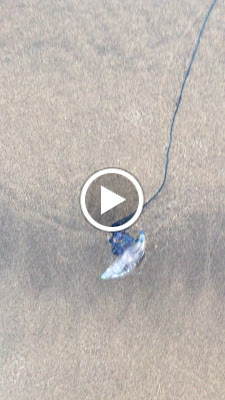
The Blue-bottle jellyfish, were no more than an inch long. Their bodies are transparent and oblongish, like tiny, tightly inflated, amoebic balloons. They have dot-like bluish stains on the upper length, suggestive of feint vertebrae markings. It's highly unlikely that they have this mammalian feature, but these marks seem to be more than just adornment. Possibly serving like a fortified seam, to sustain the air within their fragile bodies, protecting the sheer membrane from being torn by lashings of sea. On the lower part, of it’s essentially see-through body, were dark and densely coloured, indigo blue clumps, spread-eagled in an ungainly sort of way. This is the area of their form which contains the dreaded poison. Some had larger blue appendages surrounding them and others had barely any at all. I later realised that where I could see less of the indigo patches, these tentacles had penetrated the surface - holding tightly onto the golden grains. Most likely, as terrified as me. Apparently, they can see and hear us and were probably holding out against the power of the mighty sea which had unwittingly carried them, to this place. However, I did wonder, if by plunging their toxic feelers into the sand they had now rendered that patch of sand poisonous. Would it ever be safe to stride with naked feet again?
 
 
In the water, when these jellyfish float, buoyed by their inflated bodies, the indigo-blue limbs, which I'd seen gathered as clumps, unfold and dangle below the primary body-form, like vertical ribbons of uneven length. Pictures, I found on google, made them look exotically delicate and quite beautiful too. But, all through my forty-five-minute stroll, I had to watch my feet, carefully avoiding contact with these fragile beings, for fear of being stung in retaliation. I didn’t want to hurt them nor be infected. I knew nothing beyond the chance warning given by the life-guards. I had no idea what could occur if any of them were accidentally trod underfoot or if I brushed passed one without seeing it. My subsequent internet search revealed that, if anyone does get stung, a quick wash with sea-water should be followed by a generous cleansing with vinegar. They're inclined to leave their tentacles in or on their victims’ bodies, attaching themselves to it, which vinegar dissolves. And finally, but most importantly, is a must visit to the hospital. Depending on each person's physiognomy the impact of their sting can be a mildly irritating allergy to life-threatening cardiac arrest.
 
After the demise of my last iphone, I'd taken to leaving all phones and other technical paraphernalia behind. It was meant to allow me to be as carefree as I wanted to. However, if there is one thing Goa has shown me, in the last six months since I'd moved here, is that carefree as I understood it in Gurgaon wasn't the same carefree here.
 
In a gated complex, within its secured, mile-long, walled perimeter, it was easy to cycle or walk in the rain, there was no peril in the swimming pool either. Here, green snakes lie camouflaged in the paddy fields and don't announce their presence like the gently croaking frogs who reside there too. They crawl up, onto the narrow roads - some get run over by vehicles at night to be seen mutilated early the next morning. And that's how I've identified their secret habitat. If I happen to amble alongside these fields at sun-down, it's with considerable trepidation that I tread the narrow roads. Vying for space to pass along the slender, tarred passage, honking trucks and buses push me right at the edge and I'm wary, lest I haplessly trample an unseen, snaking green, who may then bite back in self-defence. Trekking in the rain, is even more hazardous as the roads are slippery, but the vehicle drivers - especially the motorcycles and scooters don't have a care. If I want to cycle, I must rise early and hit the road by 6.30 -7.00 am. It’s a planned endeavour where I wear a helmet and gloves for a better grip, as well as proper shoes - quite unlike the spontaneous cycling sprees with rubber chappals, in Gurgaon. There, I'd be able to ride at any hour - even in the dark, which is unthinkable here, particularly for a novice like me. And now, on the beach, where I'd otherwise felt able to hang loose, these creatures of the sea were staring menacingly at me.


Walking beside the ocean, has often prompted me to open my arms to receive the wisdom it's spirit might share with me. Striding with utmost concentration, I didn't do so that evening. I was alert to everything that could vaguely resemble the Blue-bottle jellyfish. My eyes were focussed on the sand, visually sifting through the tide borne debris of discarded water-bottle caps, drifting twigs, transparent fish-net, seeds, stones and coconut husks. With furtive but frequent side-glances, I also kept an eye on the rising flow, inching its way up the sand, striding higher and higher up the sloping coast, keeping myself away and dry. If the Blue-bottles could sting on contact, then I didn't want to be in harm's way. I might avoid stepping on them if I strode with care, but I had no way of seeing what the swollen and rushing waves carried and would unthinkingly throw at me. I dreaded the idea of splashing through them and being stung unsuspectingly. It wasn’t worth the risk.
 
At the end of that arduous exercise when I sat and recounted to Venetia, the proprietor of Palm and Sands, that treacherous but mindful gait I'd undertaken,  that I did truly begin registering the wisdom the ocean and its creatures had carried forth.
 
I'd been wondering how to make all the requisite adjustments in my new abode. Spiritual precepts were evolving and I was trying to pay more and more attention to my feelings - those vibrations that are mostly inexplicable, but which muster matter into form. How was I to keep pace with this increasingly vibrant inner world and participate meaningfully in the external one, was the dominant quest on my mind. And here, was an experiential example of how it could be done – mindfully, watching every step with focussed attention.
 
 
The limitless sea of consciousness, I understood would always be there, beside me. I didn’t have to keep looking deep into its greenish-grey waves to recognize the wisdom of my own soul. This kind of looking does open the mind, but daily living requires concentration. Meditation can be a walk, writing, cooking or sewing, all things done - mindful of the job, where rooted in the doing is sometimes enough. Each moment thus, if we can feel its power, can be rewarding in its own way.
 
A few days later, Venetia accompanied me on a walk down Candolim Beach- just to catch a glimpse of the Portuguese Men of War. Both of us wore closed shoes. A middle-aged man, was approaching us in the opposite direction, carrying a stick – possibly to ward of the dogs. Venetia saw that his feet were unshod, so went up to apprise him of the surge in the blue-bottle jelly fish. He looked down to  where she pointed and seeing a string of them lining the golden  sand, he said you mean these things are poisonous? And stomped them all with his big bare feet, adding that this is what they did when they were kids and that they were only lethal while in the water. The moment the blue-bottles came ashore, they couldn’t breathe, and lost their sting. This was contrary to what the newspapers reported and the warnings given by the lifeguards. 
 
I was in awe, but we never saw him again. I have no idea if that moment of bravado had proved fatal, or not, but I cannot forget the blue Men of War and the fear they brought forth in me.

Thursday, 28 June 2018

Through the Neighbourhood, Walking the Rain


Wet rain, dripping rain, non-stop drizzling, pouring rain. This is just the start of the monsoon in Goa, This June it is early, it is heavier than expected, but everyone I meet has something contrary to say. I have only the experience of the previous year and remember that it was hardly spectacular. And this, what I have been witnessing over the last couple of weeks and especially these past few daysy, has been very heavy rain. This wetness, the cold breeze and constant pitter-patter make me restive.  I just cannot stay indoors. I had heaps of work to do today and did want to be disciplined about it. I had been on a wonderful, long wet walk, yesterday evening and said to myself, fun is okay some of the time, lets get down to some work, and I did, but barely. Come 5pm, all that control got to me,  I had to get out.  I put on my raincoat, wore my sturdy all-weather Bata sandals, and off I went.
 
 
It has been raining all day long, more or less, since Monday. And between yesterday and this morning the Meteorological department has recorded 124 centimetres of rain, which is termed as ‘heavy rain’. I wonder what they will say of the kind of rain today and how much it would be in  terms of inches or centimetres of rainfall. It has to be tons more than the previous day's 124 centimetres. For  there was absolutely no lull whatsoever. It just poured and poured and poured – just poured. Pure unadulterated showers of drenching, snivelling, shushing rain  that has silenced the neighbourhood to a slithering hush  - of water finding her path through foliage, mud, rocks and drains. Amid the whoosh of the breeze slipping in and out of the leaves of trees.
 
 
I have rather noisy Goans, for neighbours. It’s just their way, they speak loudly and seem to work out of doors most of the time. And in the rain, quite naturally they are not heard because they are mostly indoors. But what surprises me is that the birds are also silent. It is only when the rain begins to peter out, when it is less than the occasional drizzle that, usually a crow will kaw-kaw first and another will respond. And a brief exclusive crow-dialogue will ensue. Until the hens join them and then as if an afterthought the Koel will let out one long call and then the twittering and chirping chorus of many others follows suit. But not for long, the moment the rain begins her heaving whispers, everything else becomes silent. I like to call it the silence of rain.
 
 
Today was a kind of tense day to begin with. My sister messaged to say that Mummy had gone to the hospital for a routine check-up but her blood pressure was extremely low, so the doctor decided to keep her under observation and do some tests. It was worrying and thankfully by the end of the day they discharged her as all was under control. She completes 86 years of age tomorrow, the 21st of June and it’s a fragile age.
 
 
 I am also  coming  to terms with a total change in my daily routine. I have opted out of the Gurgaon-style of housekeeping where I had a whole contingent of staff and someone to oversee them, to trying to work out another methodology. One that gives me efficient housekeeping with less staff and more space of be creative and write. This means that I have to do a whole lot more chores than I have ever done my entire life. Even as a student in London, when my dad was keen I take up a flat, find a room-mate and do that kind of living, I opted to stay in a hostel. Cooking and cleaning have always interfered with things that I would really like to spend my time on. But, the help here is not what I can handle and an open plan kitchen makes it rather crowded during the day – to accommodate a maid and me. Our auric fields clash. So, I have to do the dishes and make my own bed and cook (some of the time). I haven’t got used to the routine yet, so maybe this also makes me restive, but between this and mummy’s precarious health situation, just hours before her birthday, were unsettling and the rain only seemed to make it worse. In anycase, I am not calm in the rain. I can’t sit for hours watching it pattering down. I want to get up and do something. I want to be out there in the rain.
 

Yesterday, a young neighbour accompanied me and we went rather far from the neighbourhood, walking through lanes and by-lanes that I hadn’t seen till then. This evening, being on my own, I was less adventurous. Cycling was a option I could have explored, but didn’t because the rain was really heavy and while it keeps the dogs indoors – out of barking reach and scaring me away. I decided to walk. And with minutes I realised this intuitive decision was the right one. I had not yet exited the Riviera Sapphire complex, and saw there was water logging more than six inches deep. I made a mental note to return from the other gate because the last thing I needed was to trample a snake or encounter a frog or any other reptilian or amphibian which I plug together in the general category of creepy-crawlies.
 

Recently, another young friend, whose lived most of her life in Australia, but now lives in Siolim, told me that she had ordered a pair of gumboots online and couldn’t figure out why no-one in Goa wears them. Then I had laughed and said but why not let your feet get wet, its fun. But today, I thought of getting a pair myself. There were not just puddles to traipse through, these were rivers flowing down the slopes of Siolim. The earth bleeds such an intense russet which is so opaque, it is impossible to see what you're walking on or into. And, at the very start of my trek I fell into something deeper than it seemed. Without even realising it, the grit of the stones got caught between my big toe, on the left foot, and the sandal strap, and within minutes I had a blister that started to bleed. Fortunately it was a tiny one and I strapped the sandal Velcro ties tightly enough so that there was no movement, nothing grazing against the skin and I completed my walk up to the Chapora Bridge or Siolim bridge as it is called, and back.
 

Turning right as I left Sapphire I headed for the Sodiem Road which can be quite a busy one but fortunately for me it was lean time. Just before I turned onto this road, at the very corner, I stood and looked out at the paddy fields filled with water. Bits of green stuck out of reddish muddy water and it was quite a sight with the odd white stork hunting for something to eat in the earth. The cows, whose backs they are usually found on, were probably sheltering from the rain and the food in  the fields more enticing. This expanse of fields is what I can see from the swimming pool at Sapphire. When I looked today, it seemed as if the sea had come right up to my doorstep. The fields stretch for miles and are called Viangan, which I am told is because they get water logged and therefore are  usually sown in the winter months. When the paddy is green it is a treat for the eyes and I am fortunate to see this en-route, to and from the local markets, almost every day. Elsewhere, one can see people busy in their fields. Small tractors, colourful raincoats and umbrellas can be sighted from afar as men and women go about the arduous job of tilling their fields.
 
 
Just a little further down the Sodiem road going towards Tarchi Bhat, about five hundred meters from Sapphire, is another set of flats called Blue lagoon. And within yards of this complex, the road is flanked by fields and these too are water logged at this point. Although the frogs don’t usually start their natter until it gets dark, probably fooled by the darker shades of the sky, they were quite loud  at 5.30 pm. I had heard them yesterday too and thought they were the pigs, who lived in the land we had passed, frolicking in the rain and making a racket. But, when asked if pigs made that kind of sound, I listened and it certainly wasn’t an oink, but a sort of oinky-croak – very loud. And this is what I heard again on my walk today. I scanned the water surface to spot the frogs. I am told they are rather large too, but I could only hear them and didn’t see even one. I walked and walked through the rivulets and puddles and my blister started troubling me.
 
 
I stopped at a local kirana store. In my knee-length, lilac coloured raincoat, dripping water from every inch of my being; my hands wet, my face dribbled with raindrops and cap pulled close over my head; I must have made a very curious sight. I took off my cap and the grey hair may well have made things seem even more eccentric than before. But, when  I asked for some cotton wool, informing them that I wasn’t carrying any money, the boys who were manning the Krishan General store were rather sweet. Without much-ado one of them took out the cotton from the Puja stand  - the soft cotton that is used to make the wick for the diyas and handed it to me, saying that I may be better off going to a medical store. Soft as the cotton-wool was, it only made things worse. I thanked them,  abandoned the first aid and continued to walk as I had done before, tightening the strap as much as I could to avoid any friction between the toe and sandal. And somehow, I walked more than six kilometres, because of the puddles where I would stop more than just occasionally to wash the wound. Letting water ease the discomfort, even if just for a while.
 
 
I was now walking past familiar terrain. I was heading towards the main road that comes from St. Anthony’s church at Siolim Square on the Aguada-Siolim-Chapora road. I passed Burye’s from where I bought the paint to colour my stool ( a project still pending completion). Then Sahil's shop - the furniture maker from Dehradun who’d made the chest of drawers in the local Shivan wood, which now houses my stash of sequins and beads. His shop is out in the open with tarpaulin for a cover and today,  he had plastic-wrapped it on all sides (like most vendors who have gone home for the off-season in Goa do.) Sahil too, it seemed had gone home.  I spied a  gap on the side that had opened up with the wind and wanted to go across the road to pull the plastic tight but there was so much water everywhere with loose mud too boot, that compassion took a back seat. Even on the way back, I had to remind myself that even though I was out for fun, self-preservation must have its say. He had after all packed up this way, knowing the rains would come and he was an old hand at it, so  knew what it meant. Besides,  there must be someone looking out, to have enabled him to leave all that furniture out in the open with just bamboo and plastic for protection – which was hardly any, was it! Maybe  he’d just taken the day off, and hadn’t gone home after all. And so I  continued walking through the puddles, and running into deep waters, then spying no traffic so rushing to the higher ground – small stretches of tarmac where the road was uneven. Its funny, how one doesn’t notice that the road is so uneven while driving through or even walking otherwise, but water shows up all the cracks, all the shoddy workmanship of road building.
 
 
It’s about 3 Km from Sapphire to the bridge that spans the Chapora River. Before this was constructed, which is just 8 years ago, you had to take a ferry across the river. It must have been an awesome experience to pass by the dense mangroves and see the occasional crocodile too. And this is the season when they come to this part of the river, when the water is sweetened by the rainfall. Otherwise there is too much salt from the sea which the crocs don’t like. On my way back down from the bridge, I took a detour,  I came past the Tar Fish market. Clams, oysters and mussels are what fisherman catch aplenty in these parts. The steps from the jetty to the fish market are always littered with discarded mussel shells, especially those that have a viridian green tint. Apparently they were traditionally used to make a kind of chuna for painting houses, before the era of distemper paint. Now they just lie on the steps, like garbage, waiting for the tide to carry them into the sea. The Fish market is only operative in  the mornings, so was deserted by the time I got there. All the brightly coloured plastic tubs were overturned and each person's place saved for the next days trade. It is mostly the women who sit in the market. Earlier, it was just an informal gathering of fisherman’s wives at the village hub and bus stop. People would come from Chopdem, Morjhim, Pernem and beyond, travelling from across the river to catch the buses to and from Mapusa. So the women, prudent as ever, collected there to sell the days catch.
 
 
In the empty market-shed I met Anil and two of his colleagues who told me that the way it was raining, we’d had three months of rain in just three days. Adding, that it was too early for the monsoon and in the past three to four years, there had been much less rain. I asked Anil about the crocodile and asked if someday I could ride in his boat to catch a glimpse of it. If he had seen it. He walked to the edge of the jetty, and moved a few feet back and gesticulating, said it is very long, almost ten to twelve feet. "My friends go into the mangroves to collect the oysters and in all these years it hasn’t bothered them, but the unsuspecting dogs who dip their heads into the water at night, have been gulped down in a jiffy". Apparently a few yards down from the fish market, along the river’s edge there is a chicken and meat shop which throws its waste out at night and the croc feeds there, so is a common sight in these parts.
 
 
When I had stood on top of the bridge and looked both sides, towards Morjhim on the West and Pernem on the East, I couldn’t see much. The broken lines of water were so intense that it was as if sheets of plastic made the ambience translucent and unclear.  And when I reached the steps of the fish market, I realised how much the river had  swollen. It was beginning to ebb because the tide had changed and was working its way back into the sea, but when I had been there buying fish some weeks back, there were many steps and today I could only see two. I had on my raincoat which keeps me quite snug, but today, the rain was just too much. And I could feel wetness on my shoulder and neck areas. I suppose these things are not made for a two hour walk in the rain, but intended for those who need to get places or get home from work and are on errands for short durations. I cannot imagine the makers of raincoats taking into consideration the eccentricities of those who want to walk in the rain, for the sheer pleasure of it and that too for hours at a stretch.
 

I was still far from home and needed to go to the loo. I knew I shouldn’t have had that cup of tea before my walk. I realised that with all that water around me, that I could have piddled in my pants and no-one would even notice, but thankfully  I remembered that Amancio was only a few steps from the fish market. Amancio is a family restaurant and bar run by Ashley who has taken over from his father, who took charge from his father. It started out as a general store selling fish and tackle as well as stuff for daily use, graduated to a liquor store and now it is a rather nice space in the middle of a small village
 
 
It’s getting darker by the minute. I pass by Uday Moyhe the general store that sold me the fishing net just last week and stop to say hello, next I pass by the shop run by Mangama and Srinivas from Hyderabad who iron my clothes. I haven’t been to collect my laundry but reassure Mangama whose untypically lounging among the piles of clothes, that I will come by in the car tomorrow. As I walk, I visually map the route back home. Shall I go past the Goa electric depot, which means I must go farther the Siolim-Aguada Road. Or shall I go back via the Sodiem Road. I choose the latter and return to a rowdy chorus of crickets and frogs. My god, what a noise they were making. I still couldn’t see any, but it was a screeching, girgitting-frogging-croaking at different keys. The sopranos and baritones punctuated with the sharp tenor of the oinking croaks. How I wished I could see even one frog, but I didn’t want to be surprised by any jumping on the road ahead of me. I keep telling myself that I cannot hope to live in such unfettered natural surroundings and expect them to toe the line of social niceties. But I didn’t see any of those large, loud frogs.


And finally, finally, after shedding copious tears, it has stopped raining. The skies have decided to call it a night and I must catch some sleep too. Actually its past 1 am, and another day, forecast with thunder storms and equally unrelenting rain.
 
PS: on this walk i didnt carry a phone, so the pictures are from various other trips, usually in the car...
 

Tuesday, 31 October 2017

Harvesting Shenanigans

A rice-sifter at work


Every day, I pass through the same route, the same fields and villages, on my drive from Verem to Siolim. For the last six months, this route has been de rigeur because of the renovation work that’s in progress in my Siolim apartment.  It had been happening and stressful, then abandoned by a careless contractor,  re-started after a two month hiatus and much effort, and now I am toiling hard to get it completed. It’s been a testing phase. But, despite the anxiety of it all, over the change of seasons during the months from April to October, I’ve seen subtle variants in the landscape and activity en route; particularly in the villages of Pilerne and Saligoan.
 
Fields flank both sides of the Pilerne Road,
 from Mansher to Pilerne
 
Goa in May is surprisingly arid and dusty-dry. All the lush green that one associates with its landscape is a grimy shadow of its post-monsoon panorama.  Driving through winding roads that circle the gently undulating landscape, I’ve seen dry fields being ploughed in readiness for the rain. Watching, an otherwise laidback populace suddenly swing into action as soon as the pitter patter started, and  village men and women began sowing seeds for the paddy crop. Many fields don’t get worked upon because farming is labour intensive. And, according to locally rumoured calculations, only ten percent of land, in most of the villages of Goa, is cultivated. I’m told that the younger generation of landowners find it tedious to farm and hired labour is expensive. Rice is staple diet for the Goans but, those who opt out of farming find it easier, and cheaper, to purchase their requirement from the market. And their fields have lain barren year after year, three to four years in succession. Some locals say that the stretch from Verem to Pilerne got flooded when the Nerul creek flood gates got broken, some four or five years ago and no farming has been done since. Reportedly, it took the panchayat years to repair the system gates,  and once out of the habit of farming, these folks never mustered the energy to resume. Whatever the reasons, out of every four fields with billowing paddy green there are four more that have billowing weeds that look a lot like paddy to the uninitiated, like me.
 
Some fields are paddy and some are not!
 
 
For those die-hards who continue a dwindling tradition of farming, it’s a dedicated job.  In the middle of scorching afternoons, I’ve seen upturned plastic crates used as stools.  Placed in the middle of the large tracts of low-lying fields with not a tree for shade,  a lone, seated man or woman would keep vigil, shooing away birds and cows. Around this time, scrawny scarecrows also began to dot the landscape.  Made with the  traditional cross of sticks, these stick-figures were meagrely dressed with flapping plastic bags in pink, white and blue. On one such scarecrow, a discarded electricity meter was used to represent its face. And, it did look foreboding from the distance.
 
View of the fields off the Pilerne Road,
between Verem/Mansher and Pilerne
Towards the tail-end of the Monsoon Rains
 
For a city-bred lass like me, these things are novel and interesting to note. I’ve never had occasion to watch any kind of agricultural process and have only heard from domestic help about the rigours of kheti-baari. For me, being in the midst of this sowing and harvesting, of rice, was a first.  And even though it wasn’t always possible to stop, while driving, to satiate my curiosity. I couldn’t prevent myself from asking people I met during the course of my day, the many questions that would go through my head, as I passed the activity in the fields.
 
View of the fields off the Pilerne Road, between Verem and Pilerne
 
On the few occasions that I’ve stopped to chat with the farmers, I’ve learned a few things that local gossip couldn’t tell me. I’ve also seen dead snakes the exact colour of the glistening leaf-green paddy crop, crawl out of the fields onto the tarred road, crushed under the wheels of a truck or bus. I’d wonder how these farmers negotiated such hazards, to be told all kinds of scary tales, deepening my dread of the reptile family.
 
Freshly Threshed Rice Fields off the Saligaon Road, on my left as I drive through to Nagoa
 
May turned to October. Dussehra and Diwali have been celebrated as has Ganesh Chaturthi and Narakasura Chaturdashi. Visitors and holiday-makers throng the streets of Goa. Traffic is nearly as impossible as in  Delhi and the number of bikes is maddening. But, precisely because of the crush, in these past few weeks, the large tracts of open fields are especially soothing. In paying particular attention to them, I’ve also observed the harvesting in progress.
 
 
As comical as the human scarecrows were, at the start of the farming season, with their clapping hands and other shenanigans to distract bird, dog and cow from devouring the newly sown seeds, I’ve also noted similarly weird antics while the grain is being harvested. Just as one enters the tail-end of Saligaon leading to Nagoa, there’s a large tract of cultivated land and along this scenic route, I’ve seen some bizarre goings-on. From the point on the Pilerne Road heading towards Mapusa, where I turn off, to pass through Saligaon,  green fields lie on both sides of a generously curving road that allows me to see them from a distance and all the way through till I pass by, driving into the built-up, residential area of the village. 
 
 
One, hot, October afternoon,  I saw an ample-bodied, middle-aged woman, with short cropped hair,  wearing a calf-length, printed dress (looked like mill-printed polyester) clapping her hands and shouting out something, while intermittently waving a cloth in the air. First with one hand and then the other and alternating the two in rapid succession. This went on, right from the onset of the fields coming into my view, until I drove passed her, a good few minutes later. I have reason to believe that she did this non-stop for a good many hours and had been sitting out in the heat for much of the day, keeping vigil on the grain being threshed in the field before her.
 
 
The next day, I found her seated at another field along the same road. It could have been another person because I didn’t note the facial features earlier. But, from the body structure and attire, it seemed to be the same woman. This time, she sat on an upturned crate, at the edge of the field, on the verge of the roadside, while a handful of men stood mid-field of a small plot of land, threshing the crop, manually. She held a black umbrella over her head. It was an overcast day, but it hadn’t rained, so I was wondering about the umbrella, when she started opening and closing it. Every time she opened it, she’d raise up the umbrella and in closing it, bring it down - just above her head, and then open it and raise it again, in quick repetition of the same up-down movement. It was a most unusual sight and a quirky dance of sorts, for there was definitely a synchronised rhythm in these otherwise awkward movements. Sometimes, she’d just bob the open umbrella up and down.  And do the same with it closed. These movement were accompanied by a bevy of sounds - shouted out loud, enough to be heard but were unintelligible. She could have been addressing workers in the fields, but I cannot be sure. Most likely, she was shooing away the pesky birds, hovering above, hungry for a peck of freshly harvested grain.; telling them that they couldn’t have any.
 
During an earlier conversation, in July,  with Pratibha and Pandurang, a farming couple whose fields lie off the Pilerne Road near Moicawaddo, close to where I live in Verem, I’d learned that neighbouring farmers take turns to keep the pestilence away from each other’s land during the day and hire someone to keep vigil at night. I couldn’t help but wonder, if this lady with the umbrella was a land-owner keeping tabs on her numerous fields or if she’d been hired to do so. Because, whatever I’d seen her do was tedious. Inventive in her routine and strategy to keep prey at bay, it signalled endeavour of vested interest, precisely because of that,  but, seeing her in different fields on different says raised some doubt.
 
 
All these months, I’d been content to mostly observe the farming activities. Driving past busy, narrow roads doesn’t offer much scope for photography and neither was I in the right frame of mind. The odd conversations about farming had been with locals that I’ve met in the course of living, or the odd farmer I encountered during an evening walk. I kept telling myself that there would be plenty of time to document and get material for a story. I was always preoccupied with things to do at my apartment so there didn’t seem scope for much more than the passing glance, albeit drinking it all in with a sense of wonderment.
 
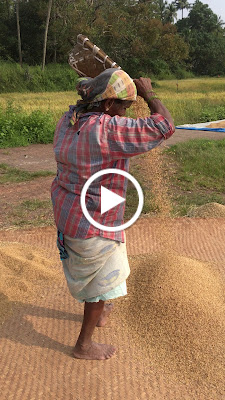
For days, prior to Diwali, I’d seen women lifting the threshed rice above their heads and shaking off the chaff, letting it fly off with the wind as they poured the sifted rice into large kattas. Lined up on the roadside these ample bags - both plastic and jute, bulged outwards, stately and statuesque with the grain. It was rural novelty at its best.
 
Work in my apartment was now happening at an easier pace. The pressure to complete this was still there, but nothing quite as strenuous as the past two months had been. Coerced by circumstance I’d taken on the role of a contractor to finish the abandoned work on my flat. I’d been going crazy with the job - so alien to anything I’d ever done in close to six decades of living. There had been almost no time to reflect on life unfolding, beyond some crochet which allowed confused thoughts to tumble out and create just enough space for another chaotic day. Fascinated as I was, I’d still be tired and too listless to make the effort to stop the car, get down and take photos. The thought of carpenters waiting for me, the constant demands for money and long list of things to be done would bog me down.  Every time I passed and noted something interesting and didn’t feel like stopping, I would tell myself that next year, I’d do a full documentation with thorough research.
 
 
But then one day, I thought that next year it will not be the same thing. I couldn’t lose the moments that fascinated me today, waiting for a good time to make note of them. Driving past, one Saturday afternoon, when there wasn’t such a crush of things to tend to, I decided that work or no work, it was too picturesque, for me to pass up this moment and wait another year to document. There were, mercifully, few cars on that stretch. Inspired to stop, by the visual of a weather-beaten woman winnowing, I parked my white i20 on the side and walked up to watch her lift the rice up in her wicker basket and sift it down, letting the wind waft away the chaff. I paused to record and listen to the soft rustle, a warm and comforting nuance, of rice grains falling: caressed by the soft hush of them kissing each other as they piled up on the ground. This was augmented with something the winnower seemed to be telling me but regrettably I haven’t yet learned any Konkani, so missed out on what she said.
 
 
I took my photos and drove on, stopping to chat with a Saligoan landowner who was selling his grain. I rolled down my window. He thought I wanted to buy some, so informs me that he has enlisted for government support, and was selling the rice at ₹21 per Kg, where otherwise the price would be ₹25 per Kg. I asked if all the rice was for sale or if he kept some too, when he said both and that by boiling the rice, it keeps well for a year.  A useful bit of information, for it was something I didn’t know. The patch of land, I found him standing by, didn’t seem to have much grain. I asked how much rice lay before us,  to be told it was about five quintals. I wondered if  that would  be enough for personal consumption and for sale, when sensing my question, he gestured to the land around, informing that he had many more fields.
 
And that is what made me realise that probably the lady of the umbrella dance also owned numerous plots of land. Since I had found her sitting in and around fields on the same stretch of fields, she could also have been his mother. I didn’t ask, but felt that I  shouldn’t have entertained those earlier doubts, because who’d imagine hired help going through such effort and such totally bizarre attempts at shooing off prey. The crazy stuff is what we rise to, when we care enough, isn’t it?


As I was wrapping up this story, the housekeeping staff walked in to clean my apartment with Saraswati leading the way. She is a young graduate, newly married, from neighbouring Karnataka and if she happens to find me in the apartment, she quizzes me about what I am doing - always curious and in awe of my creative endeavours. This time around, she insisted on knowing the story I was writing. As I narrated the dress-clad woman’s antics, telling her how I wondered if she owned the land or was hired to do these tricks, when she said with the unstoppable authority of youth : “ Maedum, paeesa dene pe bhi nahin hone ko hota, kitna sharm aata na?, voh Catholic Aunty ka khud ka land hoga, bilkul hoga, koi shak nahin!”
 
Well, that certainly put it unarguably into the same perspective I had arrived at. The crazy stuff is what we do when we are involved with and have a vested interest in the resultant outcome, anyone else would feel too embarrassed to do the same things. The ploughing and harvesting of seeds that we sow through life, are rife with many awkward moments that we’d probably be too embarrassed to own up to and face ourselves for, on hindsight. As would the woman, if I had taken a video, of her at work, and shown  it to her. Would she.....,I know that in her shoes, I would.  And probably never work with such uninhibited ardour and abandon again!