 |
| Bakshi Rana |
I met Lajwanti[i]
Parvati Maasi[ii],
Prito Aunty and Bakshi Rana in April 2013 at the Indira Gandhi National Centre
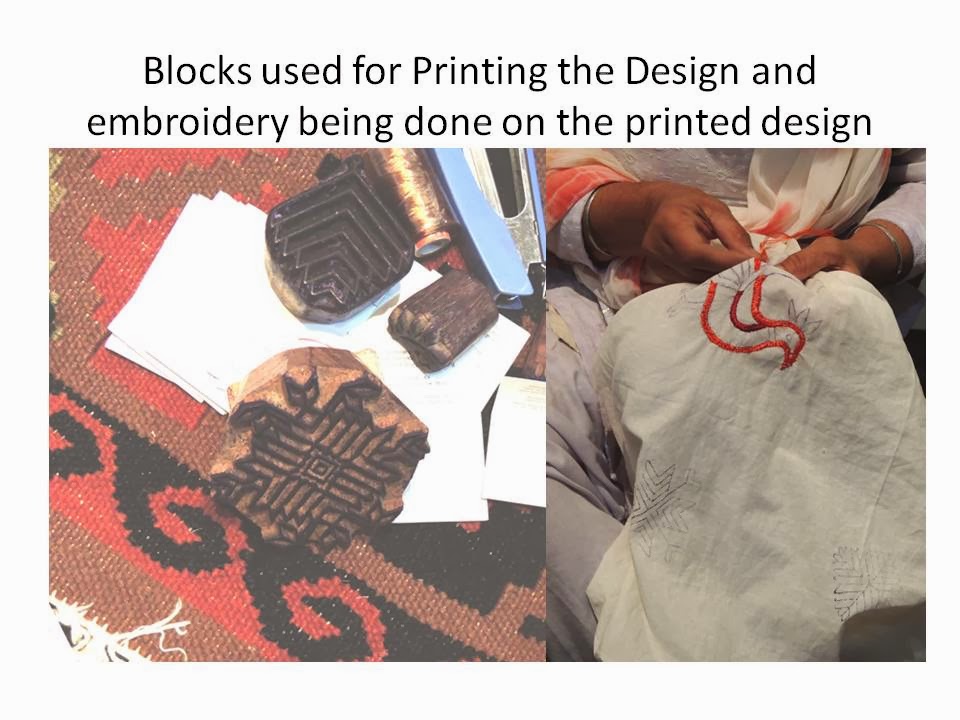
for Arts in New Delhi. They had travelled from Tripri[iii] in Punjab, to demonstrate the art of Phulkari embroidery. But while sipping chai with them and chatting, hearing their
stories, I realised that they had travelled much farther than that.
They had all learned Phulkari out of choice, to fulfil an
aspiration but, none of them did this work today, for the love of embroidery.
They said it was ‘majboori’[iv]
that they had to do it to earn, to keep a roof over their heads. Parvati Maasi,
as everyone referred to her, was the oldest and also the most forthcoming of
them all, that is, apart from Lajwanti whom they all work for and who was
miffed with the change in policy at the Punjab Emporium in Delhi because this
had taken away a large chunk of her business. Each of them had stories to tell
about errant husbands and hardships borne. Bakshi Rana and Parvati Maasi had
come to India from Pakistan at the time of Partition and they had some stories
to tell about that too, even though they were very young at that time. But, it
was their journey through Phulkari,
as women who spent their days working with needle and thread, that interested
me.

Phulkari, which
literally means ‘flower work/craft’, is the embroidery of rural Punjab. It was traditionally passed on from mothers to their daughter. “Ih phulkari meri maan ne kadhi, iss noo ghut ghut jhaphiyan paawan” [“My dear mother has embroidered this Phulkari, I embrace it again and again with affection”] is a song that refers to the tradition where mothers [and grandmothers] embroidered shawls for the young bride-to-be of the family. Prito Aunty aka Pritam Kaur recounted how she had made her own dowry, yet also spoke of the work she did today as majboori. When I asked what she would do if she had all the money she could ask for. Her reply was ironical. She said she would like to buy these fabrics like she had seen us urban women do. It was disconcerting to note that she had the wealth she sought in her own hands but did not see it as such. When I said as much, she just kept quiet.

Prito had embroidered chaddars and dupattas as well as woven punja dhurries to take with her to her new home. She was born in Kinnaur village, district Patiala, around 1963; her parents were poor and did ‘majdoori’[labour], mostly making ‘manjees’[beds made from rope] . Her mother earned through doing some embroidery work too. Although traditionally this art was practiced mostly as a personal pursuit and not something for profit or sale, it was not uncommon for wealthy families to get others to do it for them, even though they themselves had learned Phulkari work.

My Naani was from Kapurthala which is in the heart of Punjab but she was married at fourteen years of age and moved to Delhi, so this connection to the traditions of Punjab was clearly not a strong one. My mother also said that, from the age of ten, Bibijee [xii] showed a deeply religious inclination and did not do any kind of embroidery or much else aside from taking care of her home and family, adding that her own grandmother, did not do any embroidery either but, she was a fabulous cook. Well, that put paid to hopes of any thread of interest that I had in embroidery being drawn from family tradition, at least from my mother’s side of the family. Although we are Punjabi’s, Phulkari embroidery had not been passed down through generations in my family and when I think about it, I cannot remember seeing anyone in my family wear these embroidered shawls either.
 Phulkari and Bagh are really colourful, embroidered shawls
worn by the women of Punjab[xiii]
and were enormously popular from 1850-1950 AD. Their origin is lost in time but
it is thought that the tradition came into India with the migration of the Jat
peoples from Central Asia[xiv].
There are apparently no references to Phulkari in classical Indian literature[xv], nor
are there any surviving pieces from before the 1850’s.
Phulkari and Bagh are really colourful, embroidered shawls
worn by the women of Punjab[xiii]
and were enormously popular from 1850-1950 AD. Their origin is lost in time but
it is thought that the tradition came into India with the migration of the Jat
peoples from Central Asia[xiv].
There are apparently no references to Phulkari in classical Indian literature[xv], nor
are there any surviving pieces from before the 1850’s.History tells us that the plains of Punjab were rich cotton growing areas and almost every village had a settlement of weavers who wove the hand spun yarn provided by their farming neighbours, in exchange for agricultural produce. Spinning was a household occupation. The untwisted skeins called ‘pat’ that were used as embroidery thread were imported from Afghanistan, Kashmir and Bengal. This silk was expensive and therefore not wasted on the reverse of the cloth. The stitches were made by counting the threads of the woven structure of the cloth – typically stitches are made at right angles so that the embroidered patterns reflect light, according to the direction of the stitches. The basic stitch is a darning stitch and, a Holbein stitch is used for the Phulkari called Chope[xvi] but, several other stitches are also employed, for outlining motifs and edging the piece.

 In north Punjab, another tradition developed known as Thirma which was made exclusively by
Hindus and Sikhs. Their colours range from rich raspberry red to pink. In some
pieces, large-scale triangles interrupt the long border on opposing sides.
Placing of these triangles is significant, for when worn by a bride, the
triangle falls over her head, symbolizing the auspicious ‘tilak’ worn on the forehead.
In north Punjab, another tradition developed known as Thirma which was made exclusively by
Hindus and Sikhs. Their colours range from rich raspberry red to pink. In some
pieces, large-scale triangles interrupt the long border on opposing sides.
Placing of these triangles is significant, for when worn by a bride, the
triangle falls over her head, symbolizing the auspicious ‘tilak’ worn on the forehead. Apart from regional differences there are also religious differences. The geometrical designs primarily associated with Muslim communities reflect the Islamic restraint on figurative work. Hindu and Sikh Phulkaris incorporate human figures animals, flowers and birds, presenting a rich repertoire of designs including myths and legends but they can also be quite abstract such as patterns that recreate the ‘maze’. Another feature of Phulkari is the deliberate mistake: because only God is perfect, so either black was added or a part of the design was left unembroidered. This was also done to avert the evil eye. After 1920, the tradition of Phulkari is said to have declined with the introduction of poorer qualities of material and fewer stitches employed. However, it is Partition that marks the greater decline of this tradition[xix].

The Parvati that I met was obese; she was old with failing eyesight and diabetic but full of stories. She had retired from active work but came along with the others because they are family[xxiii]. All the four women were above fifty years and had long-standing relationships with Lajwanti. Most of Parvati’s family used to spin thread -“Gandhi wala charkha”[xxiv]– her mother, Naani and Parvati did spinning, more than embroidery even though they did embroidery for a living : “mn badde chakkar khaunda hai, Na khushi na dukhi – velli nahin baith sakdi hu, mn bahut khush haunda hai, kadhai karde karde” [the mind goes round and around. I feel neither happy nor sad. I just cannot sit idle, but when I am embroidering my mind is at peace.]
In the Marg article Jasleen wrote: “Ghoo ghuoo would go the lacquered charkha which my grandmother carried, much to my father’s irritation, all the way from Abbotabad when we moved to Delhi” adding that, the charkha was intertwined with memories of her childhood. It was her Dadi’s companion and she would spin everyday while reciting the Gurbani[xxv] or Pothwari[xxvi] songs from her childhood - “ghoo ghoo charkeya main kata ya na?”[shall I spin or not]. In Abbotabad, their ancestral home, the thread was then given to the Hindu weaver to weave and the Muslim dyer to dye a deep maroon or russet, her Dadi never dyed the fabric black or blue. Jasleen then recounts her Dadi sitting with Hazra Bibi, an expert embroiderer, who also looked after Jasleen, discussing what embroidery to do. Old, empty, English biscuit tins were filled with colourful silk threads bought from itinerant Aghani thread-sellers. Colours were selected and matched and the Phulkari work commenced by Hara Bibi, who apparently produced the finest work in that region.
She also recalls karva
chauth[xxvii]
when her mother would dress up, wrapping herself in her wari-da-bagh[xxviii],
which Jasleen’s fathers Dadi[xxix]
had made for her. Jasleen however, never
learned the art as they had already left Abottabad when she would have been old
enough to learn and her Dadiji never taught her. However, traditionally, she
says, a girl learned to embroider from her paternal grandmother and mother,
beginning with using cotton thread, graduating to embroidering her own dowry,
when the older women in the family or around her, would smile and say that she
was embroidering her own garden of happiness.
It was a common sight to see women sitting in an open court-yard
embroidering and singing: “Bharam koiya
shant, sehaj, swami, Pargas bhaiya kauul khilia” [when doubt in the mind is gone, there is peace and
quietude my lord. Just as the sun rises and the lotus blooms.]

 It’s no wonder then, that umang turned into majboori.
I keep wondering whether things would have been different if Partition had not
happened and they had stayed in Pakistan, in their villages. Would these women
have had different stories to recount?
As if reading my thoughts Parvati Maasi started singing this song: “Bande teri zindagi Waghe nadiya da paani, chaar
din di bahar, ho hoshiyaar bandeya, nahin toh royega zaro zaar bandeya” [your
life is like the waters of the river Wagah, the precious days of bliss may flow
without your realising it, so be present and enjoy each day, for otherwise you
will shed tears in regret for the rest of your life]
It’s no wonder then, that umang turned into majboori.
I keep wondering whether things would have been different if Partition had not
happened and they had stayed in Pakistan, in their villages. Would these women
have had different stories to recount?
As if reading my thoughts Parvati Maasi started singing this song: “Bande teri zindagi Waghe nadiya da paani, chaar
din di bahar, ho hoshiyaar bandeya, nahin toh royega zaro zaar bandeya” [your
life is like the waters of the river Wagah, the precious days of bliss may flow
without your realising it, so be present and enjoy each day, for otherwise you
will shed tears in regret for the rest of your life]
Embroidery is a great stress buster and I experience this first hand. These ladies also agreed that doing this work helps them deal with their lives in various ways and “sukoon milda hai”[xxx] but without the ability to think creatively, cultivate the imagination of women like Jasleen’s grandmother and those before her, who made things for their families, recording events in the family life through subtle changes in colour and pattern; without the freedom to do this, out of choice, for themselves, the work cannot have the same resonance and energy.
 The quality of workmanship has changed. It was Punjab that
was most affected with the advent of Partition and it is possible that this
played its part in the decline of the art of Phulkari. But, I think that
basically the creative spirit of the subcontinent had been stifled much before
this. The process was slow and subtle and difficult to perceive or comprehend
until things came to a head.
The quality of workmanship has changed. It was Punjab that
was most affected with the advent of Partition and it is possible that this
played its part in the decline of the art of Phulkari. But, I think that
basically the creative spirit of the subcontinent had been stifled much before
this. The process was slow and subtle and difficult to perceive or comprehend
until things came to a head.
Indian textiles were enormously valued in the maritime trade of South-East Asia. These fabrics were used as currency for trade in spices which were prized by Europeans. Getting monopoly over Indian textiles was a way to profit in this trade. For Indonesians, the people from India who made the textiles they prized were considered gods. But when the Europeans came they did not understand the significance of this beyond the money they could make and the British were especially ruthless in this regard. Gradually, they changed the way that these fabrics were created and started introducing designs brought from Britain which were then copied and exported back. They stopped trading fabrics that the local artisans lovingly crafted, in much the same way that the women of Punjab used to embroider the Phulkaris [even though Phulkaris were not part of this trade] with marks and patterns that reflected their personal histories, investing the fabric with the labour of love.
When you take creativity out of anything you virtually kill the spirit of the person doing the work. The art of living, understanding the freedom to create life the way you imagine it can be, which was intertwined with the concept of crafting in ancient India, is further being eroded by this frenetic age of technology.
 The once creative craftsmen/artisans have become reduced to
skilled labour[xxxi].
These women cite majboori as the
reason they do embroidery. There is no personal investment or sense of
creativity and joy. Living in poverty, personal grief and a lack of education
has stifled the spirit of creativity through which humans thrive and grow. Can
any art flourish and grow this way?
The once creative craftsmen/artisans have become reduced to
skilled labour[xxxi].
These women cite majboori as the
reason they do embroidery. There is no personal investment or sense of
creativity and joy. Living in poverty, personal grief and a lack of education
has stifled the spirit of creativity through which humans thrive and grow. Can
any art flourish and grow this way?

Ah! What nostalgia, but there was none of this in the stories
of the four women I met that day. They had only pain and hardship to recount. Bakshi Rana was born in Khanpur Pakistan and came to India in 1948 when she was around nine years old. She began doing Phulkari embroidery when she was about fifteen years of age. Watching others, “ik umang jaag uthi”, a desire came into being and she thought she would like to do it too. Around the same time, she was married to her dead sister’s husband, her brother-in-law, and widowed five years later at the age of twenty. Of all the four women, she seemed the saddest and wore a really haunted look. Her sister had four or five children [their stories all lack accuracy and clarity in telling] whom she brought up as her own. As I listened, I couldn’t help thinking, what a life! There was this fifteen year old with that faint desire in her heart to do some colourful embroidery work, possibly to create her own dowry, when her sister dies and the responsibility of her sibling’s family falls on her young shoulders. She doesn’t have the luxury of choosing her spouse or the pleasure of bearing her own children, so where then is there the luxury of desires and aspirations? The mind possibly shuts down all its imaginative faculties when faced with such circumstance.
of the four women I met that day. They had only pain and hardship to recount. Bakshi Rana was born in Khanpur Pakistan and came to India in 1948 when she was around nine years old. She began doing Phulkari embroidery when she was about fifteen years of age. Watching others, “ik umang jaag uthi”, a desire came into being and she thought she would like to do it too. Around the same time, she was married to her dead sister’s husband, her brother-in-law, and widowed five years later at the age of twenty. Of all the four women, she seemed the saddest and wore a really haunted look. Her sister had four or five children [their stories all lack accuracy and clarity in telling] whom she brought up as her own. As I listened, I couldn’t help thinking, what a life! There was this fifteen year old with that faint desire in her heart to do some colourful embroidery work, possibly to create her own dowry, when her sister dies and the responsibility of her sibling’s family falls on her young shoulders. She doesn’t have the luxury of choosing her spouse or the pleasure of bearing her own children, so where then is there the luxury of desires and aspirations? The mind possibly shuts down all its imaginative faculties when faced with such circumstance.
 It’s no wonder then, that umang turned into majboori.
I keep wondering whether things would have been different if Partition had not
happened and they had stayed in Pakistan, in their villages. Would these women
have had different stories to recount?
As if reading my thoughts Parvati Maasi started singing this song: “Bande teri zindagi Waghe nadiya da paani, chaar
din di bahar, ho hoshiyaar bandeya, nahin toh royega zaro zaar bandeya” [your
life is like the waters of the river Wagah, the precious days of bliss may flow
without your realising it, so be present and enjoy each day, for otherwise you
will shed tears in regret for the rest of your life]
It’s no wonder then, that umang turned into majboori.
I keep wondering whether things would have been different if Partition had not
happened and they had stayed in Pakistan, in their villages. Would these women
have had different stories to recount?
As if reading my thoughts Parvati Maasi started singing this song: “Bande teri zindagi Waghe nadiya da paani, chaar
din di bahar, ho hoshiyaar bandeya, nahin toh royega zaro zaar bandeya” [your
life is like the waters of the river Wagah, the precious days of bliss may flow
without your realising it, so be present and enjoy each day, for otherwise you
will shed tears in regret for the rest of your life]Embroidery is a great stress buster and I experience this first hand. These ladies also agreed that doing this work helps them deal with their lives in various ways and “sukoon milda hai”[xxx] but without the ability to think creatively, cultivate the imagination of women like Jasleen’s grandmother and those before her, who made things for their families, recording events in the family life through subtle changes in colour and pattern; without the freedom to do this, out of choice, for themselves, the work cannot have the same resonance and energy.

Indian textiles were enormously valued in the maritime trade of South-East Asia. These fabrics were used as currency for trade in spices which were prized by Europeans. Getting monopoly over Indian textiles was a way to profit in this trade. For Indonesians, the people from India who made the textiles they prized were considered gods. But when the Europeans came they did not understand the significance of this beyond the money they could make and the British were especially ruthless in this regard. Gradually, they changed the way that these fabrics were created and started introducing designs brought from Britain which were then copied and exported back. They stopped trading fabrics that the local artisans lovingly crafted, in much the same way that the women of Punjab used to embroider the Phulkaris [even though Phulkaris were not part of this trade] with marks and patterns that reflected their personal histories, investing the fabric with the labour of love.
When you take creativity out of anything you virtually kill the spirit of the person doing the work. The art of living, understanding the freedom to create life the way you imagine it can be, which was intertwined with the concept of crafting in ancient India, is further being eroded by this frenetic age of technology.

[i]
Lajwanti has been awarded a master-craftsman award for phulkari. Born in
Patiala in1953, she learned from her naaani and has worked in this field since a
child. Her husband left her with small children [3 boys 2 girls] when she
started this work as a business. All her
children have worked with her and are national craftsman awardees too. She has
500 women working for her in Tripri.
[ii]
Like mother – mother’s sister is traditionally called maasi
[iii]
near Patiala
[iv]
Necessity/compulsion
[v]
shawls
[vi]
Veils/ lighter shawls
[vii]
Richly patterned Dhurries [rugs] where a tool, which draws it design from the
five fingers of the hand, is used to push the weft thread down.
[x]
Marg Publication, Mumbai. Volume 58, NO:4, edited by Laila Tyabji
[xi]
mother’s mother
[xii] We
addressed my naani as Bibijee – a traditional Punjabi way of addressing the
female elders in the family
[xiii]
This work was also done in parts of neighbouring Haryana
[xiv] Ancient European historical records and archaeological findings support that the Central Asian people such as Scythians, Samartians and Alans are possible forefathers of the modern Jats, in part.
[xv]
The Embroidered Shawls of Punjab. John Grisham. Asian Embroidery edited by
Jasleen Dhamija. 2004.Crafts Council of India
[xvi]
The Chope is quite distinct from form the Phulkari and Bagh embroideries where
bold patterns of stylized peacocks are embroidered in Holbein stitch with gold
thread on a red/maroon khadi background.
[xvii]
Coarse, cotton fabric woven on a pit loom, in plain weave.
[xviii]
Four colors of khaddar were generally used where each color
had its own significance– white used by old women or widows, red used by young
girls and brides-to-be, blue and black were kept for daily use.
[xix]
The Embroidered Shawls of Punjab. John Grisham. Asian Embroidery edited by
Jasleen Dhamija. 2004. Crafts Council of India.
[xx]
Trader from Rajasthan
[xxi]
lane
[xxii]
‘Anchor’ [brand name] floss
[xxiii]
I imagine there was also some business prudence involved as Lajwanti did not
want her younger karigars[xxiii]
poached upon
[xxiv]
Spinning wheel used by Mahatma Gandhi
[xxv]
Word of the Sikh gurus, usually sung
[xxvi]
a dialect of Punjabi spoken widely by the population of the
Potohar Plateau in Northern Pakistan.
[xxvii]
is an annual
one-day festival celebrated by Hindu women
in North India in which
married women fast from sunrise to moonrise for the safety and longevity of
their husbands
[xxviii]
Is embroidered by the groom’s paternal grandmother in golden yellow silk. The
grandmother begins to embroider when the boy is born and it often takes her ten
years. The random appearance of different colours or change in pattern is not
careless mistakes but represent significant events in the life of the family.
The embroidery mirrors the family’s joys and sorrows so when the young bride is
wrapped in this she is symbolically entering her husband’s family’s history
[xxix]
Paternal grandmother
[xxx]
We find peace and solace.
[xxxi]
As designers many of us go into the villages and give them our designs to make.
And my own experience and that of others is that even when given a free hand to
create, they hesitate and prefer to be told what to make.


