Tuesday, 10 September 2013

I Am The Music I Could Never Be - Guest Post by Neeta Gupta


 Over the last few years I suffered a series of accidents that severely affected my cervical vertebrae. The only thing that helped was physiotherapy. And it seemed as if I would have to live with this debilitating pain for the rest of my life. I was also reading this wonderful book at the time, Anything Can Be Healed by Martin Brofman and his personal experience in healing was amazing. He uses something called “The Body Mirror System”. The system is based on the idea that the parts of your body that suffer reflect the parts of your life that are dysfunctional; that there is tension in your consciousness which causes these symptoms. To release a symptom, one has to release the stress that caused the symptom, and bring harmony to the parts of your life that have been, well, out of balance. 

When I looked within, I found an answer.

Now consider the fact that the cervical area is controlled by the Vishudha Chakra [i]. According to Brofman, “Metaphysically, this chakra is related to creativity manifesting in the physical world and the fulfillment of one's goals….This chakra controls the aspects of expressing and receiving. Expressing can be in the form of communicating what one wants and what one feels, or it can be an artistic expression, [singing, for instance] basically using a form for expressing and bringing to the outside what is within…” I realized that there was something I had been in denial about for over a decade. Of course there was disharmony.


There was a time when I was obsessed with classical music. There was a time when this music was like a secret language to me. It was the language that I used to express my thoughts. Not only was I training under a guru, I had also enrolled at a reputed music school to learn classical music theory. For me at the time, the raga was supreme: the be all and end all of my existence.

The word raga is derived from its root, ‘ranja’, which means ‘to colour’ or ‘to tinge’. And hence, ‘that by which all people are coloured or elated, that which gives pleasure to all, is raga.’

 A raga is pure aesthetics. It is the basic melody or phraseology of traditional Indian Classical Music. In the semantics of music, a particular arrangement of notes ‘colours’ or affects the emotional core of the mind. Every raga is composed of a set of principal notes which when employed in varying degrees, in a prescribed order - stressing on some, while bypassing others - achieves a particular shade or mood, building the character or personality of the raga. But a raga belongs to a realm larger than the notes it contains. The notes are just a key. A performance is not just a blending of swaras[ii] sequentially, and randomly achieving an effect. A performance actually deepens that ‘colour’ or mood in the listener.
 

Alternately, a raga has also been described as the language of the soul. This theory probably comes closest to explaining my own relationship with music. Each raga expresses itself under the pressure of a certain emotion. For instance, under the stress of sorrow, one might automatically render a particular raga; similarly we might sing a completely different tune on the wings of joy, irrespective of the time of the day. Imagine what songs we might sing in a storm of passion …imagine what joy we can communicate in union! A raga is richer than any musical outline of it could ever hope to describe. Any mental picture of it is limiting.

Coming back to my story, life and work took over and this music, which was so important to me, got relegated to being something I indulged in over the weekend, and then to something I went back to once a month or so--in a burst of enthusiasm, until finally I covered my tanpuras[iii] in velvet-lined casing about twelve years ago and there they remained, un-strummed.

By denying music, I had been denying myself my secret language, my self-expression.


And thus began a morning ritual of garam masala chai and riyaaz[iv]. Free of any formal structure or instruments. No rigours of taal[v]. No bandish[vi] of words. In this moment I dwell in the sphere of the swara. I dissolve in the deep concentric circles that surround each note, and as I go deeper and deeper in it, my only aim is to reach the centre—that ethereal space where my personal deity exists. It is a sacred journey I undertake each day. And every day I chance upon a different tune, thrown up by the vibrations and moods around me: mellow and sombre sometimes; playful and wanton at other times.

And unknowingly, a raga is born in that moment. And although it is born to me and of me in that moment, it has existed before. It’s just that I had banished it from my conscious memory but it had continued to exist in my sub-conscious. And slowly as I flesh out its texture, it takes on a life of its own. A known form - not bound by any bandish and taal, more like a gypsy tune that refuses to be bound by words, or ever be repeated. And for a few moments in that sacred space, this melody sings its song into my ear, and just as quickly flits away. Before I can catch it, before I can note it down, and later it is hard to recall. But for that brief moment I am captured by that sound. I am saturated with it, until I feel I might burst.
 
When I get up from this almost trance-like state, I feel as if I have been recharged by a high-tension main power line in space. And simultaneously from the very core of the earth this energy has both exhausted and replenished every cell in my body. I am in harmony.

And through the rest of the day I strum an imaginary tanpura in my head and as its music infuses my soul, I know that I may not be fully repaired but I feel strong and free.


Neeta Gupta has been working towards creating publishing connectivity's across different languages and cultures
www.yatrabooks.com
http://twitter.com/yatrabooks
 
 Link to artists :


[i] Vishuddha is positioned at the neck region, near the spine, with its Kshetram or superficial activation point in the pit of the throat. Hence it is also known as the throat chakra
[ii] The seven notes of the scale in Indian music
[iii] A long-necked stringed instrument used in Indian music to create a harmonic resonance on the basic note or keynote.
[iv] to practice
[v] literally a "clap"; used in the sense of rhythm
[vi] A Bandish provides the literature element in the music, for standard structured singing; another connotation of Bandish is ‘binding’.

Friday, 9 August 2013

Not Drinking Chai in Kutch - Guest Post by Australian Artist and Writer Maggie Baxter.


Zurra Village, Pakko hand embroidery is done here.
Or anywhere.
 
My ideal black, unsweetened coffee sits at the opposite end of the taste bud spectrum from the powerfully sweet and milky chai of the Kutchi palette. But here I am at Gopika’s invitation to Garam masala chai (and she knows my preference) to share my experience of working in Kutch

Young woman doing Maggie's embroidery
Twenty something years ago, I had never heard of Kutch and for those blog followers with the same question mark in their heads, it is the district with a very singular identity that sits at the northern end of Gujarat, next to the Pakistan border.

Neither did I have a burning interest in the craft sector – just a vague idea that traditional Asian textiles could be an interesting platform for contemporary art.
 
My induction into and subsequent fascination with the textile traditions of Kutch came about from a chance meeting in my home city of Perth, Western Australia with Indian designer Kirit Dave. He suggested I go there, and without much forethought, or research, I did.

Kutch is not an easy climate and terrain even now, but back then it was much more rigorous. The roads were poor, the electricity was off more than on, telephones barely existed, and travelling was in old Ambassador cars well past their retirement age.
 
 
Luckily I had travelled regional Australia. If I was hot, bothered and dusty, I was used to being hot, bothered and dusty in Australia too. If the village water was dodgy, I had thrown up on bore water in Australia too. But, at certain times of the year, Kutch is just one bit too challenging.

What draws me there? I have joked that it is like in being in a slightly dysfunctional long-term relationship. Old diary entries tell it all: the good, the bad, the endlessly frustrating, and the much-needed tranquillity.

The Good

Kutch has an amazing confluence of textile crafts stemming from centuries of migration from what are now Afghanistan, Pakistan, the Middle East, and other parts of India. There are weavers, printers working with four types of block printing and at least 16 different styles of embroidery done by different communities.
 
 What first intrigued me were the endless possibilities inherent in block printing – not within the existing traditions of exquisitely accurate registration of patterns, but more in the way of reproducing an abstracted form of drawing: lines and marks floating without symmetry on the fabric. I am still as excited by block printing, as I was when I started. It took me longer to decode embroidery and work out how to connect it with my linear mark making.

Monday 22 December 2003

‘Grid forms, and lines contained within grids are where I am starting. I have also used some photocopies of the structure of Japanese cloth as an impetus.

As I was drawing I started to think about using the blocks in simple, but strong graphic black and white, with a large border of brightly coloured embroidery. Maybe this will be left to Rabari[1] women, or maybe I will do the design and get it done with Sodha[2] women in Pakko[3]. This is in keeping with local odhnis [shawls], which have fields of black wool with simple tie-dye and then amazingly rich borders.

I am also keen to explore the same design in a number of different techniques…the rug design is about to be done in Ikat…’
 
The Bad

August 1991 (My first visit to Kutch -why did I ever go in oppressively humid August?)

The horizon began to fill up with a sinister, foreboding, dark heavy purple cloud….As we left [the main city] Bhuj, a powerful wind started to pick up dirt and debris, flinging it around unpredictably, reducing visibility to an impenetrable  pale red murk…The storm finally broke….great columns of lightning and torrential rain smashed to the ground…. Our car only had one windscreen wiper.

The road to the farm was a mess of fallen branches and mud. One large tree trunk had fallen across the road. The guys got out to shift it and I started to go with them but they stopped me…I told them later that they are more chivalrous than Australian men, who would have told me to get out of the car, roll up my sleeves and push hard.

When we finally got to the farmhouse there was no food left. The rain made the air even more clammy and humid. I sat on a bench and disturbed a cloud of insects, who retaliated by swarming down my blouse.’

The Tranquil

February 2004.

‘Sunday… Very quickly it has gone from winter to summer in Kutch. Just two weeks ago there was snow on the Himalayas and a biting wind hurried across the salt marsh deserts, through our clothes and right into our bones. Now the evenings are balmy and the air is perfumed with the scent of lime trees in flower….

Since 6.00 a.m. Rimalbhai, the farmer has been coaxing his bullocks and cows to wake up. His voice is louder than truck horns on the highway and has the same tone.

[In the morning] I sat on the verandah of my bhunga[4] eating breakfast and watching the passing parade of people. The farmer’s wife Leriben made bhakuri[5] on the griddle and, to escape the chai, I have Twinings ginger and lemon tea and coffee with me.

There is a constant flow of visitors [to the farm] from nearby Bhujodi village. Some of the women wear traditional clothing…. we have nicknamed one ‘Mrs Mix not Match’ because of the astonishing arrangement of colours and patterns displayed in all her outfits.

One day it was a loudly floral orange ghagra skirt over a red petticoat. A long turquoise odni [shawl] with a diamond print hung from her head, long enough to tuck into the ghagra forming another over skirt. Above the waist she wore a purple backless choli [blouse] with turquoise sleeves and a turquoise and orange hem. A choli is shaped a bit like a brassiere with two cups in the front for the breasts….gravity had triumphed and the cups were in one place and the breasts another. Big rolls of fat poured over the sides of the choli. But she was nicely unconcerned about any of this.

The
 
Frustrating                                                                                                                                     

Production September 2004

‘The fabric that I wanted from Devjibhai was a nice cotton and silk mix with a subtle texture that would suggest parchment. But as soon as this was selected, it turned out that the silk fibre was not available.
 
Unseasonal rains came. Block printing stopped at Ajrakhpur. They have no shelter for the fabric to dry out, which seems incredible in a village that relies entirely on printing and dyeing for its livelihood….
 
Tailors suddenly went into short supply. There is a huge pilgrimage in Kutch…70,000 people were estimated to be walking through... And in amongst this throng were all my tailors. Who cares about a Delhi deadline when the Mata[6] is calling? Let’s hope that when they return blessed, they are also refreshed and ready for the challenge I want to inflict on them’.
 
But, in that astonishing and miraculous Indian way in which disaster is averted at the 11th hour, collections do come together. What has strangely evolved over the years is that complicated, one-off pieces suitable for exhibition in art galleries work best and that is what we have been doing for the past decade.
 
None of this could happen without the extraordinary skill and willingness of all the artisans that I work with and I salute and honour them. Equally the work can only come together because of the mediation of Kirit Dave, who has over the years translated my ideas from English ‘artspeak’ to Gujarati, and his production manager Dhaval Raval, who, after I have left, ensures deadlines are met.
 
In Ahmedabad earlier this year I happened to have lunch with a group of women travellers, one of whom had taught at the Kala Raksha Vidhyalaya Design School for traditional artisans in Kutch. The exercise that she set her group was to design in response to music, letting their tie-dye or blocks flow over the cloth as the chords suggested. She told me one of the students in the class said ‘Ah, there is this Australian designer who has been coming for years and now we have designed to music I finally understand what she was doing’.
 
  Thank you, I really appreciate that you said that, and to all the artisans in Kutch, long may we continue to make music together. But it is still no to the chai.


Maggie Baxter is an Australian artist, writer, curator, and public art coordinator.


[1] Members of the Rabari or Rewari live throughout the Rajasthan and Gujarat states in India. There are some Rabari families who also live in Pakistan especially in the region of Sindh. Rabaris are also known by other names such as Desai, Dewasi, Hiravanshi, Rebari, Rebadi, and Rayka or Raika. The word "rabari" basically means the "Path breakers". This is because hundreds of Rajputs migrated to the desert in protection of the Jaisalmer state against the Mughals. Since then, they were left out of the Rajput community and were later known as Rabari. The Rabari's main business has been to be raise cattle, camels and goats; for some traditional-minded families this is still the case. However, the new generation, as they become better educated, are slowly moving away from this way of life.
 
[2] Sodha Rajput migrations to Kutch started in 1971 after the Indo-Pak war. Originating from Thar Parkar in east Sindh, Pakistan they had relatives in Rajasthan, Gujarat, and Kutch, hence, they settled here and have led a contended life in Kutch. There are 32 Sodha villages in Kutch about 25,000 members of the group with 4,000 artisans among them
 
[3] Pakko embroidery is done by the Sodha, Rajput and Megwar communities. Pakko literally means solid.  The designs and motifs are very similar to Aahir, but slightly more geometric. The outline is done with a square chain-stitch, but the filling is a dense variation of a buttonhole stitch, which gives a raised appearance. Mirrors are used frequently. The original design is drawn freehand and then transferred to the cloth through a stencil
 
[4] Bhungas are closely linked to the identity of Kutch desert areas. They are single cylindrical structures put close to each other to form a house. In common terminology, each bhunga would be equivalent to a room in a house. As per one story, after the 1819 earthquake, all building craftsmen from Sindh and Kutch region got together to discuss the damage caused to the houses in the region by the earthquake. After a series of discussions, they came up with the circular house-form design of bhungas which is in practice since then. Even after the earthquake of 2001, it was observed that most of the bhunga houses survived the earthquake despite being very close to the epicentre of the earthquake, while many other constructions failed.
 

[5]Bhakri are a dense form of roti made from coarse wheat flour and ghee. They are found throughout the western states of India and can be either soft or hard. In Kutch they are hard and biscuit like and can be eaten at any meal  with sabzi,[veggies] curd and pickles. I eat them for breakfast with fruit and honey, but this is not traditional.
 

[6] Goddess

Friday, 21 June 2013

Living Without The Glass Tea-Pot


A few weeks ago Mahipal broke my Borosil, glass tea-pot. I was upset, but took out an old stoneware one from the cupboard and have been using that since. I have not had the time to get another glass one, nor really felt like it. I thought what the heck; it’s just a tea-pot, what I relish is the tea and who cares what the tea pot looks like, ha!
 
And that is the mistake I made. It does matter how you see the tea being brewed. Not just because it makes a better cup of tea, but it’s like living without being able to watch yourself, see how your thoughts create life and its circumstances; witnessing your life unfold. When one is busy with the world, it does seem tedious to live this way. Yet, when I am less restless - in that relative quietude, at ease with myself, I tabulate the way my mind works. I watch questions being answered effortlessly through intuitive leaps and have also observed people do things even before I have asked them. It’s fascinating.  In that space, conversations are like someone telling me what I am feeling, even though they are expressing their own - like looking into a thought mirror. 

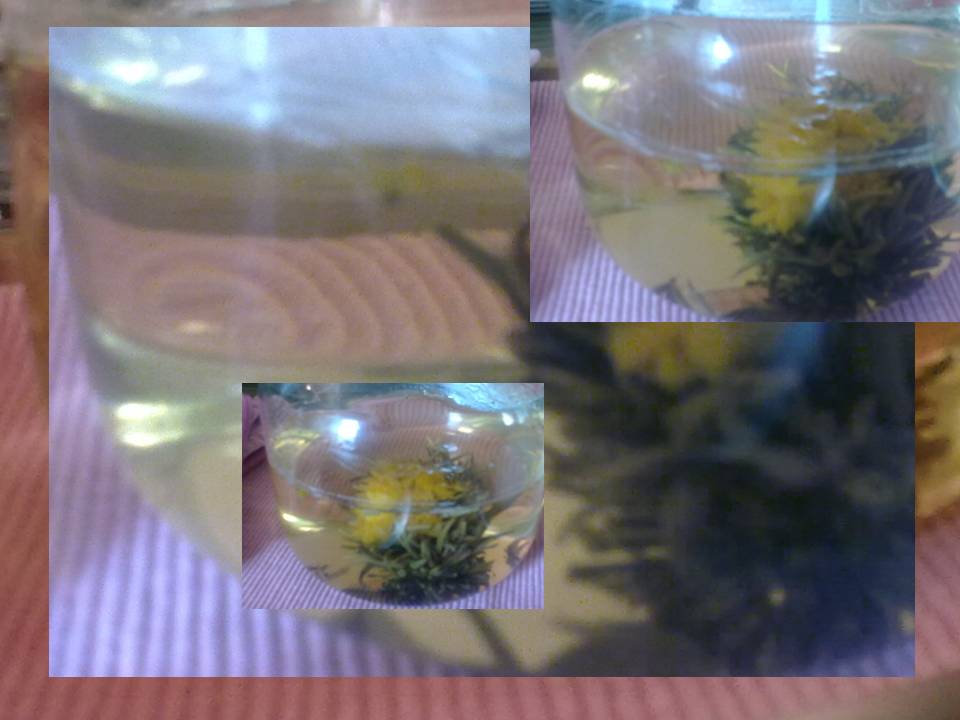
In some ways, it’s not unlike observing tea brewing in a glass tea-pot where leaves create patterns and the colour of the tray cloth also becomes part of the design. The way you look determines what you see.  Some of the photographs that I have taken hardly look like tea leaves at all. This may have something to do with the fact that in trying to get really close up with my ‘point and shoot’ Olympus camera, the image is blurred. Out of focus or not, they work well for me because it is not really watching tea brew that enchants – but looking at the scene, as if watching the inner landscape unfold. And in these photos, with the turquoise blue or pink ribbed handloom tray-cloth as a backdrop, the images seem almost ethereal.
 
 
 In the ceramic pot everything is eclipsed from the eye.  If I get absorbed in something else, the tea becomes too dark and bitter.  But when I can see through clear glass I enjoy watching the leaves swirling as they open up in the heated water, gradually infusing it with their hue and flavour, waiting till it’s just right before I take a sip. Sit back, my head leaning against the wall or chair, relishing the warm liquid coursing through me; cup nestled cosily between my palms as I savour the flavour of the moment. How often has life been this good, when you can sit back and reflect upon things achieved effortlessly, when everything happened exactly as you had imagined it, or better? 
 
I cannot see clearly enough inside the stoneware pot because its colour is similar to that of lightly brewed Darjeeling tea and can be deceptive. So I pour out a bit, take a sip and this has to be done at least two or three times before I am satisfied. It’s a plodding affair: remove the tea-cosy, open the lid and look inside. Does it look okay? Prod it a bit, stir it with the spoon; is it done yet? And I often equate this process with arguments or long dialogues we have with each other to ascertain what the other is thinking and where we stand in respect of them. And especially so, when you cannot get your point across, time is short and work needs to get done. But when one has the luxury of clarity: living with awareness and ease, watching thoughts unfold, heeding our own feelings, this dialogue is superfluous. Opportunities present themselves almost as if unbidden, yet are exactly what I needed and everyone seems to understand precisely what I want without elaborate discussions. Its bliss; an ideal state, but alas, nothing is permanent, is it?

When I embarked on this project on tea, observing the marks left behind in the tea cup I found them evocative of those feelings and thoughts that linger in embarrassment, guilt and pain. At that point, I would not have been able to acknowledge that I had been careless in my approach to life. But, as the creative process unfolded, a lot of things became clearer because it provided an objective perspective.

In the beginning, I took a lot of photos as I made my pot of tea each day and some were printed digitally onto fabric. For a couple of years this was how I contemplated the stains, until one day I decide to create actual tea stains onto fabric. And it was in the process of watching how I created the stains that I started making a correlation with being careless with my life - of doing things, that were punishing just because I wanted to achieve those ‘marks’ as it were.

In order to stain the fabric, I made tea and drank it. The used leaves or tea bags were then placed ad hoc on some muslin fabric. Hot water was poured over them and then left for as long as I felt like it.  This fabric and tea leaves were later placed in a baking tray, inside a hot oven. Sometimes I would forget about it altogether until I could smell the fabric burning. I found the dark burn marks most interesting and further ‘cooked’ this fabric with a fresh bunch of used tea leaves in the microwave oven. I punished the fabric as much as I dared. I loved the marks that emerged. I felt a certain empathy with them. They were evocative of what I had endured through life, what I felt like: burned, torn, stained and so fragile that some of the time all I seemed capable of was trying to make sense of what my life was and why it had turned out this way.

 I created these stains through sheer, utter carelessness. I didn't care what happened to the fabric. And in many ways I have realized that I didn’t really care what happened to me through life. I thought I did, but as life unfolded and I grappled with the pain of my carelessness, I realized just how uncaring I had been in terms of trying to understand myself. For some reason I had not thought much of what I wanted to be or do and why, but had been driven by the spoken or unspoken dictate of what was expected of me. This was not necessarily family pressure alone, but social constraints and expectations that brought into play cultural and gender conditioning and more besides. I am not alone in this; many of us are driven by these pressures until we begin to understand that it does not have to be this way. Being yourself, being different among your peers is a challenge that we are not necessarily geared to take on, which makes it harder to be what you are. 

When we accept that something we are embarking upon is challenging we prepare for it. Recently, I read an article on aerialist Nick Wallenda's plan to walk across the Grand Canyon in Colorado, USA, on a 2 inch wire, 1500 feet above ground, across a 1400 feet gorge, without a harness. He narrated the elaborate preparations he and his team had made for this event and I thought to myself: what if one approached living with the same attitude? We prepare for exams and job interviews and things one may do in the public domain because we know we are being watched, but when it comes to the personal sphere, these challenges – of relationships, parenthood and those of daily living, are left to pure chance - much like the stains I created on the fabric.

For the last 20 years, I have spent a lot of time watching myself think and focusing upon my feelings. It felt odd at first and I would often think that I was being self-indulgent, wondering how I would achieve all that I wanted to in the span of one life, if I spent so much time this way. However, when I try and push the pace, I succumb to the stress of doing rather than being and it feels like brewing tea inside the dense stoneware pot. I have to keep looking, mostly looking back on the day, analyzing things and arriving at all manner of insecure conclusions. Drinking this bitter tea only adds to the stress.
Mahipal breaking the old one has been fortuitous in reminding me of the tedium of life, when one doesn’t allow enough time to be effortlessly tuned into oneself. Despite know this, I do sometimes get caught up in the whirlwind of living. This also has its place in life but, I really must get myself another glass-tea-pot and start looking again. It is not nearly as much fun living without it.


for more about the stains: http://gopikanathstitchjournal.blogspot.com