Wednesday, 30 May 2012

One Woman's Choice


She is shy. She never looks me in the eye when she talks, but neither does she look away either, just tilts her head to one side, looks down, then up and asks some oblique question. Often when I addressed her, asking her to do something, she’d nod silently in a way that made me doubt my request had registered, but it would be done without a fuss. And it took a year for me to understand how much she processed in her mind, without articulating, or letting you know what she is feeling.

The other day, when reprimanded for taking too much time off from work, she revealed she had been sick for the better part of the month, but had come to work nonetheless. I felt guilty; knowing her temperament I should have realised there would be good reason. It was about ten days later that I was apprised of what was troubling her when she said “mera pati mujhe pareshan kar raha hai, vo kehta hai ke naukri chod do, kisi ne shikayat ki hai, ke mein aur mardon se zyada baatein karne lagi hu![i]”He had apparently been pestering her for a while and she could not deal with the tension anymore.

Her husband Ranjeet works with the local municipal department as a sweeper and earns a modest salary of about four thousand rupees. He and Priti live in Shankar Vihar, on the periphery of Palam Vihar, across the railway line that comes down from Gurgaon to Bijwasan. Isha, her neighbour, had brought Priti to work for me. Ranjeet had accompanied them for the interview and seemed a decent sort of guy, so I was surprised at the things I kept hearing about him.
 A few months ago, the cook’s temporary replacement Neha, had been making erotic calls to Ranjeet while Priti listened in. This came to my knowledge because of some other issue When Ranjeet discovered that I knew, he demanded that Priti leave the job. She didn’t want to. I suggested she assert herself and not refer to the incident again, as most likely he was not proud of what he had indulged in. She never brought it up again and work continued as per normal until this morning, when she said that someone had told her husband that she was cavorting with Mahipal, an old hand who has worked with me for twenty years.

I was as surprised to hear this as she was, not because Mahipal is a saint, but because Priti was reserved and I had not heard her speaking much to the other staff. There had been an incident a couple of years ago when Mahipal and another maid had got romantically involved, creating a major upset in my household and his marriage. But I thought that I had given him such a hard time as had his wife, so he must have learned his lesson, at least as far as my maids were concerned.

Priti is petite and pretty, is about twenty years old and her daughter is four. She dresses decently in clean and colourful salwar kameezes with matching dupattas. I’d see her walk into the complex, alone, every morning while Mahipal rode in on his ‘Scooty’. They came to work independently but at the same time. However, Priti left earlier and the chance of anyone seeing them chatting together, except those who work inside my apartment, was really an off-chance. It troubled her because she said, “Mein toh kisi se baat nahin karti hu”[ii], all the other women chat up the drivers and guards, but I just sign in and take the lift up.”

She also revealed that Ranjeet would drink and beat her up in his inebriated state, and often walked around the colony in dirty clothes even though she had new ones stitched for him. The neighbours would taunt her by asking what his problem was, why he behaved this way, citing that she earned as much as he did, kept a good home and they ate well too. I too thought the same: Why would any man do this?

Why was he insecure? Did he think she was too beautiful for him? Today, he finds fault with a male employee in my home, even though he had no qualms about flirting with another woman under his wife’s nose, indulging in erotic sexual tele-talk. Tomorrow he’d find fault with someone or something else. I asked if my talking to him would help, thinking I could explain that these situations could come up wherever she works and that he had to find the capacity to trust her. But is the problem really about trusting her, or his lack of confidence?

She kept saying, “Aadmi toh aadmi hota hai, guzara toh karn hai[iii], I’ll have to do what he says” elaborating that “my mother says phir koi kaam nahin karna, ghar pe he baithe rehna[iv]I asked if she was okay with this and she responded saying, “Last month, I saved my salary to pay for my daughter’s school admission. How will I educate her, if there is only one income? He’ll send me to the village to stay with his mother and in all probability my daughter will not be educated in the way that I want her to be”.

I asked if she’d talked to her father. She said, “Mein toh papa ke samne kuch nahin keh sakti hu[v] There was a tattoo on her arm that said ‘Priti and Ranjeet’ in Hindi, prompting me to think that she had married him of her own choosing but she revealed that he was twelve years older and her parents had arranged the marriage. Ranjeet apparently sported the same tattoo on his arm too. I could see a gentle blush on her face and glint in her eyes as she shyly recounted when the tattoo was inscribed. They had clearly shared some special moments despite it being an arranged marriage.

The status of women in India has had a chequered history from enjoying equality with men in ancient times to female infanticide and dowry deaths in recent times. Many women were part of India’s freedom movement but many wives, sisters and daughters were also burned alive to protect them from the rape and violence that took place during partition. Annie Besant[vi]  and Sarojini Naidu[vii] both served, independently, as Presidents of the Indian National congress and Vijay Lakshmi Pandit was not just the first Indian to become the President of the United Nations General Assembly in 1953; she was also the first woman in the world to hold this office. Indira Gandhi’s tenure as Prime Minister, of almost fifteen years, is the longest for any woman in the world.


In addition, the current President of the nation and Speaker of the Lok Sabha are both women. However, despite according women such high office and prestige, we also indulge in bride burning, child marriage and domestic violence. The Constitution of India guarantees equality to all women but there is wide gender disparity in literacy between men and women which has a negative impact on family planning and could contribute to women like Priti lacking the confidence to stand up to their husbands. Yet one has also seen women from the same social strata make bold choices to remarry with children from their first marriage. Some even chosing to abandon them to remarry.

There is a great deal of development around us where large tracts of farm land have been sold to build multi-storied urban housing, creating a lot of wealth for farmers and villagers around the metros. Mobile phones have made telephonic connectivity accessible to all parts of the country and all income groups. All of this has brought about a lot of change in the social profile but is the issue of how women are regarded within personal relationships really a social issue or an individual one? And how much does the social environment influence personal choices?

Priti earns, but that’s a threat. She can be financially independent, but does not have the will to leave an abusive husband; paradoxically she has the courage to want to deal with this but not to fend for herself and her child. Yet neither does she seem able to assert herself within the marriage, maintaining her independence and being respected as an equal partner. She has to find the courage to tackle him one way or another. It can’t pay to give into his insecurity, but for someone as reticent as Priti, asserting herself may not come easy. I know from my own experience that this is easier said than done. Personal ‘Mahabharata’s’ are fraught with subtle dilemmas that are hard to unravel. It can get ugly and emotionally stressful. However spiritually enlightening these experiences may end up being, no one comes out of them in shining armour.

 Her husband did not come see me, her mother came instead. The woman seemed intent upon separating them but her daughter was not keen. Priti left the job abruptly, coming to collect her dues a couple of weeks later, when she mentioned to my other domestic help that she would like to come back. When I called, she said Ranjeet had been treating her better and indicated she could resume working, as they do miss the extra income. She then handed the phone to Ranjeet who said he doesn’t mind the money, but the problem was that when Priti was earning “bolti bahut hai![viii]

The dynamics of this equation were complex. I thought it was best to let them sort it out on their own.The woman was quiet but no walk-over. She had a mind of her own and, although generally reserved, I am told she was capable of a sharp tongue and that working here had given her some confidence to stand up to Ranjeet. And when she did, she gave as good as she got. This did not strike me as a woman who had given up her job to sustain her relationship because she was afraid to stand up to him.

She earned as much as he did and if she had walked out of the marriage, she and her daughter would live off the kind of money he was presently earning and one less mouth to feed. Her mother had tended to her child while she was at work, so this too would have been taken care of. When her mother had asked me to ascertain the legalities of her moving out, I called the women’s cell in Gurgaon, but Priti did not want to know what needed to be done. She struck me as a woman who may not like confrontation and contention, but did not lack confidence either. The choice she made was not determined by logic but her heart and this eventually requires a lot of faith. She had talked as though the situation bothered her. She had dilemmas but looking at various options presented and discussed with her, she ascertained what she wanted to do, or rather what she did not want to do.

Can she be faulted? In this day and age when women are encouraged to take a stand and walk away, prove their mettle in the world rather than within testing relationships, Priti was going against the tide. What she was doing could be lot harder than walking away. From what I have heard, she is not keeping well. She is sacrificing a lot and it must be uncomfortable to deal with a choice that defies reason. But personal issues involve personal choices and while social conditioning may play a part, for someone as silently strong willed as Priti, perhaps there could have been no other choice.


[i] My husband is harassing me, says leave the job, someone has tattled, saying that I have become very chatty with other men.
[ii] I dont’ speak to anyone
[iii] A husband [man] is a husband,  have to endure/compromise/make do
[iv] Then don’t plan on working, you will have to stay at home
[v] I cannot say anything in front of/to my father
[vi] 1917
[vii] 1925
[viii] talks to much [is vocal about her feelings]

Saturday, 28 April 2012

Of Kaavads and Kanvarias

Each year during the month of Saawan, which usually falls in August, the long drive from Gurgaon to Delhi and back, is peppered with ‘Kanvariyas[i] bringing the ‘Kaavad’ or holy water carried on poles, from the Ganges, on the way back to their village temples in Gurgaon. Bhupinder, who drives my car, takes great pleasure in pointing them out to me; some barefoot, some in trucks with blaring music and others resting in the make-shift tents on the route. He delights in giving me details of their customs and the peculiarities of the ritual, where some I believe, do not put the pot of water on the ground through the entire journey on foot from Haridwar until they get home. Even when they take a nap, someone from their party of travellers is entrusted with the task of holding it on his shoulders. And Bhupinder insists that custom dictates that no one ever does this yatra[ii] only once; it has to be made at least twice in your life-time. The vagaries of sacrifice to challenge oneself, as presented through such religious rituals, never fails to amaze and fascinate me. 
 

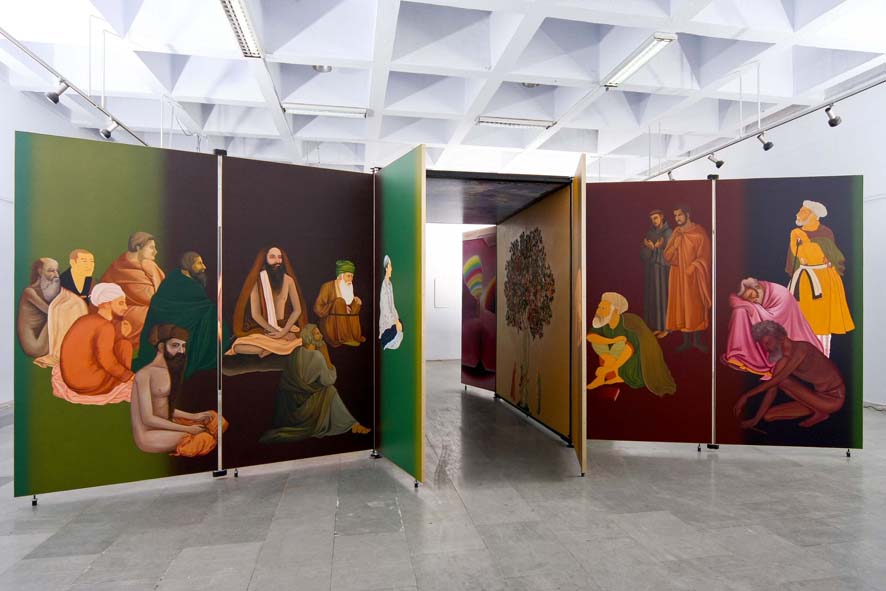
In October 2011, I walked through the glass doors of the newly furbished gallery at Lalit Kala Academy in New Delhi, into another experience with the Kaavad. This time it referred to a portable shrine, containing painted narratives which travelling performers, like the Kaavadiya Bhats of Rajasthan used as a prop for their storytelling, where the narrator would open each door of the Kaavad to reveal a new layer, building anticipation with each new painted one to finally enter the inner core. Using this concept, artist Gulammohammed Sheikh[iii] created a monument called ‘Home’. This life-sized, box-like structure with panelled doors opened out to enable one delve deeper into the central core of the shrine, ponder on various images on the way, as each panel or door was opened. It was constructed in part by paintings with acrylic and melamine on wood, and a digital and electrically lit roof of the central hall, depicting the Baroda sky-line with various buildings that crowd the city, inhabited and abandoned, surrounding the sky like a constructed wall. Floating in the middle of this pale greyish-blue expanse, were all manner of mythical characters drawn from various texts and traditions, across the globe.
 

 I felt like a novice, a first time Kanvaria; intimidated by the swirl of images and words of the artist’s painterly universe of cross-referenced imagery that I was not well acquainted with. Rama and the deer Maricha, an angel from the Renaissance art of Italy, figures from a South-east Asian version of the Ramayana, profound words from Kabir with painted images of this weaver saint, a Chinar tree presented as the tree of life where a burning car and refugees carrying their baggage on their head, were a part of this journey through life. In addition, images from the artist’s earlier works were also presented. Visuals of the nuclear cloudburst of Hiroshima, Gandhi, Hitler and much more were also presented in various forms; some in smaller shrines or Kaavad-like boxes, others in digitally printed accordion-style books and as large 3-D sculptural installations. At first, I did not relate to this exhaustive outpouring for I could not find an immediate, succinct message in its vast intellectual exploration, such as I needed, to feel reassured in its midst. But I was enchanted by the marvel of technology in the making of the digital books and the eighteen-minute, three-channel video, where the artist and his collaborator had played enchantingly with all these images, juxtaposing them in historically unprecedented ways,  where the imagined and the real, all came together in a kind of surreal fantasy. 


Viewing this exhibition of works by artist Gulammohammed Sheikh was akin to a pilgrimage; necessitating humility, reverence and silence to view, question, listen and understand. I was humbled by my ignorance of myths, lore, history and even some contemporary events, which Sheikh presented that I felt I should have been able to recall, but could not. I read Kavita Singh’s simple yet elegant essay, watched the videos of work-in-progress and sat through the three-channel video, alone. Watching clouds and Sheikh’s version of ‘Mappae mundi[iv] merge, as people from the past converged with the present, I saw through aerial maps from Google, what this, our corner of the earth looked like from the sky; where perhaps some unseen eye of God observed and judged, and then maybe not.

Sheikh explored notions of a world gone by through figures of the past. He also called into question, by juxtaposing them with the contemporary world, the way we live today. He brought into play the demolition of Babri Masjid, Godhra riots and the issue of ‘whose Kashmir’: to whom does this coveted land belong? Were the sweepers of Baroda, who sweep away the city’s dirt, also the very people instrumental in creating the violence that Gujarat has seen?  All this and more was referenced in a quest to find meaning or solace or some perspective. Searching for clarity, Sheikh sieved through years of human history, asking us to question the premise of our existence today and where we draw our ideas from.


He questioned not just parameters of contemporary life and historical ways of living, such as a possible parallel, in the traditional churning of the seas or samundra manthan and the bombing of Hiroshima; Sheikh also enquired into the all-encompassing notion of life itself. Is there a right way or a wrong way to live? Was Ravana’s deception, his disguise as the deer Maricha legitimate? Sheikh drew me into an internal dialogue with myself, compelling me to question my own exploration of these ideas, making me aware of deeper reaches of my cultural and philosophical past. Like the Kanvarias I had observed on NH8, I too did not put the quest to rest, but kept up this solitary conversation with the artworks, even after I had left the gallery space. And when I returned home, late in the evening, I went through my library of books, looking up all those characters and notions I lacked in knowing.  

In this vast, exhaustive and intellectually rich presentation, I felt over-awed by the legendary characters and events which Sheikh had chosen to speak through, but where the self-effacing artist had seemingly retreated into the background, leaving me to decide for myself.  I cannot claim mastery over this vast repertoire of intellectual icons. I have not really explored these specific facets of life, or read the books he has, nor pondered the profundity of these words. When humbled by my inept and limited knowing, how could I possibly decide what the truth was, what was right or wrong, if at all? But Sheikh did not tell us. He presented a gamut of ideas, lending direction, but implying that each one had to decipher the truth for themselves.  


This pilgrimage, my very own experience as a novice Kanvaria, of carrying the burden of my ignorance through Sheikh’s universe, reminded me with each step, of all the world’s literature, myths and lore I had yet to explore; of countless intellectual journeys I had yet to take, or as Bhupinder had told me that a Kanvaria must do, at least twice in my life-time. As I sipped a cup of tea the next morning, I wondered: if and when I have performed this gargantuan intellectual exercise, will I find some answers to the all-encompassing, paradoxical nature of life? Does anyone?


[i] The Kānvar Yatrā or Kavad Yatra  is the annual pilgrimage of devotees of Shiva, known as Kānvarias, to Hindu pilgrimage places of Haridwar, Gaumukh and Gangotri in Uttarakhand to fetch holy waters of Ganges River, Ganga jal, which is later offered at their local Shiva temples. It is named after the kānvar (काँवर), a single pole (usually made of bamboo) with two roughly equal loads fastened or dangling from opposite ends. The kānvar is carried by balancing the middle of the pole on one or both shoulders. This practice of carrying Kavad as a part of religious pilgrimage, especially by devotees of Lord Shiva, is widely followed throughout India

[ii] Pilgrimage to holy places such as confluences of sacred rivers and/or places associated with Hindu epics such as the Mahabharata and Ramayana, and other sacred pilgrimage sites

[iii] (b. 1937) is an artist, educationist and writer whose work has spanned more than five decades. He is a founder-member of Group 1890, which was founded in 1963 by a group of artists.

[iv] Mappae mundi were schematic and meant to illustrate different principles These diagrams were primarily meant to preserve and illustrate classical learning. The zonal maps were a kind of teaching aid—easily reproduced and designed to reinforce the idea of the Earth's sphericity and climate zones.

Sunday, 1 April 2012

Cross-Stitching

In December, Delhi usually gets quite chilly. But last year, the weather was exceedingly strange. Most of December was so warm that I didn’t need to wear socks or even loosely wrap a shawl. One night, however, it rained.  The next day, Friday, was bleak; no sun and the chill seemed to seep in. I wrapped up well but couldn’t adapt quickly enough to this unpredictable weather. I had the sniffles that night. Did the usual ministrations to prevent a full blown cold but the symptoms didn’t totally disappear. I pushed myself to do yoga the next morning. I had overslept and felt very lethargic, but slowly got myself together and actually managed the full regimen which always makes me feel really good; in control. 
Kantha from Bangladesh approx 1970-80's
But later, I felt sluggish again, so decided to drink some masala chai with adrak, Tulsi and Echinacea, combining them with the other spices that make up the regular masala. Adrak heats up the body temperature, Tulsi, with its anti-oxidant properties boosts the immune system and Echinacea is also good for colds. I could have done some mudras to raise the body temperature, exercises to activate the thymus, as I did the  evening before, but sometimes all this doing really becomes tedious. How much healing can I do? Why do I have to get a cold, when there is so much to be done? Spend the whole day pandering to whatever emotional need was creating this dis-ease in my system? Trying to balance oneself through each day, between ideals, aspirations and the practical aspects of living,   means looking at everything with a fine toothcomb and sometimes it gets to me.

 I needed some creative intervention, so added finishing touches to the embroidery I had been working on; a portrait of Jehangir, the child who works at a tea stall in Palam Vihar. This had taken quite a while to complete and the process had been thought provoking too.  It was challenging to bring, the gamut of my experience of engaging with this boy, into a visual context. I had taken digital photographs, worked with Photoshop on them, then had these images digitally printed onto fabric.  

 The ideas that emerged from my experience did not convey lushness or a comfortable feeling. So I opted to use fabric that had an everyday quality; not glossy or expensive.  I used muslin and markeen for the digital printing, layered the images in multiples of three; one on markeen [as the base] and two on mul. I then stitched these layers together with a loose running stitch, like those used in ‘kantha’ embroidery of Bengal.  I feel a bit odd appropriating its name and associations when my usage has no direct relationship to the tradition, but I do like the idea of what I am doing being rooted in such a rich tradition of crafting. I recollect reading about Kantha, or Sujni as it is called in Bihar, for the first time in the early 1980s. The India Magazine carried a story about how women used old and worn-out dhotis, worn by men, and sometimes sarees, to make quilts; stitching together three or more layers of this well-worn and softened fabric with a running stitch and sometimes a back stitch too. I have been fascinated ever since, but incorporated this technique in my own work, just five or six years ago.
I love the rugged quilted look that comes from binding layers of soft, well-worn material together. Depending upon the distance between the rows of stitches and the thickness of the layers, the texture is quirky and unpredictable, augmenting the narrative such that form or colour alone could not. The women of Bihar and Bengal create lush, naive imagery with this technique; embroidering stories around religious myths and their own lives, depicting daily and festive rituals, often finishing the work with woven borders cut out of old sarees. I work in my own way, not really drawing upon these traditional practices. I tally the colour of my thread with the colours on the printed fabric, changing as needed, to match the colour modulation of the printed image, but I use the thread-work to bring out the features of people, utensils, kettles, tea cups and the stains in them. I watch what emerges intuitively and then orchestrate the technique, threads, colour and textures to bring out qualities that are evocative of my thoughts and feelings about the person or situation.

Jehangir was a difficult task. How could I convey my frustrations, limitations, guilt and concern without overriding this young boy’s courage, or the spirit with which he and others like him accepted their life and its travails with grace? To me, he seemed so grown up, so unlike the children of more wealthy and privileged parents. At his young age of ten or so, he was taking responsibility for his family, working to provide food and shelter, assisting his parents in doing so. How many of us have had to do this at ten?
I was about the same age when I learned cross-stitch embroidery.  A birthday gift-set of some fabric and designs to embroider had me spend many hours, during school holidays that winter, doing this. Cross stitch is not part of the popular repertoire of traditional Indian embroidery but, just like its more natural for me to speak the English language than write or converse in Hindi, cross stitch is also ‘native’ to my fingers. I once tried to transfer a well-known Indian miniature painting of a ‘nayika’ in a red dress, seated on a bed of white flowers waiting for her lover, onto fabric, using cross stitch. I gave up after a year because I had chosen too fine a count of fabric, and had barely managed to complete one-third of the whole picture in this time.

There’s something very fascinating about the process of embroidering a picture using squares. This breaks down the figure not unlike the pixels of a digital image. The cross-stitch method uses fabric that has little squares, demarcated with dots for easy insertion of the needle. The square is then defined by means of a thread that crosses itself, diagonally, going in and out of the four holes. There are many variables of this fabric called Aida or cross-stitch matte, manufactured specifically for this type of embroidery. The varieties you get in Delhi are very coarse as cross-stitch is not popular, so I have to go to great lengths to get the fabric I need. The latest purchase was on-line from a store in Australia, where I paid an exorbitant amount for it, primarily because of the cost of sending it all the way to India. However, I love the patterns you can make using this fabric; and the ordered manner in which these are executed, appeals to my inherent need for order.

Woman's dress, Paksh
from Baluchistan,
Pakistan, late C19th,
cross-stitch used
among other
embroidery stitches

This language of thread, using a traditional stitch like ‘Kantha’ along with     the adopted ‘tradition’ of cross stitch, makes me marvel at how customs from diverse cultures have become part of my own. I have no idea about the origin of cross-stitch and how it permeated the Indian psyche. Everyone I asked assumed it must be related to the influence of Christian missionaries or a more direct, colonial fall-out. I had gone to an Irish Catholic, convent school so am familiar with how much of the culture they brought with them has unquestioningly percolated into our lives. When did they come to India? Did the practice of cross-stitch really come through them or was there some other link? I did some quick research, and discovered few examples of cross-stitch in garments from Hissar, Bihar, Sindh and Baluchistan. Most were folk and tribal dresses from around the late nineteenth or early twentieth century. Kasuti, which is done in Karnataka, also uses the spaces between warp and weft threads, counting them, to create geometric patterns but, as yet, I have not found out how this technique came to the sub-continent or why it remains on the periphery of the embroidery practices for which India is renowned.
skirt fabric, mid C20th, Kutch, Gujarat
 or Sindh Pakistan
Kasuti
Embroidered woollen shawl, Hissar,
Haryana,  [cross stitch] c.1880

Sipping my tea, warming my hands as I held the round white cup, I started thinking on another tangent - of the larger socio-political influences.  Was it possible that ideas governing our attitude to life, ourselves and to people like Jehangir, today, were derived like cross-stitch, from cultures that had seeped into ours through centuries of invasion and rule by foreigners, but were technically not Indian?  How relevant is this question of identity, the origin of things? I mean what’s relevant, is what is, right? The much touted spiritual mantra of the day, of living in the present moment, seems to contradict my quest to study the past but this mystery, whodunit trail is just too fascinating to pass up on.  

The investigation may lead to nothing, or to some nebulous, unintelligible idea or infinitely, unrealistic possibilities, but the process of examining how things came into being; what came from where, when and how and the possibility of their influence on my thinking, intrigues me. Unravelling these threads doesn’t just fuel my curiosity, it lends purpose to being. It’s as if I am becoming acquainted with the dots or squares or pixels, as it were, that paint the larger picture of me. Inspired by this criss-cross of threads from the past, I return to look at the thoughts I’d earlier neglected to examine, which had brought on the sniffles.
 
Contemporary Sujni, Bhusara, Bihar, 2005


Thursday, 15 March 2012

Darjeeling Tea, Mendelssohn and the Flight of Pigeons


Darjeeling tea, with a touch of loose leaf Assam adding colour as well as fullness of flavour, a December afternoon’s wintry sunshine, Mendelssohn’s Leider Ohne Worte [Songs without words]: the recipe for a perfect, lazy Sunday.
 
 
 The air is still; barely a rustle among the leaves. The odd pigeon flies from tower to tower. The intermittent cry of a child for its mother or someone talking loudly on his cell phone disturbs the quietness, but not enough to send me back indoors, into the chilly, sunless north half of my apartment.

Last week, I had been nudged by Manisha to go see an exhibition. And when I pulled up the chicks this morning, a large flock of pigeons flying past, gracing my view, reminded me of Amina Ahmed’s video – ‘The Call or Bism’ ,shown at Gallery Seven Art, which showed a flock of flying birds and the patterns they make as they fly back and forth. They do make a wonderful sight as they take to the skies and I appreciate being reminded of the beauty in this, that otherwise goes unnoticed in the humdrum of daily living. Pigeons inhabit this building more than human beings do. They nest in every crevice and potted plant and are a nuisance with their incessant droppings. It’s only on occasions like this that one is able to appreciate some facet of their existence.

I relate to Amina’s idea that these birds flock to a call, unheard by human ear, for why else would they all seemingly rush in one direction, inexplicably, following each other? What is it that they hear? Do they hear or simply sense something that compels them take a particular direction?  There are some that initially take off in the same direction but then move rapidly away. And the few stray ones that probably never quite hear the call fly hither, thither, rather aimlessly, as if confused. Or maybe they are just less connected?

Most of the time, I have to confess, I think of them as stupid birds for the mess they create but, of late, my more detailed observations of them has brought about a change in perception. I recollect one time, when having run out of the bajra[i] that I usually feed them each morning, I decided to give the hungry birds, pecking on my window pane, some roasted sunflower seeds I had bought for myself and noted how they didn’t touch a single seed. Stupid they may seem, I decided then, but they clearly knew what they liked or didn’t. Since then, a grudging admiration has arisen.

I wanted to dwell on this ‘flight’, the seemingly intuitive response of mute birds to something unknown. It intrigues but my lazy Sunday reflections have been rudely interrupted by a party in the complex. Some resident and their guests are jiving to loudly played ‘Desi Boyz’. The mix of Hindi lyrics, a heavy, pounding bass, designed for jhatkas and matkas and Barenboim’s delicate tinkling on the piano, of Mendelssohn’s lyrical pieces, is such a crazy sound that the moment of reflection is lost. These Songs without words were early compositions when Mendelssohn was just nineteen and German music was shifting from compositions of the more rigid, classical forms, towards romanticism. They were the perfect accompaniment for ruminations on a Sunday afternoon and I most certainly, did not appreciate the Bollywood intervention.
 I was not willingly to sacrifice my sunshine either, so requested that the volume be turned down. I cannot relate to the culture of listening to such loud music that you cannot even think! Maybe that is the idea? Frankly, thinking can be a pain. It’s tedious to reach that understanding where the heart and mind are in synch and this is what intrigues me about the mute birds that do not seem to need to think. When they are called, by the divine, as Amina Ahmed suggests, then their response is seemingly collective, without resistance, or delay. This is the stuff I admire, because, for the thinking mind, the intellectual who has learned to depend on logic and reason, it’s tough. We need to understand. At least I do.

Actually, it isn’t the thinking that irks as much, as how much time and energy it takes to put things into perspective and even though it’s necessary for clarity, in order to deal with what comes up through the day, it also makes me feel inefficient, because there always seems to be so much thought to process. And if one does not, then the aches and pains start. But then I think: I wouldn’t really like to be a pigeon, aimlessly flitting, constantly shitting, messing up the place and then sleeping in this crap too. Like people, nature and her creatures are a constant source of inspiration, but can we ever be anything other than what we are?
 
The noisy music, screaming children, hysterical mothers and loud telephonic conversations are getting to me. They did try turning the music volume down but it still disturbed. I wanted to savour the soft lyrical music on my head phones but it really was a futile endeavour so I went indoors to meditate.

When I returned an hour later, the party had wound up and the birds seemed nowhere in sight, till I heard a mock gunshot; and from somewhere, they all appeared in the same formation, I had wanted to romanticise about earlier in the day. Someone must have fired a shot to compel them vacate the crevices they had sought refuge in, creating an inconvenient mess, not to mention the objectionable stench. When I saw they did the same thing when there was a sound I could also hear, as they did earlier, when I had considered they were responding to something  heard at a frequency inaudible to the human ear, I realised this is what birds do, they fly. Their call is to just to be what they are meant to be; do what they were created to do.

Within hearing distance they all rose rapidly up into the sky, carving the wind with their wings; flapping them energetically but effortlessly. Doing what birds were made to do; they flew up into the air, rising higher and higher, inspiring my own spirit to soar and reach greater heights, live the dream, and fulfil all its ambitions and desires.  Hearing this call or ‘Bism’, I realised that just like the birds who do what they must; be what they were meant to be, so must we.


[i]millet

Monday, 27 February 2012

The Perfect Brew


I’ve noticed that when I leave a tea-bag in a pot of hot water with some milk, it usually doesn’t release its full flavour or colour. After a couple of minutes, when I remove the tea-cosy, I can see an auburn tinge, appearing like a halo around the bag and the rest of the liquid is unstained. I have to do a dip-dip routine with considerable vigour, even if it is for just a few seconds, to get the desired colour, before I can start drinking my tea.

I do this every morning in a rather routine manner, without really noticing what it is that I do. After years of habit, I am on auto-pilot. Today however, the tea-bag demanded attention. First, it showed reluctance to come out of the paper covering and when I pulled at it, the string came loose. I had pulled too hard and the staple pin, that attached the string to the bag, had been prised open. I was fiddling with it, trying to get the string back into place when Mahipal walked into the room, saw what was going on and said “doosra leke aata hu, isko baad mein dekh loonga.[i] But I fiddled around, slid the string into the now opened staple pin, using my fingers to gently close it. I then pressed the bag – the top part which is kind of pointy, puckering the soft whitish paper, to bring the two points of the staple pin together. I did it! Then tying a gentle knot I placed the tea-bag into the glass, ‘Borosil’ carafe, of hot, milky water, with a sense of achievement.

Having given so much of my time and attention to an otherwise innocuous tea-bag, I was unable to do the dipping ritual in my normal absent-minded, auto-pilot mode. The tea-bag had become more than just a thing. I paid more attention. I observed the bag noiselessly touch the hot liquid, sometimes turning this way and that, doing a strange kind of dance. At one point, it seemed to squirm as I raised it up and then pushed it back in. Its muteness affected me. I felt rather cruel compelling it to shed all its flavour and colour in this way. I mean, would I like to be treated like this - shoved into a pot of boiling water, to open up and reveal my flavour? Be pulled up, barely allowed to breathe the cool breezes and then be unceremoniously dunked right back into the hot stuff, without any say in the matter?

But my feelings of guilt didn’t last long. I thought with a certain self-righteous indignation, that if it hadn’t just sat there like a lump of mass but done what it was meant to, then I wouldn’t have to do any of this. And that was when something opened up in my mind and it occurred to me, what if all of us just did what we were supposed to, without a struggle? Then would living be as simple as being lowered onto the earth, just be there, quietly letting our thoughts and emotions infuse the environment – the world we lived in? I guess that would be an ideal state of ‘being,’ of living without inhibition, without fear, without letting the gamut of emotions that we experience, wrought one’s being, everyday: Being totally at ease with who I was and had become, effortlessly achieving simply by thinking it. I have been working at it and seen how this does indeed work in many ways, especially when healing others, but I had a long way to go yet when it came to things that I wanted for myself. The ‘masters’ as they were called, it is believed, had managed such enormous control over their minds, that nothing caused a ripple of doubt or discontent as life unfolded around them, however chaotic it may be.

The water is hot. It is brought to boiling point over the gas and then poured into the teapot. Who, among lesser mortals can truly sit still and elegantly be one’s self without squirming and cursing the heat? But apparently the evolved human being can and does. And somehow, I had expected it of the inanimate tea-bag too. I suppose, one could write to Twining’s in Calcutta and complain about this tea bag, maybe it was defective.  Maybe it was the case with all of them. They were just lazy sods and had to be prodded to bleed. But I had only myself to blame for when I felt restless, angry or pained and inept. I seemed to need the rigour of living, of facing problems, being hurt and my sense of self diminished to look deeper within and find courage to speak up, through the ups and downs of life, to do what I was born to; realize it through the experience of being.

if only it really were as simple as it sounds. Most of our lives are lived engaging with other people. Dealing with people is a complicated affair because unlike the tea bag, they too have feelings. What I say has a similar effect on them, as what they say, does to upset or uplift me. Taking a gulp of tea I surmise, a tea-bag isn’t something I get myself into a tangled mess about. It’s a thing, its mute, just sits there, quietly doing its stuff, even though I may have to prod and jiggle it up and down a bit. It doesn’t bite my head off for it; nor does it question or challenge any assumptions I may have arrived at about it.  People, on the other hand, can do all of these things and often we say and do things that hurt each other as we speak, defend and assert ourselves and more. Some of us are better or more brutal at this than others. Sometimes, things seem unfair but then, we also like what they do for us at other times and its balancing this that gets me into a twist. How much should one say? When and where, or how? 

Untangling these knots, I suppose, is what makes life both frustrating and fascinating. But the pressing question is how much is one supposed to brew? How do we ascertain when we have arrived at the perfect brew, in any given moment? More often than not, I tend to kept quiet, hoping my silence will do the trick. In principle it should work, because thought is what creates life, but the paradox is that life is lived on the physical plane and that entails a certain amount of doing or saying in this realm and it is only when I am able to sufficiently detach, not worry about the result, do I  succeeded in this way.

The other day, as I did my affirmations and sent energy to the day’s events, I also asked for a special wish to be granted. As the day progressed, I started feeling apprehensive about this desire, could I handle it? Was it what I really wanted? Everything else fell into place effortlessly, but this wish did not come to fruition because clearly, I did not have sufficient control over my emotions, and focussing on negative feelings, I signalled doubt which derailed its manifestation. Yet, in my heart I knew that I did want this to be. It was very confusing and that is what I ended up manifesting. I would create the opportunity and then not be able to take it through. Then I’d regret this and reaffirm, but eventually decided to give up because, at this point, I clearly could not do what was needed.

The perfect brew is an elusive thing. Sometimes one gets it right without much effort and at other times, it just isn’t quite as you would like it to be, no matter how many formulae or recipes you try. Tracing the antecedent of thought and undoing what has happened in the past are daunting, if indeed possible. Faith seems to be the key; being flexible about how things unfold.  If we do not like what happens, we can always change it. No point letting anxiety complicate and delay things.


[i] I’ll get another one and take a look at this problem later